Where does the word discard come from, and why does it fit badly?
An avoidant discard is not a term from attachment writing. It is a word borrowed from online commentary about manipulation, then reused by people trying to name an ending that arrived without warning after a close stretch. The experience it points at is real. The implication it carries — an object used and thrown out — usually is not.
Words matter here more than usual, because this one arrives pre-loaded. To discard something is to decide it has no further use. That framing tells a partner that the months before the silence were a performance, that the warmth was collected on purpose, and that they were selected as a target. The pattern this site describes does not support that reading.
What the word does get right is the shape of the event. Sudden. Total. Unexplained. Those qualities are the reason people search for a strong word in the first place: ordinary vocabulary for endings assumes a conversation happened, and here it did not.
So the useful move is to keep the shape and drop the motive. Something ended abruptly after closeness, with no account given. That sentence describes what happened without assigning a character to the person who left, and without asking you to accept that the earlier part was staged.
The term is usually met in the same places: forum threads and comment sections where someone is describing exactly what happened to them and reaching for the strongest available word. That is why searches for it so often carry a site name attached. The accounts there are worth reading for recognition, and worth discounting for explanation, because a crowd agreeing about a motive is not evidence of one.
One more thing the borrowed word smuggles in: the idea that a category of person exists who does this. Avoidant attachment is a description of how someone handles closeness, not a label that belongs on anybody as a verdict. Nothing on this page is a way of diagnosing an ex from a distance, and a page that offered that would be selling certainty it cannot have.
What are people describing when they call it a discard?
A relationship that had been going well — often unusually well — narrows quickly: fewer messages, no plans, shorter answers, warmth gone from the tone. Then contact stops. Accounts of an avoidant discard tend to line up on that much. There is rarely a final conversation, and rarely a reason given that matches the size of the ending.
The run-up looks good, not bad. The most disorienting detail people report is that the weeks before were among the best. For example, a trip, a first meeting with family, a conversation that went further than either person expected. There is no argument to point back at, which is exactly why the ending feels like it came from outside the relationship.
The change is in register before it is in frequency. Partners describe noticing tone first. Humour flattens, replies get practical, affection becomes brief and scheduled. Messages still arrive for a while; what has left them is the sense of being wanted rather than accommodated.
Reasons given are small and reasonable. For instance, work, a bad stretch, needing to focus, not being in a good place. Each explanation is plausible on its own and none of them accounts for the whole. People describe accepting several in a row before realising they had been describing a direction rather than a series of bad weeks.
The ending is often delivered thinly. For example, a short message, a stalled thread, a plan that never gets rescheduled. Where a conversation does happen, partners describe it as brief and oddly calm, with the other person seeming settled about something that was never discussed out loud.
The silence afterwards is complete and does not read as anger. No arguing, no last word, no attempts to reopen anything. That flatness is the part most likely to be read as proof the relationship meant nothing, and it is the part where that reading is weakest.
Put together, the phrase what happens when an avoidant discards you usually points at this: a fast contraction of contact after a close stretch, an ending delivered in fewer words than the relationship earned, and then a silence that holds. The order rarely varies. What varies is how long the contraction takes and how much of it gets explained away while it is happening.
The cost of it lands mostly after the fact. During the narrowing, attention goes to managing it — being easier to be around, asking for less, waiting out what looks like a bad patch. The full weight tends to arrive once the silence has settled and there is nothing left to manage, which is why the worst stretch is often not the first one.
The shape people are describing
Closeness, then the drop
One relationship, from the good stretch to the silence
- WarmReal interest, real attention, nothing being asked for yet.
- ClosestPlans, access, a word like "us". Closeness starts to carry obligation.
- DeactivationDiscomfort registers as a need for space, not as a feeling about you.
- WithdrawalFewer messages, small reasons, warmth out of the tone.
- SilenceContact ends. From outside it looks like a decision that was never announced.
The line does not fall because something went wrong. It falls from its highest point.
There is another experience filed under the same word, and it is worth separating. Sometimes the ending follows a request rather than a good stretch: a conversation about commitment, moving in, meeting people who matter. The sequence is the same, but the trigger was visible, and people who lived it often blame themselves for having asked. Asking is not what broke it. The request made the stakes explicit, and explicit stakes are what this pattern manages by leaving.
How does a discard connect to deactivation?
The mechanism underneath is deactivation: closeness rises, being known starts to feel like exposure, and distance brings the pressure back down. A sudden ending is that same move carried to its end point — the retreat continues instead of easing, until there is nothing left to retreat from. That is the whole connection, and it explains the timing.
Deactivation is the flagship subject of this site rather than of this page, and the full mechanism, including what sets it off, sits on the deactivation hub. What matters here is the implication people most want and least believe: the drop tends to follow the closeness rather than replace it. The relationship did not stop being good before it stopped. It stopped because of how good it had got.
That is also why an ending in this pattern rarely comes with a reason. A reason requires the person to have located a feeling, named it, and decided something about it. Deactivation does the opposite — it lowers the volume until the feeling is no longer available to be described. The absence of an explanation is a symptom of the same process, not a further insult added on top of it, even though it lands as one.
There is a limit to how far the mechanism should be pushed as an account. It explains the shape of the exit. It does not explain the choice to leave without a word to someone who was owed one, and it is not an argument for patience. Understanding why something happened and deciding whether you want to live near it again are separate decisions, and only the first one belongs to a page like this.
The letters
Written for the stretch after an ending
That did not go through. Nothing was saved and nothing was sent — try the address again, or write to us directly and we will add it by hand.
- What arrives
- A note when a page here is rewritten or a new one goes up, with one line on what changed.
- What does not
- Assessments, quizzes, coaching offers, anything that claims to tell you what someone else is.
No spam, ever. Unsubscribe anytime.
What is breadcrumbing after an avoidant breakup?
Breadcrumbing is the name people give to contact that arrives after an ending but carries no structure with it: a reply to a story, a message on a birthday, a warm exchange that goes nowhere and is not repeated. In this pattern it usually reflects the pull toward connection returning once pressure is gone, not a plan to keep someone waiting.
Signs of breadcrumbing from an avoidant partner tend to be described the same way. Contact appears at low-cost moments and in low-cost formats. It is warm in tone and empty of commitments. It reopens nothing about the ending, asks nothing about how you are, and disappears again without a bridge. When a question about meeting or talking properly is put to it directly, the thread usually goes quiet rather than saying no.
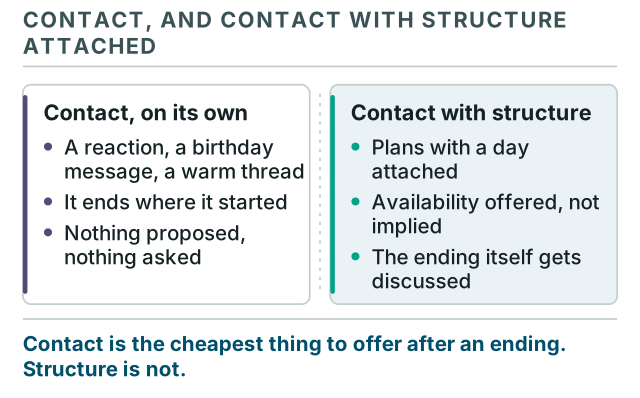
Examples people give are small and repetitive. A reaction to a story rather than a message. A song sent with no sentence attached. A late-night thread that is warm for a while and then stops mid-conversation. A check-in on a date that mattered to both of you. A message that answers something you asked earlier, as if the gap had not happened. None of them ask for anything, and none of them close anything.
What makes them hard to ignore is that they are genuine in the moment they are sent. The warmth in a crumb is usually not manufactured, which is precisely why it misleads. A partner reads sincerity and infers intention, and the two are not linked here: this pattern can mean a warm message completely and still not want the week that would follow from acting on it.
The distinction that saves people the most time is between contact and structure. Contact costs almost nothing and can be genuine at the same time. Structure — a plan with a date, availability that holds, a conversation about what happened — costs the thing this pattern avoids. Reading the first as evidence of the second is a familiar way an ending gets extended long past the point where it ended.
How to respond is a smaller question than it feels. There is no wording that converts a crumb into a conversation, and any method sold that way runs on pressure, which is the input that produced the withdrawal. What people describe as workable is answering if they want to, not treating a warm message as a reopening, and saying plainly what they would need in order to talk properly. Then letting the answer, or the silence, be the information.
Blocking sits in the same category of decision. It ends the arrival of crumbs, which is sometimes the only way to stop reading them. What tends to follow is silence rather than protest, and the silence is not scoreable: an absence of pursuit is the ordinary state of this pattern and says nothing in particular about what preceded it. Whether the return that some people do describe is a real prospect is covered in do avoidants come back, and whether a quiet stretch is an ending at all is the subject of signs an avoidant is done or just deactivating. The rest of this section sits on the breakups hub.
What “discard” is not
What this page does not claim
The word this page is about arrives loaded with claims about intent and character. Those are the claims we are not making, and on this subject the limits matter more than the description.
- Not a diagnosis of your ex
- Avoidant attachment is a descriptive frame for how someone handles closeness. It is not a condition, and nothing here supports labelling a person from the outside on the strength of one ending, however it was handled.
- Not proof of a plan
- The sequence people describe is usually experienced by the person leaving as pressure lifting, not as a strategy aimed at a target. We do not claim to know intent, and we do not print the popular assumption that intent was there.
- Not an excuse for how it was done
- Explaining a mechanism is not defending a choice. Leaving without a word is a way of handling an ending that costs the other person a great deal, and understanding the pattern does not require anyone to be fine with it.
- Not evidence the relationship was fake
- An abrupt ending is compatible with the earlier warmth having been genuine. We take no position on any particular relationship, because that is not something an article can know about yours.
- Not a prediction
- Nothing here forecasts whether contact resumes, when, or what it would mean. We publish no figure we cannot trace to a named, dated source, so there is no timeline for silence and no likelihood attached to a return.
- Not a method for producing a reaction
- There is no script on this site for making someone regret an ending, chase, or come back. Approaches sold that way work through pressure, and pressure is what the withdrawal was organised around.
What we do stand behind
- The shape, described plainly
- Closeness, deactivation, withdrawal, silence — named as a sequence of behaviour rather than as adjectives attached to a person.
- The separation of contact from structure
- The clearest available distinction after an ending in this pattern, and the one that most reduces time spent decoding messages.
- The point where we stop
- Where a question turns clinical or turns to safety, we say so instead of answering it. What we read is listed on our sources page.
One distinction is worth stating on its own, because people arrive holding it. An ending that can be explained is not thereby an ending that should have been accepted. The pattern account says why the exit took that shape. It says nothing about whether this was a relationship worth waiting near, and that second question is about you rather than about anybody’s attachment style.
People also ask what to do with the questions that were never answered — the ones an ending without a conversation leaves behind. There is no reliable route to getting them answered later. What partners describe as the closest thing to a resolution is writing the account themselves: what happened, in order, without a motive assigned to it. It is a worse ending than a conversation and a better one than an indefinite wait.
There is also a version of this search that is really about self-blame. People retrace the last weeks looking for the sentence that caused it, and usually find one, because there is always a request or a moment of need to point at. In this pattern the trigger tends to be the closeness itself. Removing your own request from the story would have changed the timing, not the direction.
Where this page stops
This page describes a sequence that partners report after abrupt endings, using attachment language. What an ex was feeling, why one relationship ended when it did, and what comes after — none of that is visible from here. Avoidant attachment is one description of distance after closeness, and it is not the only one available.
Where the ending involved threats, coercion, monitoring, or anything that made you unsafe, this is the wrong frame entirely. That is a safety question rather than a pattern question, and it belongs with a professional or a support service rather than with an article about attachment behaviour. The same applies where the aftermath has become more than a hard time — sustained hopelessness or an inability to function are matters for a doctor or a qualified therapist, and we do not write about them here.
The mechanism behind the shape is covered on the deactivation hub, and our reading list sits on the sources page.