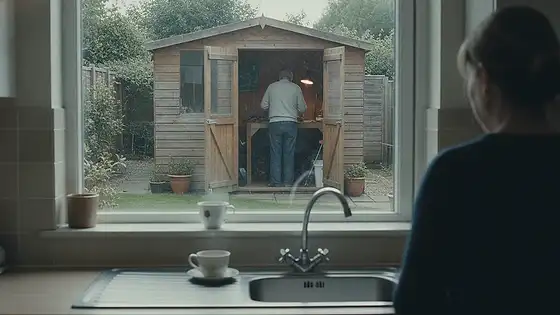
Dealing with an avoidant partner means not treating distance as a verdict, and not organising your own life around waiting for it to end. A search for how to deal with an avoidant partner is rarely a search for a definition. It is a search for an explanation of a specific week: one that started close and ended with short replies, a full schedule and the sentence that everything is fine. This section is written for that person — the one on the other side of the pattern.
Two things about what follows. It contains no scripts for changing another adult, because those do not work and the writing that sells them makes the situation worse. And it does not advise you to stay or to leave. That decision belongs to somebody with the whole picture, which a website never has.
What it does contain is a description of what the distance tends to be, what tends to lower the temperature, what reliably raises it, and the point at which this stops being something a guide can help with. The last part matters as much as the rest.
What are you actually dealing with?
The distance tends to be a response to closeness rather than a judgement about you. Attachment writing has a name for it — deactivation — and the short version is that the need for the other person gets dialled down rather than acted on, most often just after the relationship went well or asked for something. What drops is the felt pull, not the caring underneath it.
That ordering is why partners spend weeks hunting for the mistake. Distance after a row is self-explanatory, and nobody goes looking for a term to describe it. Distance after the best evening of the month has no story attached to it, so the searching starts. The mechanism has its own section, and this page assumes it rather than repeating it.
Some description of what changes is worth having in plain terms, because the change is easy to feel and hard to point at. For example, replies get shorter and later. Plans stay theoretically alive but lose their day and time. Conversation slides toward logistics. The week acquires obligations that are all true and all newly urgent. Practical reliability often continues untouched, which is exactly what makes the whole thing so difficult to raise without sounding unreasonable.
A caution about vocabulary before going further. The pattern itself is a description drawn from attachment theory. Describing a pattern is not the same as diagnosing a person, and reading a page like this one does not qualify anyone to tell their partner what they are. The frame is useful for understanding a shape you keep seeing. It is not useful as a label to hand somebody across a kitchen table, and used that way it converts a conversation into a defence within a sentence.
There is one more thing to hold, and it is uncomfortable. Two honest descriptions of the same week can look nothing alike. From your side, something visibly changed and nobody will name it. From the other side, the week was heavy, the quiet was ordinary, and the upset arrived from nowhere. Neither account is a lie. Neither one is complete. What the relationship does with that gap is most of the story, and the longer-range version of it sits in what this looks like inside a relationship.
What actually helps with an avoidant partner?
The moves that tend to help are the ones that reduce the number of things awaiting a response. Raised sideways rather than announced. One subject at a time. A stated preference instead of a required answer. Permission to reply later, meant rather than implied. None of it produces closeness on demand, and none of it is a lever.
The adjustment that does the most work is lowering the stakes of any particular conversation. A relationship in which every difficult subject arrives as a scheduled summit teaches both people that difficult subjects are dangerous. The same subject raised while doing something else, in fewer words, with no verdict attached to the answer, is a different event even when the content is identical.
Specific and answerable beats sincere and enormous. For instance, I would like to see you Saturday can be answered by someone with very little to spare. I need to know where this is going cannot be answered at all without a paragraph, and the paragraph is precisely what is currently expensive. This is not about wanting less. It is about asking in a size that fits through the door.
Timing does more work than wording. The same sentence lands differently sent into an ordinary Tuesday than sent at the end of a quiet stretch, on top of messages that have not been answered yet. Following your own message with genuine absence from the conversation is not a tactic; it leaves the other person room to answer as themselves rather than as somebody under review.
Warmth is worth stating even when it seems to go nowhere. Appreciation offered without a request attached — no follow-up question, no test of whether it gets returned in kind — is warmth that does not arrive as pressure. Care that arrives as logistics is worth receiving as care, too. Handled problems and unlapsing reliability are a real form of expression, and partners who only count words can miss it entirely.
| The response | What it tends to do | Why |
|---|---|---|
| Raising one subject, sideways, in few words | Tends to help | It can be answered without a summit meeting, which keeps the stakes of answering low |
| Saying your own limit plainly, once | Tends to help | It is information rather than pressure, and it does not require an answer that evening |
| Appreciation with nothing attached | Tends to help | It is warmth that does not read as a request for access |
| A long message asking what is wrong | Tends to escalate | It arrives as a demand for emotional access at the point where access feels most expensive |
| Repeating the same question in new words | Tends to escalate | Each version resets the pressure, and none of them can be answered while the pressure is on |
| Silence used as a test | Unpredictable, and costly to you | From the other side it reads as ordinary distance, while you carry the entire strain of it |
| Rearranging your week around a phone | Harmful regardless of outcome | It costs you the weeks whether or not anything comes back |
Two cautions about that table. Every row describes a tendency rather than an outcome, and none of them is a method for producing a particular response in another person. It is written for the person doing the waiting, about the only side of the situation they actually control.
What makes an avoidant partner pull away further?
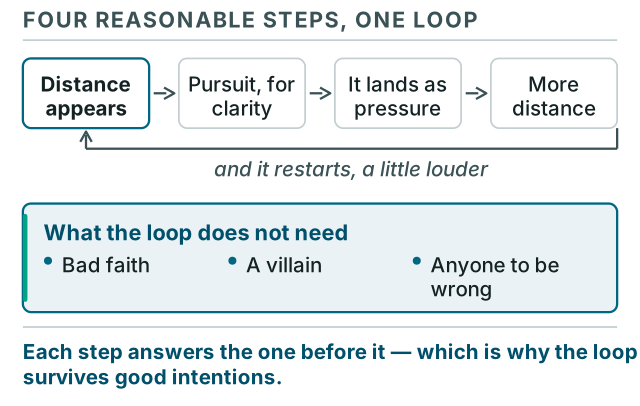
Pursuit is the response that backfires most reliably, and it is also the most natural one. When contact thins, the instinctive move is to add contact: another message, a longer explanation, a request for reassurance, a conversation about what the silence means. Each addition raises load on a system that is currently shedding it.
The loop is worth seeing laid out, because from inside it every individual step feels not only reasonable but necessary. Something changes. You reach for clarity. The reach lands as pressure. The pressure produces more distance. The new distance is more alarming than the last, so the next reach is larger. Nobody in this sequence is doing anything malicious, and the sequence still runs.
Naming the pattern at somebody is its own category of backfire. Telling a partner they are avoidant, or forwarding them an article about what they are, turns a description into an accusation. Whatever accuracy the frame has, it stops being available the moment it arrives as a verdict — and the conversation that follows will be about the label rather than about the week you actually wanted to discuss.
Ultimatums delivered in the middle of a withdrawal tend to produce compliance or an exit, rarely either honestly. A limit stated calmly, in ordinary conditions, is a different object entirely. The difference is not toughness. It is whether the other person is answering a question or answering a threat.
Then there is the quieter one: waiting as a way of life. For example, weeks arranged around a phone, plans kept provisional in case they are needed, friendships thinned because the energy is going somewhere else. This one does not escalate the loop. It just costs you the weeks, and it costs them whether or not anything comes back.
The letters
One letter a week, for the person on the other side of the pattern
That did not go through. Nothing was saved and nothing was sent — try the address again, or write to us directly and we will add it by hand.
- What arrives
- A note when a page here is rewritten or a new one goes up, with one line on what changed.
- What does not
- Assessments, quizzes, coaching offers, anything that claims to tell you what someone else is.
No scripts for changing another adult. Unsubscribe anytime.
How do you keep your own needs in the room?
Lowering the pressure is not the same as removing yourself from the relationship. A partner who asks for nothing, mentions nothing and adapts around every withdrawal has not solved the distance; they have agreed to it privately and started keeping a ledger. That arrangement holds for a while and then arrives all at once.
The workable version is stating things as information rather than as demands. What you noticed, what you would like, what you are not able to keep doing. Said once, in ordinary conditions, without a deadline attached. Whether it is met is a separate question, and the answer to that question is data about the relationship rather than a referendum on how well you phrased it.
It is worth being specific about what you are entitled to want, because pages written for partners have a habit of quietly editing the list. Being told plainly when something has changed. Plans with a day attached. A conversation that gets returned to rather than closed. Knowing where you stand. None of these is excessive, and none of them stops being reasonable because the other person finds them hard.
The question underneath how do I detach from an avoidant is rarely about leaving at all. What it tends to mean is: how do I stop living in a posture of waiting. That is a change in where your attention goes, not a manoeuvre aimed at anyone. Put the week back together. Answer messages when you see them rather than instantly. Let a plan be made with somebody else. It reads as strategy from outside; it is not one, and treating it as a technique for producing a return is the fastest way to make it useless.
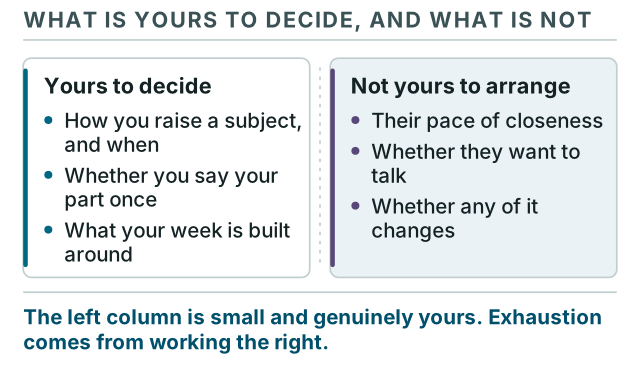
There is a useful test for the private version of this question, and it has nothing to do with the other person. Ask what your life looks like now compared with the way it looked before this stretch began: the friends, the sleep, the work, the things you used to do on your own. If the answer is narrower, that is information worth taking seriously, independent of anything the relationship does next.
Where this stops being a pattern question
Some situations are not attachment questions and should not be read through this frame at all. If the dominant feeling in your relationship is fear rather than distance, if money, movement or contact with other people is being controlled, or if leaving the room ends an argument through intimidation, that is a safety question and belongs with a qualified professional or a domestic abuse service in your country, not with a website.
What this page does not do
Writing for partners is a market with a strong incentive to promise more than it can deliver. Here is what this section will not do, stated before you rely on it.
- It does not tell you to stay or to go
- That decision needs the whole picture — history, children, finances, what you want your life to look like. A page that reaches a verdict on it from a search query is guessing with your years.
- It does not sell techniques for changing another adult
- Nothing here is a lever. Material framed as a method for making somebody open up, commit or come back is selling certainty it does not have, and the attempt tends to deepen the distance it promises to close.
- It does not diagnose your partner
- What is described here is behaviour under particular conditions. Nobody can have it, and nobody can be given it from across a room on the strength of a page. Recognising a shape is useful; issuing a label is not.
- It does not predict what will happen
- No timelines appear anywhere on this site, and no forecast of another person's behaviour. Both would be more quotable than the truth and would hand you a countdown to measure ordinary days against.
- It does not treat your needs as the problem
- Lowering the pressure in a conversation is not the same as wanting less. Advice that resolves every difficulty by asking the partner to need nothing has stopped describing a relationship.
What this section does stand behind
- Concrete, not characterological
- The changes a partner can actually point at: a plan that lost its date, a subject that stopped coming up, a reply that got shorter.
- A limit you can see
- The page names the place where it runs out instead of holding the same tone all the way down.
- A page that shows its age
- The month this was last reviewed sits on the page rather than being left for the reader to guess at.
Where this page stops
This is descriptive material about a relationship pattern, written for people trying to make sense of a confusing stretch. It is not clinical, and it cannot distinguish between the pattern described here and something that needs proper assessment. Withdrawal alongside sustained low mood, withdrawal that follows a frightening event, heavy drinking or drug use inside the relationship, and any situation where you feel unsafe are all questions for a professional rather than for a guide.
The page also stops at the edge of the individual case. It can say what this pattern tends to look like. It cannot say what your partner feels, whether they will move toward you, or whether this relationship is one you should be in. If you want the couple version of these conversations held by somebody in the room, a therapist who works with couples is the appropriate route, and wanting that is not an escalation. The sources page lists what this guide was built from and where its vocabulary originally came from.
One boundary of vocabulary, since readers arrive here having read widely. This site covers the dismissive-avoidant pattern. Where distance alternates with intense pursuit in the same person, that is a different pattern with a different literature, and stretching this frame to cover it produces confident writing about the wrong thing.
The rest of this section
The pages below take the partner-side question at closer range. Both assume this page rather than repeating it, so this is the order they are meant to be read in.
How to communicate with an avoidant partner is the conversation mechanics: why we need to talk lands badly, what timing and an available exit actually change, and how to state a limit without it arriving as an ultimatum. It is the page to read before the next difficult subject rather than after it.
Married to a dismissive avoidant partner is the long view. Over years the pattern tends to stop being dramatic and become structural: separate routines, practical care standing in for emotional conversation, and a growing list of subjects that never get opened. That page is about what changes with time, what does not, and what living alongside the second category honestly involves.
If you arrived here in the middle of a withdrawal and want the mechanism rather than the response, deactivation is the page that explains what is happening and why the timing looks so strange from where you are standing.