
Dating an avoidant is dating someone for whom pressure rises with commitment rather than with the calendar, so an easy start tends to get harder as the relationship gets serious. People looking up dating an avoidant are rarely at the start of it. They tend to be somewhere in the middle of a first confusing month: a run of good dates, then a stretch of short replies, then a warm evening that seems to prove nothing was wrong, then the same thinning-out again.
This section describes what that early phase usually looks like when one person leans avoidant, in what order the parts tend to arrive, and where the description stops being useful. It describes behaviour under pressure. It does not tell you who the person you are seeing is, and it makes no prediction about what they will do next.
One thing is worth stating before anything else, because it changes how the rest reads. In this pattern, pressure rises with commitment, not with the calendar. Weeks of easy dating followed by a sudden change are not evidence that something went wrong on a particular evening. They usually mean the relationship crossed from casual into serious, and the pattern started responding to that.
Why does the early stage feel easy?
The early stage of dating asks very little of the pattern, which is why it often goes unusually well. Contact is optional, distance is built into the format, and nobody is owed access to anyone’s evening. Someone who finds continuous closeness costly can be warm, curious and fully present in exactly these conditions, and mean all of it.
That last point matters, because the most common reading of a later pull-back is that the early warmth was performance. It generally was not. What made it possible was structure. A couple who see each other on arranged evenings and go home afterwards have a built-in recovery gap, and the pattern only becomes visible when that gap starts closing.
The specific things people describe about this phase are consistent. Attention that feels genuine rather than strategic. Good conversation about almost anything except the relationship. Plans made readily as long as they sit inside a known horizon. Physical closeness that arrives sooner and more comfortably than emotional disclosure does.
There is also a quieter feature of the early weeks that only makes sense in retrospect: a lot of biography gets shared and very little interior gets shared. For example, you may come away knowing where someone worked, why they left, and what their family is like, while knowing almost nothing about what any of it felt like. That asymmetry is not secrecy. Facts are cheap to hand over and feelings are not, and the pattern spends what is cheap.
None of this is a warning about early enthusiasm. The point is narrower: the ease of the first weeks is information about the format, not about how the relationship will handle weight. Nothing has been tested yet, and that is exactly what makes it comfortable.
What does the first pull-back usually follow?
The first noticeable pull-back rarely follows a fight. It usually follows a high point: an unusually open conversation, a first night that ran into the morning, a weekend that felt like a preview of something. Closeness is the trigger, not conflict, which is why the timing looks irrational from outside and feels reasonable from inside.
From your side, the sequence is disorienting because the good evening and the retreat are causally linked in the wrong direction. From the other side there is often no drama at all: an increase in pressure, a wish for an ordinary quiet day, and a run of small decisions that each seem sensible. Reply later. Keep it short. Do not make a plan yet.
This is the mechanism the rest of this site is built around, and it has a name: deactivation. We describe it once, in its own section, rather than retelling a shortened version on every page. What belongs here is only the dating-specific shape of it.
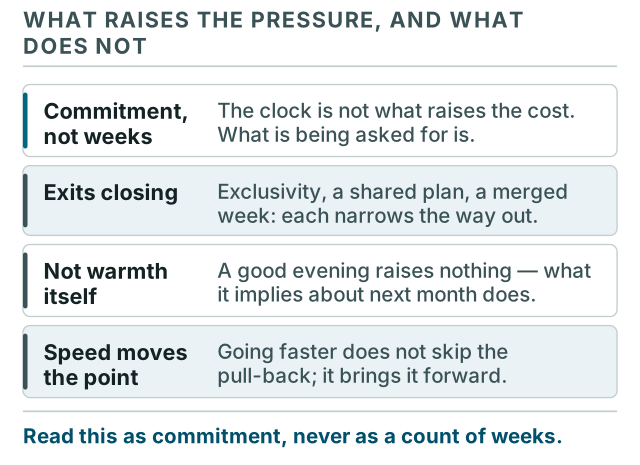
Practically, that means the pull-back tends to appear at recognisable crossings rather than at recognisable dates. Deciding to stop seeing other people. Meeting a friend of theirs. A question about a holiday next year. The first argument that does not resolve inside an evening. Each one raises what the relationship asks for, and the response is to reduce contact until the level feels manageable again.
What the pull-back usually is not: a decision. People describe it afterwards as drifting rather than choosing, which is why direct questions during it produce genuinely unhelpful answers. For instance, Are you pulling away? meets a person who does not experience it as pulling away, and answering honestly from the inside sounds like denial from the outside.
The other part of the shape is the return. Contact often resumes on its own once the pressure drops, sometimes as though nothing happened and with no reference to the gap. That return is the most useful piece of information available to you in the first months, and the next section is about how to read it.
Avoidant, or just not interested?
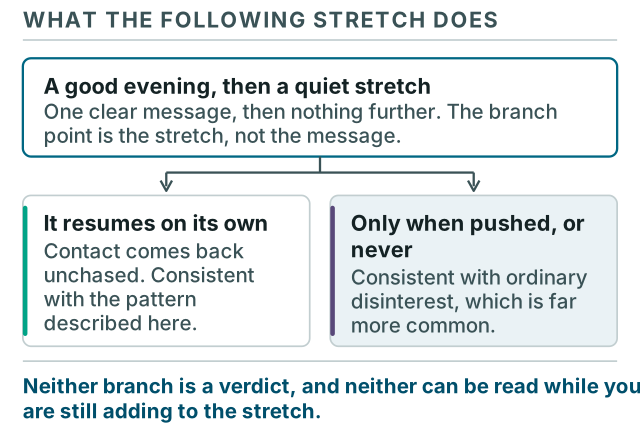
The honest answer is that during a single quiet week, the two look identical, and nobody can tell them apart from the outside. What separates them is what happens after the quiet week without any effort from you. A pattern of managing closeness produces distance that ends by itself. Ordinary disinterest produces distance that keeps going.
This is the question people arrive at this page for, so it is worth being exact about what can and cannot be distinguished. Not the person’s feelings — those stay unavailable. What is observable is a shape: what the withdrawal follows, whether contact resumes unprompted, and whether the warm phases keep their quality or get thinner each time.
| What you notice | More consistent with the pattern | More consistent with disinterest |
|---|---|---|
| What the pull-back follows | A high point: an open conversation, a very good weekend, a step toward exclusivity | Nothing in particular, or a gradual fade that never had a high point |
| Whether contact returns | Returns without being chased, often as though the gap needs no explanation | Returns only when you initiate, or not at all |
| Quality of the warm phases | Genuinely warm and attentive when they happen, not distracted | Polite, shorter each time, increasingly hard to schedule |
| How plans behave | Made readily for the near term, avoided for anything with a horizon | Avoided in both, or agreed and then quietly dropped |
| When you name the distance | Discomfort, a flat answer, and no argument — but the contact usually continues | Agreement, relief, and a conversation that closes the subject |
| What you learn about them | Detail about facts and history, little about how any of it felt | Little of either, and no curiosity in the other direction |
There are cautions about that table, and they matter more than the rows themselves.
The first is that a single row proves nothing. Anyone can be slow to reply during a bad month, and anyone can go quiet after a good weekend for reasons that have nothing to do with attachment. What is being described is a repetition: the same sequence, arriving at the same kind of moment, more than once.
The second is that the two readings are not mutually exclusive. Someone can lean avoidant and also not want a relationship with you specifically. The pattern explains a shape of behaviour; it does not supply motive, and it is not a reason to reinterpret a clear answer as a symptom. If someone has told you plainly that they do not want this, that statement is the better evidence.
One reading deserves separating out, because it is where the confusion of the first months usually sits: warmth and unavailability arriving together. Ordinary disinterest is usually consistent — the person is mildly pleasant and mildly absent throughout. What people describe in this pattern is a swing: full presence on the evening itself, then a stretch where the same person is hard to reach. The contrast is the signal, not either state on its own.
The mirror-image mistake is worth naming too. A person who is genuinely not that interested can also produce a warm evening, because an enjoyable evening requires very little investment. This is why the useful question is never was that evening real but what happened in the following week, and who made it happen.
There is a low-cost test available, and it is mostly a test of your own patience. When contact thins, send one clear message, then stop and watch what the next stretch does on its own. Not as a tactic to produce a reaction — as a way of getting the only information the situation can actually give you.
The letters
One letter a week, for the confusing first months
That did not go through. Nothing was saved and nothing was sent — try the address again, or write to us directly and we will add it by hand.
- What arrives
- A note when a page here is rewritten or a new one goes up, with one line on what changed.
- What does not
- Assessments, quizzes, coaching offers, anything that claims to tell you what someone else is.
No scripts for changing another person. Unsubscribe anytime.
What happens when it stays a situationship?
Some of these arrangements never resolve in either direction. They run for months in a steady in-between state: consistent contact, real affection, and no movement toward anything defined. Inside this pattern, that is not usually indecision or a strategy. It is the arrangement that keeps pressure at a sustainable level, so there is no internal push to change it.
That is worth understanding rather than resenting, because it explains an otherwise baffling combination. The warmth is real and the reluctance is real at the same time. Asking what are we gets a genuine answer of I don’t know, which sounds evasive and is often accurate, because the question is being asked of someone who has not modelled the future part of it at all.
What the frame explains, and its limits, are worth separating clearly:
What it explains. Why the pull-back arrives after the closest moments. Why a direct question about status produces vagueness rather than a refusal. Why the same person can be reliably present in the arrangement and unwilling to give it a shape.
What it does not explain. Whether this particular arrangement will ever change, whether the other person wants it to, and whether staying in it is a good idea for you. Those are not attachment questions. They are questions about what you want and what you are able to wait for, and no description of a pattern answers them.
One practical thing does follow, though. Ambiguity of this kind is generally easier for the person who finds closeness costly than for the person waiting on it, so the cost of leaving it undecided is not shared equally. Noticing that asymmetry tends to be more useful than any attempt to determine what the other person secretly intends.
The undefined stretch also has a habit of being read as a test you can pass — that enough patience, or enough lightness, will eventually convert it. What people describe more often is that the arrangement stays exactly as stable as the pressure allows, and changes only when something outside it changes. That is a description, not a discouragement.
What helps when you are dating an avoidant?
The things that help early are unglamorous and mostly about pace: fewer requests for reassurance, more direct statements about what you want, and enough space in the schedule that distance does not have to be manufactured. None of it manages the other person. It changes what the situation asks for, which is the only lever that is genuinely yours.
The clearest version of the advice is a short list of what people describe as making the early phase workable — and it is worth saying that none of these are moves designed to produce a reaction.
Say your own part plainly, once. For example, I like this and I’d like to see you weekly is a statement. Where is this going is a request for an answer that may not exist yet. The first tends to get a real response; the second tends to raise pressure and produce a vague one.
Let the quiet stretch be quiet. Volume of contact during a pull-back reliably extends it. One message, then waiting, is not passivity — it is the version of the situation that gives you clean information rather than a reaction to pressure.
Do not accelerate the good weeks. The pull-back tracks commitment, so a very fast escalation after a good weekend brings the difficult part forward rather than skipping it. Slower is not a manipulation; it keeps the level of ask closer to what the pattern can hold.
Watch actions with a longer memory than words. Reliability, remembered detail and practical help are the channels the pattern uses comfortably. Care that does not look like care covers what that looks like and where wishful reading of small signals starts.
Keep a limit that does not depend on them changing. Deciding what you need in order for this to work is a decision you can make on your own information. Waiting to find out whether they will supply it is a decision that hands the timing to someone else.
A note on what none of this is. Slower pace and less pursuit get sold in a lot of dating advice as tactics: hold back and they will chase. That is not the reasoning here, and the difference is not cosmetic. A tactic is aimed at producing a reaction in someone else and quietly turns the relationship into a game with a scoreboard. What is described above is aimed at keeping the level of demand honest, so that whatever happens next is information rather than a response to pressure. If holding back is being done in the hope that it works on them, it is a tactic wearing a description’s clothes, and it tends to be transparent.
The thing most likely to make the early phase worse is also predictable: increasing the emotional demand at exactly the moment contact thins. It is the most natural response available and it reliably produces more distance, which then produces more demand. If you have already been through that loop, talking to a partner who leans avoidant is written for the conversation that comes after it.
The rest of this section
This is the dating part of the guide. It covers the early phase specifically — the stretch before a relationship has a settled shape, where the confusing signals get sent.
Texting when the other person leans avoidant — the scenarios people ask about most: no reply for a day, the disappearing typing indicator, one-word answers, and what each of them usually does and does not mean.
Beyond this section, these pages carry the weight for someone in this situation. Deactivation explains the mechanism behind the pull-back, and it is the page to read if only one thing gets read. Inside a relationship picks the story up after the early phase ends, once the pattern has to work over years rather than weeks. And the wider frame sets out what avoidant attachment describes in the first place, for anyone who arrived at the term this week. Our sources page sets out what this guide is built from.
What this page cannot tell you
Stated plainly, because the questions this page attracts are exactly the ones a website cannot answer.
- Whether the person you are seeing leans avoidant
- Nothing here identifies an individual. A description of a pattern is built from many people's behaviour over time; it cannot be applied to someone you have known for a month, and reading it is not an assessment of them.
- Whether they will come back, commit, or change
- We do not predict individual behaviour, and any page that offers you a timeline for it is inventing one. Contact returning after a quiet stretch is information about the past week, not a forecast of the next.
- Whether you should stay
- That depends on what you want and what you can live with, neither of which is knowable from here. We describe what tends to happen; the decision is not ours to route.
- How to make someone want more
- There are no scripts on this site designed to produce a reaction in another person. Everything under what tends to help is about stating your own part and adjusting what the situation asks for.
- How common any of this is
- You will not find percentages here. The figures that circulate about attachment patterns could not be traced to a source we had read, so we print none — including in answers where a number would be reassuring.
What we do stand behind
- Sequences, not calendars
- We describe the order things tend to happen in — closeness, then pull-back, then return — and refuse to attach weeks to it, because the timing varies with commitment rather than with the calendar.
- Behaviour you can observe
- Every distinction on this page rests on something visible from outside: what the withdrawal follows, whether contact resumes unprompted, what happens to plans.
- A visible check date
- The month this page was last gone over appears on it. Nothing here is presented as timeless.
Where this page stops
Everything above is about ordinary dating, and it is written from outside anybody’s head. It cannot tell you which reading applies to the person you are seeing, and it has no way of separating a way of handling closeness from something a professional would want to look at properly. Where a quiet stretch sits alongside a mood that has not lifted in a long time, where it started after something frightening, or where what you are describing to yourself is closer to being afraid of someone than to being kept at arm’s length, the next step is a conversation with a clinician rather than another page.
There is also a limit that has nothing to do with clinical questions. Early dating produces very little evidence, and a frame that explains behaviour well can make thin evidence feel conclusive. If you find yourself building a full account of someone from a slow reply, the frame has stopped helping. The reliable move at that point is not more interpretation. It is saying what you want out loud and watching what happens next.