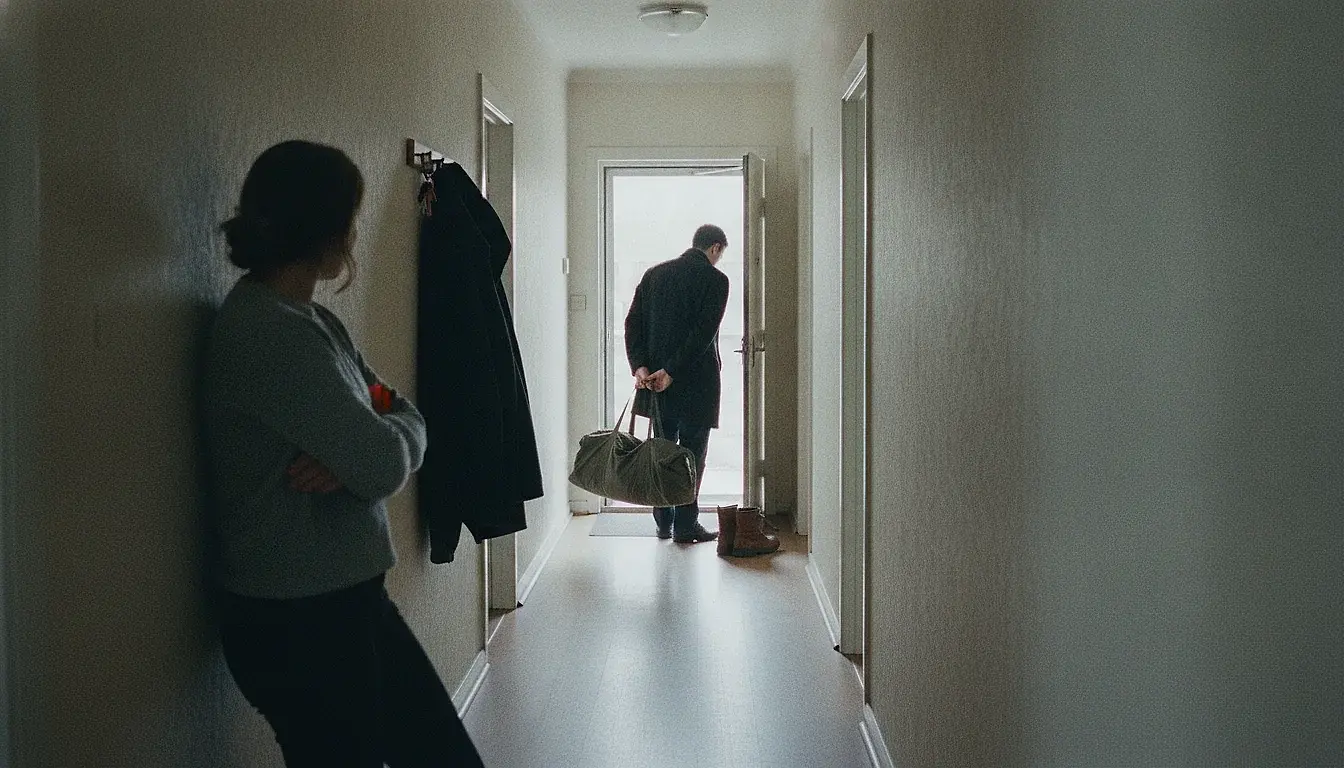
An avoidant breakup is usually described the same way by the person who was left: it was calm, it was quick, and it made no sense. There was no scene worth remembering. For example, there was a short conversation, an agreement about who collects what, and then a silence that has not moved since.
This section of the guide covers what tends to happen around an ending when avoidant attachment is part of the picture — what the run-up looks like, why the separation itself is often flat, and what people report happening afterwards. It is written as a sequence, not a timeline. The order is describable. The dates are not, and any page that gives you dates is guessing.
Readers arrive here from opposite directions. One is the partner trying to work out what just happened to them. The other is the person who recognises their own behaviour in the description and wants to know whether it is as cold as it looked from the other side. Both are addressed below, separately, because the same ending genuinely produces two different experiences.
What does the run-up to an avoidant breakup look like?
The ending rarely starts at the conversation. In this pattern the withdrawal comes first, and it comes gradually enough that neither person can name when it began. By the time the sentence is said out loud, the decision is frequently old.
What thins first is not affection. It is availability. Replies get shorter and later. Plans stop being made for anything beyond the immediate. Conversation drifts toward events, logistics and other people, and away from the relationship itself. Physical closeness often continues while the emotional channel quietly closes, which is why the run-up is so easy to miss.
The partner usually notices something and gets told it is nothing, and that answer is not always a lie. From inside the pattern, distance registers as needing a bit of space rather than as an ending in progress. The mechanism that produces this — closeness rising, pressure rising with it, distance restoring steadiness — has its own section in deactivation, and it is worth reading before anything here is interpreted as a decision that was made coldly and executed on schedule.
| What changes | How it reads from outside | What it is doing inside the pattern |
|---|---|---|
| Replies get shorter and slower | Losing interest, punishing me | Lowering the volume of contact until the pressure drops |
| Plans stop being made far ahead | Seeing someone else, planning to leave | Removing commitments that cannot be exited quietly |
| Talk moves to logistics and other people | Nothing is wrong, so I imagined it | Staying in the relationship on the channel that costs least |
| Closeness continues, warmth does not | Mixed signals, deliberate cruelty | The parts that were never the expensive part still work |
| Difficulty gets handled alone | Being shut out on purpose | The default strategy: report the outcome, not the state |
Why the same ending feels sudden to one person and slow to the other
The asymmetry is the reason these breakups are so often remembered as unfair. For instance, one person experienced a decision arriving out of nowhere on a Tuesday. The other experienced a long, private, uncomfortable process that finally concluded on a Tuesday.
Neither account is dishonest. They are records of different amounts of information. The withdrawal was legible from the inside because the person could feel it happening; it was illegible from the outside because almost nothing about it was said. Whether a particular withdrawal is an ending or a temporary retreat is the question done, or deactivating? works through, and it is the question the run-up cannot answer on its own.
What happens at the point of separation?
The separation itself is usually shorter than expected. There is often no argument, because argument requires two people willing to raise the temperature, and raising the temperature is the thing this pattern is organised to avoid. What arrives instead is agreement.
Partners describe a specific and disorienting combination: the ending is accepted immediately, the reasons given are general, and the practical questions get answered with unusual efficiency. For example, keys, boxes, the shared account. Nothing to fight against, and nothing to hold on to.
Different things are happening at once, and together they explain the flatness better than any account of a person not caring.
The first is that the reaction has already partly happened. The withdrawal that came before was processing done privately, in advance, without an audience. What is left for the conversation is the administrative part.
The second is relief, and it is real. An ending removes the pressure of being continuously available to another person, and this pattern is steadied by exactly that removal. Relief at the point of separation is not a verdict on the relationship. It is the nervous system getting what it has been reaching for, which is a much narrower thing.
The third is that expressing distress in front of someone is the one move this pattern has never had a comfortable version of. Being visibly devastated in the room requires a channel that has been closed since long before this relationship. Its absence is not proof of its contents.
What happens after an avoidant breakup?
The visible order tends to be inverted: the person who left often struggles later, and the person who was left often struggles first. This is where the sequence separates from what people expect. Both are described as normal within this pattern, and neither is a measurement of love.
The order people report is recognisable. Distance, then a flat ending, then relief, then a period where the ending looks entirely settled from outside. Then, at some point that nobody can predict, contact with what was lost — usually when nothing is being asked of them any more.
That last stage is what the phrase dismissive avoidant breakup regret is reaching for. It is better described as delayed access than as a change of mind. The feeling was not manufactured later; it was held at a distance while the relationship was still making demands, and it becomes reachable once the demands stop. Whether it produces an apology, a message, or nothing at all is a separate question, and this site does not forecast it.
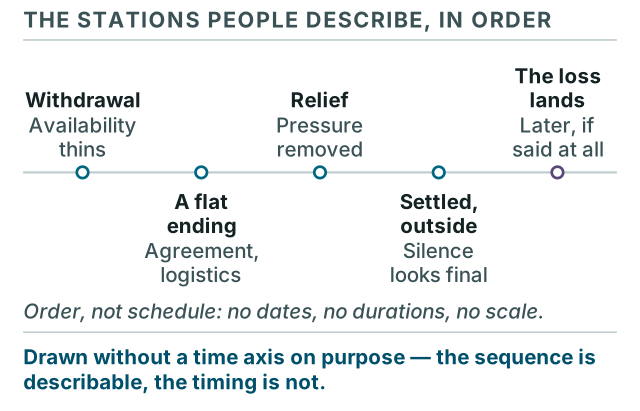
Searches for dismissive avoidant breakup stages are usually looking for the missing piece of that picture: how long each part lasts. We do not publish those durations. The timings that circulate could not be traced back to anything we had actually read, and a figure that turns out to be folklore does real damage to somebody counting days against it.
Other things also happen after the ending and have their own pages, because they generate more questions than anything else in this section. One is the abrupt version of the cut-off, where warmth disappears without explanation and intermittent messages follow — covered in the avoidant discard. The other is reappearance, which is common enough in this pattern to deserve a mechanism rather than a myth: do avoidants come back? explains why distance makes contact possible again, and why that says nothing reliable about what happens next.
The letters
A short letter when we publish something new on this
That did not go through. Nothing was saved and nothing was sent — try the address again, or write to us directly and we will add it by hand.
- What arrives
- A note when a page here is rewritten or a new one goes up, with one line on what changed.
- What does not
- Assessments, quizzes, coaching offers, anything that claims to tell you what someone else is.
Occasional emails about the avoidant pattern. No advice on winning anyone back. Unsubscribe anytime.
If you are the one leaving
The searches here — how to break up with an avoidant, breaking up with an avoidant — usually come with a specific worry attached: that the conversation will go badly, or that it will go strangely well and mean nothing.
What people report landing best is plainness. A decision stated as a decision, not as an opening position. Reasons given in behaviour rather than in character terms, since character terms invite a defence and behaviour can simply be true. Practical questions separated from emotional ones and handled in their own conversation, because the practical channel is the one that stays open.
Expect less reaction than the relationship deserves. Agreement is likely, argument is unlikely, and the calm in the room is not consent to how it happened or a report on how much it mattered. Anyone who needs to be visibly grieved at in order to feel the relationship was real is likely to leave that conversation without it.
What we do not provide is a script engineered to produce a response — no wording designed to make someone plead, chase or reconsider. Sentences aimed at manufacturing a reaction in another person are outside what this guide does, in either direction. If you want your own part said clearly rather than strategically, talking to an avoidant partner covers the mechanics.
If you were the one who withdrew
The other side of this section gets far less written about it, partly because people in this position rarely ask out loud. The experience described is usually some version of: I ended it, I felt fine, and now I do not, and I cannot work out whether that means I made a mistake.
Relief arriving first and grief arriving later is the ordinary order here, and neither one is the verdict. Relief was the pressure leaving; it reported on how much closeness cost, not on how much the person mattered. The feeling that shows up afterwards is not a correction issued by some more honest part of you either. It is contact with something that was held at a distance while the relationship was still asking for things.
What that later feeling does not settle is whether the ending was right. Both a good decision and a bad one produce the same sequence in this pattern, which is exactly why the sequence cannot be used as evidence. Reaching out because the loss has finally become reachable is also a decision with a person on the other end of it, and that person has been living in the silence in the meantime.
How do you get over an avoidant?
How to get over an avoidant is a real search and a slightly wrong question, because the difficulty is rarely the loss on its own. It is the loss plus an unanswered question, and the question is what keeps the thing alive.
Ordinary endings hand you a story. This kind often does not. What people describe carrying is an ambiguity: whether the warmth was real, whether they caused the withdrawal, whether a different sentence at a different moment would have changed the outcome. Grief with an open question inside it does not settle the way grief with an explanation does, and mistaking one for the other is why people conclude that something is wrong with them for still being here long afterwards.
Clarifications do more work here than any technique. The first is that the withdrawal has a mechanism that predates you, described across this guide and in detail on deactivation; it was not a referendum on your worth conducted quietly in the background. The second is that the explanation you are waiting for may never be delivered, because the ability to narrate the inside of that process is precisely what this pattern is short of. Closure assembled by one person is a worse experience than closure given by two, and it is the version that is actually available.
Generic breakup advice — waiting rules, contact schedules, methods for reappearing at the right moment — is not what this site does, and it belongs to a different subject entirely. Everything here stays inside the attachment frame: what the pattern explains, and where the explanation stops being any use.
The rest of this section
The pages below sit under this one, each for a question this hub only summarises.
The avoidant discard — what people mean by an ending that arrives abruptly after closeness, why the borrowed word fits badly, and what intermittent contact afterwards does and does not indicate.
Done, or deactivating? — the difference between a temporary retreat and an ending, described through what changes in the structure of the relationship rather than through what gets said.
Do avoidants come back? — why returns happen in this pattern at all, what people describe noticing beforehand, and why no page can tell you whether one is coming.
What this section will not do
What we do not publish about breakups
Endings are the point where this subject is most often turned into a technique. Several things are off the table here on purpose.
- Timelines and stage durations
- No durations, no phases with dates attached, no countdown. The order of what people describe is useful; the timings that circulate online could not be traced to anything we had read, and someone counting days against a made-up figure gets hurt by it.
- Methods for getting an ex back
- This guide does not run strategies aimed at producing a reaction in another person — no contact rules, planned silences, or messages engineered to prompt a reply. That is a different subject with a different ethic, and it is not covered anywhere on this site.
- Predictions about your particular ending
- A pattern describes tendencies across many people. It cannot tell you whether this person will reach out, regret it, or explain themselves. Any page that claims otherwise is selling certainty it does not have.
- Verdicts on the person who left
- Withdrawal is described here as a strategy for handling pressure, not as evidence about someone's character or worth. This site describes behaviour under conditions and does not hand out labels for a partner.
- Figures
- You will not find percentages here for how often avoidant breakups end this way or that. The fact file behind this site is empty by design, so no page prints a number.
What this section does offer
- An order you can recognise
- The sequence people report, stated plainly, so the flatness of the ending stops reading as proof of indifference.
- Both accounts of the same stretch
- What the run-up looked like from outside and what it was doing inside the pattern, set side by side rather than one at a time.
- Where the frame gives out
- The point at which description would turn into forecasting is marked, and the page stops there.
Where this page stops
This page describes a pattern reported around endings. It cannot tell you what happened in your relationship, cannot confirm that avoidant attachment is what you were dealing with, and does not distinguish this pattern from other reasons a person becomes distant and then leaves. An attachment pattern is a description of behaviour, not a diagnosis of anyone, and nothing here is assessment or care.
A breakup that is not lifting, sleep that has not returned, or distress heavy enough to sit on ordinary functioning is a question for a therapist or a doctor rather than for a guide — someone who can ask about your context in a way a page cannot. That is also the route for anyone whose own withdrawal has started to worry them rather than merely to be noticed by other people.
If a partner’s safety or your own is involved in any way, that is not a subject this site covers, and it should go to local emergency or support services rather than to an article about attachment. The reading behind the language used here is listed on our sources page.