Why do a retreat and an ending look the same at first?
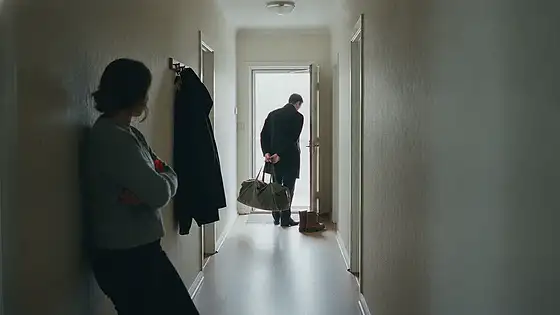
A retreat and an exit begin the same way in avoidant attachment, which is why the question cannot be settled in the first quiet week. Signs an avoidant is done with you are changes in the structure of the relationship rather than in its tone. People searching for them tend to describe the same opening scene: less contact, shorter answers, plans that thin out, a partner reading messages for temperature.
The reason they overlap is that both use the same instrument. Distance is what this pattern reaches for under pressure, and pressure can come from closeness, from a difficult stretch, or from a decision already made privately. The behaviour on the surface does not report which one is underneath.
That is the first thing worth accepting, because the exhaustion in this situation tends to come from trying to force a reading that the evidence cannot support yet. Watching harder does not produce a verdict faster. In practice, it produces a partner who has memorised the timestamps on every reply.
The frame matters here as well. Avoidant attachment describes a way of handling closeness — space used to bring the temperature back down — not a diagnosis and not a verdict about anyone’s character. Nothing on this page reads a mind. It describes what people who lean avoidant report doing, and what their partners report seeing.
There is a second question hiding inside the first one, and it is worth separating. Is this over and do they still feel anything are not the same enquiry, and they are answered by different evidence. The second one has its own page: signs an avoidant loves you but is scared.
What does eventually separate the two is not intensity but scope. A retreat narrows the channel; an ending dismantles the structure the channel ran through. That distinction takes time to become visible, and it is visible in arrangements rather than in tone. The rest of this page is about where to look.
What does a withdrawal usually leave intact?
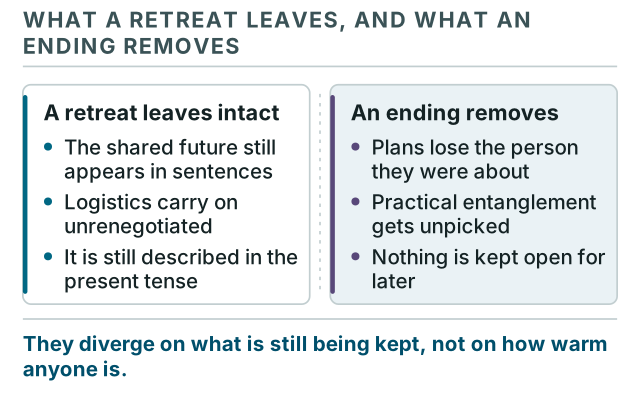
A retreat narrows contact but tends to leave the relationship’s structure standing. Shared logistics stay in place, belongings stay where they are, the calendar still assumes two people, and the relationship is not being described to other people in the past tense. Distance is being taken inside an arrangement that still exists.
The mechanism behind that is covered in full on deactivation, which is the part of this pattern that gets mistaken for loss of interest. What matters for this page is one consequence of it: deactivation is regulation, not a decision. It is aimed at lowering the temperature, and lowering the temperature does not require taking anything apart.
So the practical markers of a retreat are largely negative — things that have not happened. Nothing has been cancelled outright; it has been moved. Nothing has been returned. Nobody has been told. The shared arrangements that would be inconvenient to unwind are still sitting there, untouched, while the contact around them has gone thin.
Partners often report a particular shape to this: contact narrows to a floor and stays there rather than going to zero. For instance, replies get short but keep arriving. A weekly habit survives even when the conversation around it has emptied out. That floor is doing something, and its existence is more informative than its coldness.
The other marker partners describe is the return that nobody engineered. Someone who has pulled back to regulate tends to come back on their own once the pressure drops, without being chased, usually acting as though the gap needs no discussion. That reappearance is not a promise about anything, and it is not the same as repair — but an unprompted return is not what an ending tends to produce.
None of this is comfortable to sit inside. A retreat that leaves everything technically intact can still be lonely, and describing it as not an ending is not the same as describing it as fine.
What does an ending remove that a retreat does not?
An ending tends to take structure out rather than turn the volume down. Plans get cancelled instead of postponed, shared logistics get unwound, access to the person’s life narrows and stays narrow, and the relationship starts appearing in the past tense to other people. The removals are practical, and they generally do not reverse on their own.
The order is usually the reverse of what a partner expects. The conversation, if it happens, tends to come after the withdrawal rather than starting it — which is why partners describe being told something they had already been watching for weeks. A pattern built around avoiding exposed conversations produces the exit as a series of removals first.
The removals are often small and administrative, which is exactly why they get missed one at a time. For example, a key handed back with an explanation attached. A recurring booking quietly not renewed. A shared password changed. Individually each has a reason; together they describe a life being rearranged to work without a second person in it.
Access is usually the clearest of them. Being let into the unedited version of someone’s week — the work problem, the family thing, the plan they are not sure about yet — costs something in this pattern, and it is withdrawn early. Not with a scene, but with a steady drift into general answers about everything.
| What changes | During withdrawal | At an ending |
|---|---|---|
| Contact | Narrows to a floor and stays there | Thins out and keeps thinning, or stops |
| Plans | Postponed, vaguely rescheduled | Cancelled without a replacement date |
| Shared logistics | Left untouched, still running | Unwound, one item at a time |
| Access to their life | Reduced in detail, still open | Closed; answers stay general |
| Belongings and keys | Stay where they are | Returned, collected, or asked for |
| How others hear about it | Not mentioned to anyone | Described in the past tense |
| Return after distance | Comes back without being retrieved | Contact resumes only for practicalities |
| What a request produces | Friction, then a partial answer | Politeness, and no change |
The table is not scored, and matching several rows on the right decides nothing. Both columns describe behaviour that has more than one story behind it: someone can unwind logistics during a hard month and still be present, and someone can leave everything in place while having privately finished. The columns are directions to look, not evidence to count.
One more distinction is worth naming because it gets read backwards easily. Coldness is not the reliable marker. Removal is. A retreat can feel far icier than an ending, since an ending is often accompanied by a kind of careful politeness that partners describe as the worst part of it.
The letters
One email when there is something new to read
That did not go through. Nothing was saved and nothing was sent — try the address again, or write to us directly and we will add it by hand.
- What arrives
- A note when a page here is rewritten or a new one goes up, with one line on what changed.
- What does not
- Assessments, quizzes, coaching offers, anything that claims to tell you what someone else is.
No spam, ever. Unsubscribe anytime.
What do people notice in hindsight?
The descriptions partners give afterwards cluster around recurring themes, and they are about calm rather than conflict. Read them with the caveat that hindsight is a reconstruction, not a record, and that people assembling a timeline after the fact tend to promote whatever fits the ending they now know about.
One of them is that the arguing stopped. Not resolved: stopped. A topic that used to generate friction stopped generating anything, and the relief that came with the quiet was later reread as the sound of someone who had stopped negotiating because the outcome had already been settled somewhere else.
The second is the disappearance of the future as a casual subject. Not a refusal to discuss it, which is familiar territory in this pattern anyway, but its quiet absence from ordinary conversation — the offhand we should that used to appear without anyone planning it, gone without a discussion having taken place.
The third is a change in the texture of the withdrawal itself. People describe earlier retreats as having a charge to them, something unresolved sitting inside the distance. The last one is described as flat. Whether that difference is real or a story told afterwards is not something anyone can verify from outside.
| What happened | How it read at the time | How it read afterwards |
|---|---|---|
| Arguments stopped | Things are calming down | The negotiation had already ended |
| Politeness increased | They are being considerate | Distance kept at a comfortable temperature |
| Plans got vague | Bad month, busy period | The future stopped being shared |
| A retreat lasted longer | Deactivation, as before | The gap that did not close |
| Practical talk continued | Still connected | Logistics outlast everything else |
A related trap is worth flagging. A return does not retroactively prove that nothing had ended, and a long silence does not prove that something has. People do reappear after distance in this pattern, and what that reappearance means is a separate question with its own page: do avoidants come back.
The honest summary of this section is that hindsight produces good descriptions and unreliable proof. It is useful for knowing where to look while something is happening. It is not a method for dating the moment a decision was made.
Why you may not get a clear answer
What this page does not do
Everything above describes behaviour that people report. Descriptions have limits, and these are the ones that matter most for someone reading this in the middle of it.
- No verdict on your relationship
- Nothing here can tell a particular reader whether a particular relationship has ended. The same behaviour appears in retreats that close and in endings that were decided weeks earlier, and no page can tell those apart from outside.
- No checklist with a score
- We do not publish a list where a number of matches means an outcome. Scored checklists feel decisive precisely because they are made up, and a person waiting for clarity is the easiest reader in this category to sell false precision to.
- No predictions
- We do not write that someone will return, reopen the conversation, or explain themselves by any particular point. Timelines for another person's behaviour are guesses, and presenting a guess as guidance is how this subject takes advantage of people who are waiting.
- No techniques for forcing an answer
- There are no scripts here for pressure, testing, or strategic silence. Those work by raising the cost of not responding, and an answer produced that way settles nothing for either person.
- No numbers
- Nothing on this site carries a figure we could not trace to a named source with a date on it. That rules out a share for how often a retreat turns into an ending, and any average length for either one.
What we do stand behind
- Behaviour described plainly
- Specific, observable changes, named as changes — not adjectives applied to a person, and not a label attached to somebody who never chose it.
- The limits stated out loud
- Where the evidence runs out we say so on the page instead of filling the gap with confidence. Our reading list is on the sources page.
There is a structural reason the clear answer often never arrives, and it is not cruelty. Ending things explicitly requires the exact conversation this pattern is organised around avoiding: an exposed position, held in front of someone, with an unpredictable response coming back. Withdrawal accomplishes the same outcome without the conversation, and it does so gradually enough that no single day requires a decision.
That has an uncomfortable consequence for the person on the other side. Waiting for the sentence that would settle it can mean waiting for something the pattern produces least readily, sometimes for a very long time, while your own life stays paused for a clarification that may never be issued.
Which turns the question around. Not has this ended, but how long am I willing to live inside not knowing, and what is that costing. That one has an answer available to you today, and it does not require access to anybody else’s inner state.
Answering it does not mean forcing a confrontation or issuing an ultimatum. It usually means deciding what you will do with your own time, contact and plans while the situation stays unclear — and noticing whether the arrangement you are actually living in is one you would choose if it never changed.
Where this page stops
This page describes a difference between two patterns of distance. It cannot tell any particular reader which one they are inside, whether a relationship will resume, or what someone else has decided privately. Avoidant attachment is a descriptive frame from attachment theory, not a diagnosis, and distance in a relationship has plenty of causes that have nothing to do with attachment patterns at all.
If the not-knowing is taking over daily life, or if what is happening feels frightening rather than confusing, that is a conversation for a therapist or a doctor rather than for an article. The wider map of endings in this pattern sits on the breakup hub, and the material this site works from is listed on our sources page.