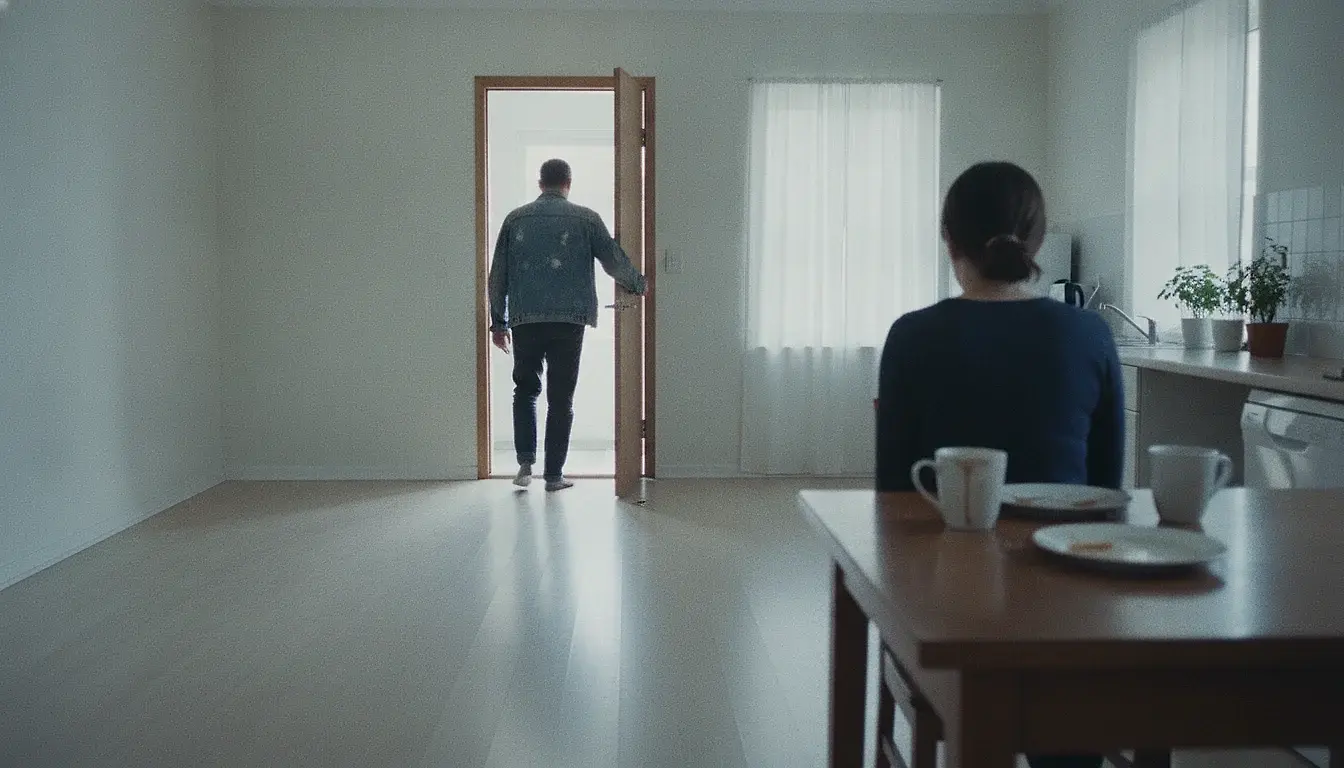
Avoidant deactivation is the name for the part that tends to arrive unannounced: a relationship gets closer, and the closeness itself becomes the thing that has to be turned down. People who search for it are rarely looking for vocabulary. They are looking for an explanation of a week that started warm and ended with clipped replies.
This section holds the mechanism. Every other part of this guide points back here rather than retelling it, because the same process sits underneath the questions that look unrelated: why someone withdrew after a good night, why a partner went quiet after plans were made, why an ending seemed to arrive without a build-up.
Before the explanation starts, some ground rules. Describing a pattern is not the same as reading a specific person’s mind, and nothing below can tell you what is happening inside someone you know. This page also contains no timelines, because the honest answer to how long it lasts is not a number, and inventing one would be the most quotable and least true sentence here.
What is avoidant deactivation?
Deactivation is the process by which the pull toward another person gets turned down instead of acted on. Attachment writing calls the individual moves deactivating strategies: distance, distraction, focusing on flaws, remembering how good life was alone. The effect is a drop in felt need, not a drop in caring.
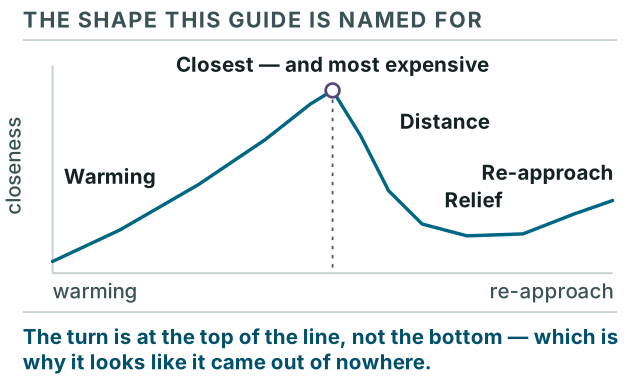
The picture that fits best is a dimmer rather than a switch. Something raises the intensity of connection — an unusually honest conversation, a night that went well, a request for more of the relationship — and instead of the intensity being shared, it gets lowered. The lowering happens quietly, usually before any thought about it has formed, and the reasons arrive afterwards looking entirely sensible: a heavy week, a bad sleep, a need to get on top of work.
That sequence is the confusing part for the person on the other side. Withdrawal after a fight makes intuitive sense. Withdrawal after the best evening in a month does not, and it is the second kind that sends people looking for a word. The wider pattern sets this in context; deactivation is the specific engine inside it.
A question that comes up immediately: how is any of this different from simply wanting time alone? The difference is not the wish for solitude, which is ordinary and human. It is the timing and the trigger. Solitude that gets planned, announced and returned from on schedule is just solitude. Deactivation is unplanned, tends to follow closeness rather than crowding, and comes with a reduction in warmth that the person does not notice happening. One restores a relationship. The other quietly removes something from it while the relationship carries on looking intact.
There is a further distinction, because it decides how the rest of the page reads. Deactivation is a response, not a plan. It is not the same as a decision to leave, it is not a message being sent by silence, and it is not something the person is usually enjoying. From the inside it rarely feels like doing anything at all. It feels like the volume going back to normal.
What starts it
Deactivation is usually set off by a rise in what the relationship is asking for, not by anything going wrong. The common starters are an unusually close evening, a request for more contact, a plan that stretches into the future, a conflict that stays unresolved, or being visibly depended on. Pleasant events trigger it as reliably as difficult ones.
The size of the request matters far less than what the request is about. For example, a partner asking for a lift to the airport rarely starts anything. The same partner asking where this is going can start it in a sentence, because the second question is about the relationship itself, and the relationship itself is the thing being managed.
Certain moments come up again and again in what people describe. For instance, meeting family. A key being offered. The word us used in a sentence about next year. An argument that ended without a resolution and is still sitting there. A period of illness or difficulty in which one person needs the other more than usual. Sex or physical closeness that went beyond routine, which is common enough to have its own page.
There is also a quieter starter that partners do not tend to guess: being appreciated out loud. Warmth that is stated rather than assumed raises the stakes of the relationship, and raised stakes are exactly what the pattern is organised to keep low.
Where all of this comes from is a separate question, and this page does not answer it. Early learning is covered in where the pattern comes from, and it is worth reading with a specific caution in mind: an origin story explains a habit, but it never supplies a schedule for its ending.
What does deactivation look like from the outside?
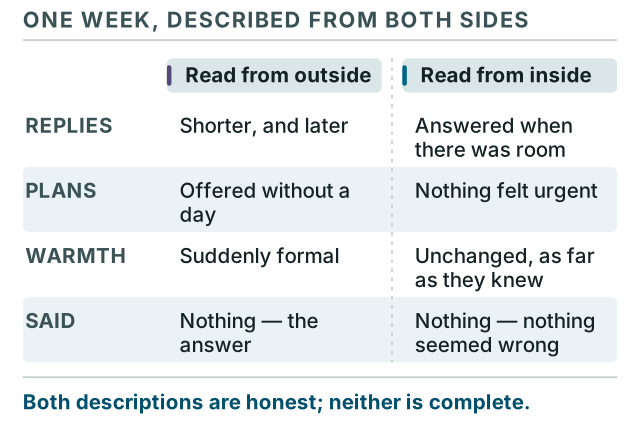
From outside, deactivation shows up as reduction rather than rupture. Replies get shorter and arrive later. Plans stay theoretically alive but lose their specifics. Conversation moves toward logistics and away from anything personal. The schedule fills with things that are all true and all newly urgent. Nothing is announced.
The details people report are strikingly consistent. Messages that used to carry a question now end in a full stop. A call becomes a text. Weekends acquire commitments that were not there before. Affection continues in a smaller, formal version, which is somehow harder to raise than its absence would be. When asked directly, the answer is that everything is fine, and the person means it.
What often does not change is practical reliability. The lift still gets given, the bill still gets paid, the thing that was promised still gets done. That combination — competent presence with the personal part removed — is what makes the change so difficult to name. There is no incident to point at, which leaves the other person feeling both certain and unable to prove it.
Competing readings of the same week are possible, and they are usually sincere. This is where the damage tends to happen: the withdrawal gets read as a verdict, the reaction to it gets read as pressure, and each reading makes the other more likely.
If the question underneath your reading is whether this is withdrawal or an actual ending, that is a different question with different evidence, and it has its own page rather than a paragraph here.
What it feels like from the inside
From inside, deactivation rarely feels like withdrawal. It feels like relief, followed by flatness, followed by mild confusion that anyone is upset. The urge for space shows up ahead of any account of it, and the account gets assembled behind it. The dominant sensation is not coldness toward the other person but the return of ordinary breathing room.
People who recognise this in themselves tend to describe a sequence. First there is a good moment, and inside the good moment something tightens. Then comes a small, private wish for the evening to end. Then a stretch of time in which the relationship is thought about less than usual and the absence of thinking feels comfortable. Only later, sometimes much later, does anything resembling guilt turn up, usually attached to a specific unanswered message.
The part that surprises partners is the genuine absence of drama. There is no plotting, no punishment being administered, no test being set. There is a nervous system that treats being needed as load, doing what it learned to do with load, quietly and efficiently.
The part that surprises the person themselves is how convincing the reasons are. Work really is busy. The friend really did need help. Sleep really has been bad. Deactivation does not require false reasons; it works perfectly well by promoting true ones to the front of the queue. That is also where change becomes possible, and the change is small: noticing the pull as it arrives, before the reasons line up behind it.
What can you do when someone pulls away?
Everything available to the person on the outside runs through one variable: how much is currently outstanding. Deactivation is load-shedding, so anything that adds load extends it and anything that removes load lets it finish. Nothing below is a technique for producing a return, and anything presented that way elsewhere should be read with suspicion.
The awkward part is that the response the situation invites is the one that feeds it. Quiet arrives, and the obvious repair is to send more: an explanation, a question about the mood in the room, an attempt to get the thing settled tonight. Each of those is an item somebody now owes an answer to, and owing answers is exactly the state the withdrawal was reducing. Deeper withdrawal raises the alarm, and a raised alarm produces more items.
| The response | What it does to the load | Why |
|---|---|---|
| A long message about the change in tone | Adds an item that cannot be answered briefly | The reply now requires an account of an internal state, which is the most expensive thing on offer |
| The same question again, in new words | Adds an item on top of the one already outstanding | Each rephrasing restarts the debt rather than clearing it |
| Going quiet in order to be noticed | Removes load there, puts the whole cost here | From the other side it registers as ordinary quiet; the strain of running it is one-sided |
| One short message that can be answered in a line | Adds close to nothing | It signals availability without stationing anybody at the door |
| Stating a limit of your own, once, then leaving it | Adds information rather than a demand | Information does not have to be answered by any particular evening |
| Holding the week open in case contact resumes | Adds nothing there and a great deal here | The waiting gets spent whether or not the pull-back ends |
Two things the table is not. It is a set of tendencies, not a set of results — nothing in the right-hand column promises what a particular person will do next. And it is written from the waiting side, about the only part of the situation that side controls. If you are the partner in this position and want the longer version, the partner section is built around exactly that question, including the part about what is not yours to solve.
If you are the one pulling away
The move that helps the person doing the withdrawing is not staying in the room by force while the pull is at full strength; that produces a stiff, resentful imitation of presence and teaches both people the wrong lesson. It is catching the pull earlier than usual, and then putting one plain sentence around it.
The sentence does not need to be perceptive. For example, I am short this week and it is not about you — ask me again on Sunday is worth more than a fortnight of careful management, because it turns an unaccounted-for absence into an announced one. Announced absences can be sat out. The version with a denial attached to it cannot, and the denial is the part that does the damage.
The harder part is the reasons. Because the reasons are true — the week really is busy — they rarely feel like something to examine. The question worth holding is not whether the reason is real, but whether the same real reason keeps arriving at the same point in the line, always just after things went well.
The letters
One letter a week, on the mechanism rather than the label
That did not go through. Nothing was saved and nothing was sent — try the address again, or write to us directly and we will add it by hand.
- What arrives
- A note when a page here is rewritten or a new one goes up, with one line on what changed.
- What does not
- Assessments, quizzes, coaching offers, anything that claims to tell you what someone else is.
No scripts for changing another person. Unsubscribe anytime.
What is worth saying, and what lands badly?
Sentences that land tend to be short, specific, about one thing, and phrased as your own information rather than as a diagnosis of the other person. Sentences that land badly tend to require an immediate emotional answer, arrive in stacks, or open with a summary of what the other person is doing wrong.
A workable message usually contains what you noticed, what you would like, and an explicit permission to answer later — and nothing else. This week has felt quieter. I would like to see you on Saturday. If that does not work, tell me and I will leave it there. It is unglamorous, and its whole value is that it can be answered in a line by somebody who currently has very little to spare.
What reliably raises the pressure is easier to list. We need to talk, sent with no subject attached, converts a phone into a scheduled interrogation. Questions stacked in a row leave no answer that is not a paragraph. Naming the pattern at the person — telling someone they are avoidant, or that they have an attachment problem — turns a conversation into a defence. Apologies for having needs teach both people that the needs were the fault.
There is also the timing question. A message sent into a quiet stretch and then followed by more in quick succession is a different message by the end of it. One sentence, then genuine absence from the conversation, is not a strategy; it is what leaves the other person space to answer as themselves rather than as someone under review.
None of this makes anybody reply. It is worth being blunt about that, because writing on this subject often implies otherwise. What careful phrasing does is remove your own contribution to the escalation, which is the only side of it you control.
How long does deactivation last?
Nobody can tell you how long deactivation lasts, and any source giving a range has produced it from nothing. What the length appears to track is set out in the table below: whether the thing that raised the pressure is still in the room, what returning would immediately cost, and whether a decision has already been taken privately that makes the whole question the wrong one.
That answer is unsatisfying, so it is worth saying why the alternative is worse. A published interval becomes a countdown. The countdown turns ordinary days into evidence, and when the day passes without contact, a person who was managing reasonably well is handed a reason to conclude something that was never actually measured.
| Condition | Direction it seems to push things |
|---|---|
| The pressure that started it has dropped away | Shorter |
| Returning would mean an immediate conversation about the absence | Longer |
| The relationship has an established rhythm to come back to | Shorter |
| An ending has already been decided privately | The pull-back is not what is happening at all |
There is one pattern worth knowing about, and it is a shape rather than a schedule. Pull-backs often end when the pressure drops, which frequently means they end at the point where the other person has genuinely stopped waiting. That timing looks cruel from outside and is usually not about the other person at all. It is described properly in the cycle, which is where the loop, rather than the single episode, gets taken apart.
Some practical notes for the person waiting. A pull-back that repeats in the same shape is information about how the relationship works, which is more useful than any estimate of its length. And the question you can actually answer is not how long this will last, but how long you are prepared to live in a holding pattern before the answer stops mattering.
What is deactivation not?
Deactivation is a response to closeness, which means the readings people reach for most often do not fit it. It is not punishment, not a strategy, not proof that a relationship has ended, and not evidence that anybody did something wrong. Ruling those out matters, because each one sends the reader somewhere expensive and hard to come back from.
What deactivation is not
Some readings of this behaviour are common, and each one costs the reader something. They are worth ruling out explicitly.
- It is not punishment
- Reduced contact is not a message being delivered by silence. In the descriptions people give, there is often no intended recipient at all — the pull toward space arrives first, and the reasons for it are assembled afterwards.
- It is not a game or a strategy
- Nothing here is a manoeuvre designed to make someone chase. Treating it as one leads directly to counter-manoeuvres, and those reliably make the situation worse for the person attempting them.
- It is not proof the relationship is over
- It is also not proof that it is fine. A pull-back is compatible with very different outcomes, and reading it as a verdict in either direction is the one thing the behaviour genuinely cannot support.
- It is not evidence that you did something wrong
- The trigger is usually closeness rather than a mistake, which is precisely why the standard search for the offending moment turns up nothing and keeps going anyway.
- It is not a diagnosis, and we do not print timelines
- This page describes a pattern of behaviour, not a condition in a person. It carries no figures and no intervals, because the numbers that circulate could not be traced to a source we had actually read.
What this page does stand behind
- Behaviour, described plainly
- What gets said, what stops being said, and what happens to plans — in place of adjectives about somebody's character.
- A stated edge
- Where description stops being useful, the page says so instead of continuing in the same confident tone.
- A check date on the page
- You can see when this wording was last looked at before deciding how much weight to give it.
Where this page stops
This is a description of a relationship pattern, written for people trying to understand a confusing stretch of time. It is not clinical material, and it cannot distinguish between the pattern described here and something that needs proper assessment. Withdrawal that arrives with sustained low mood, withdrawal that follows a frightening event, or a relationship in which the dominant feeling is fear rather than distance are all questions for a qualified professional rather than for a website, and they are worth raising sooner rather than later.
The page also stops at the boundary of the individual case. It can tell you what this pattern tends to look like. It cannot tell you what a particular person feels, whether they will return, or whether staying is the right decision for you — and a page that answers those has substituted confidence for information. What this guide is built from, and where the language originally comes from, is set out on the sources page.
The sections below this one take the mechanism apart at closer range: closeness as the trigger in withdrawing from intimacy, and the repeating version of the same shape in the cycle.