Working on avoidant attachment means a long run of small tolerated moments rather than a single breakthrough. The search that leads here is usually typed as how to fix avoidant attachment, and the wording matters, because it sets an expectation this section cannot meet. There is no repair procedure at the end of it. What there is instead is a fairly small, fairly dull set of moves that people describe making over a long stretch of ordinary life, in brief moments rather than set-piece conversations.
This section is written for the person who recognised themselves rather than a partner. If you arrived looking for a way to change somebody else, the honest answer is that no such method belongs on this site, and the pages written for partners deliberately stop at the same line.
A framing decision before anything else. Nothing on this site is treated as an illness, and the vocabulary of illness is kept off it deliberately: what gets described is something a person does under pressure, not something they have. That is not politeness. It is the difference between a habit that can be studied in the middle of a Tuesday and a verdict that can only be carried around.
Can avoidant attachment be fixed?
Working on avoidant attachment means changing what happens automatically when closeness rises, not removing the wish for distance. People who describe progress talk about noticing the pull earlier, acting on less of it, and saying something about it afterwards. The wish for space stays; the speed at which it takes over is what moves.
The searches that lead to this page want the same thing: how to fix avoidant attachment and how to heal avoidant attachment. Both are asking whether the automatic part can stop being automatic. The answer that seems supportable is yes for the automatic part, and no for the pull itself, which people tend to describe as a lasting feature of how they handle load.
This guide avoids the language of medicine for it, and that avoidance is deliberate rather than squeamish. Nothing here is broken in the way a bone is broken. The pattern was, at some earlier point, a working solution to a real situation — it lowered the cost of needing someone who was not reliably available. Where the pattern comes from covers that history, and it is worth reading with one caution held firmly: an origin explains a habit, it does not supply a method for ending it.
The other reason for the careful wording is that repair language quietly changes the goal. If the target is a person who no longer wants space, the work fails on the first bad week and gets abandoned. If the target is a shorter gap between the pull arriving and the pull being noticed, the same bad week is simply data. One version survives contact with reality. The other does not.
There is also a version of this that is not about relationships at all, and it deserves saying plainly: some people arrive here wanting to be less tiring to themselves. Less of the flatness after a good evening, less of the private argument about why an unanswered message has been sitting there unread. That is a legitimate reason to do any of this, and it does not require a partner to be in the picture.
A note on the other phrase people search with, how to stop being avoidant. Taken literally it asks for a different person to be installed, which is not on offer anywhere. Taken as it is usually meant — stop doing the thing that keeps costing me relationships — it is the same request as everything below, and it has a workable shape. The older term in the literature, insecure-avoidant attachment, describes the same pattern in flatter language and carries no instruction at all.
Something that surprises people: the work is rarely about becoming more expressive. Nobody needs to turn into a person who narrates their inner weather. What changes is much smaller and much less performative — a reduction in the exits taken automatically, and an increase in the absences that get labelled. Expressiveness is a style. This is a habit.
How do you notice the pull toward distance?
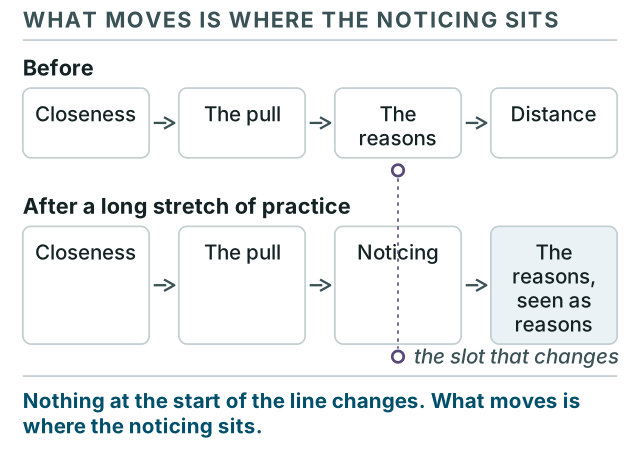
The first half of the work is recognising deactivation while it is happening rather than after it has finished. The pull toward distance arrives before any thought about it, and the reasons follow close behind, sounding entirely sensible. Noticing means catching the sequence in the right order: the pull came first, the reasons came second.
The mechanics of that shift are described in detail in deactivation, which is the engine underneath most of this site. What matters here is the practical consequence. Because the reasons are usually true — the week really is busy, the friend really did need help — they cannot be spotted by checking whether they are accurate. They can only be spotted by their timing.
So the question people teach themselves to ask is not is this a real reason. It is why did this real reason arrive now, immediately after something went well. For example, a heavy work stretch that starts on a Monday is a heavy work stretch. A heavy work stretch that starts the morning after an unusually honest conversation is worth a second look, and the second look is the entire skill.
People describe reliable tells for themselves. For instance, a sudden preference for logistics over anything personal. Relief at a cancelled plan, arriving faster than disappointment. A mental list of the other person’s flaws assembling itself without being asked for. The phrase I just need to get on top of things turning up in an internal monologue that had no such phrase in it before.
None of that is pleasant to catalogue, and there is a trap in the cataloguing. Turning the list into a private prosecution — treating every wish for an evening alone as a symptom — produces a person who is anxious about their own solitude and no closer to anything. Ordinary solitude is planned, announced, and returned from. The version being tracked here is the unplanned kind that follows closeness.
One practical note about where noticing is easiest to learn. It is easier to catch in retrospect, and the retrospective version is not a consolation prize — it is the first rung. Reconstructing a thin week afterwards, honestly, in the order things actually happened, appears to be what makes the in-the-moment version possible later. Skipping to the live version tends to produce nothing but frustration.
How do you stay in contact when distance feels better?
The second half is tolerating contact slightly past the point where distance becomes attractive. Not a heroic stretch, and not a test of endurance: one more question answered properly, one evening not shortened, one message sent while the pull is still on. The interval is small on purpose, because a large one gets abandoned.
The word people keep reaching for is exposure — staying in a situation that reads as expensive until it stops reading that way quite so loudly. What that looks like in practice is unspectacular. Answering the question that was actually asked instead of the easier one next to it. Staying at the table for the last part of the conversation. Not converting a call into a text at the moment the call gets personal.
There is a version of staying that does not work, and it is worth naming. Forcing presence while the pull is at full strength, without saying anything about it, produces a stiff, resentful imitation of contact that both people can feel. The relationship gets the body and none of the person, and the experience gets filed as evidence that closeness is unbearable, which is the opposite of the intended result.
What appears to make the difference is saying one true sentence out loud while it is happening. I have gone quiet and it is not about you. I want to leave and I am not going to, and I do not entirely know why I want to. Those sentences are unimpressive on paper and do a surprising amount of work, because they convert an unexplained absence into a known one. A stated absence can be waited out by the other person. An absence that is being denied while it happens cannot.
There is a limit to this, and it belongs on the honest side of the ledger. Staying in contact is useful when the relationship is safe to stay in. If the reason you want distance is that something in the relationship is frightening or coercive, this section does not apply to you, and no attachment framing should be used to talk you out of leaving.
A question that arrives here often: what if there is no relationship to practise in. The pattern shows up in friendship, in family, and at work, and the tolerated stretch does not require a partner. For example, answering a friend’s message on the day it arrives, when the pull says leave it until the week is calmer, is the same move in a lower-stakes setting.
Pace deserves its own sentence, because the failure mode is predictable. People who decide to work on this often begin by attempting a large, sustained increase in closeness — a candid conversation, a commitment, a stretch of unusual availability — and then vanish for a long stretch, which leaves everyone worse off than before. Small and repeated beats large and abandoned.
What do people actually do to work on avoidant attachment?
The named practices are few, and they fall into a handful of groups: writing something down, slowing the exit, and bringing a second person in. This guide lists what people say they use and refuses to rank them, because no honest ranking is available here — effectiveness claims about any of these would need evidence this site does not have.
Journaling is among the practices people name, and the useful version is narrower than the word suggests. Not a diary of feelings, which people who lean avoidant often find close to impossible to produce, but a log of moments: what happened just before the pull arrived, what reason showed up, what got done about it. Written in the tense of events, it is a record a person can actually keep.
Meditation and body-based practice come up as well, and the reported reason is consistent enough to report: not calm, but noticing. The thing being practised is catching an internal state early, which is the same skill the first half of this page describes, rehearsed in a setting where nobody is waiting for a reply.
Therapy comes up too, and this site has no stake in whether you pursue it. What people describe getting from it is not insight, which is usually available for free, but a second person who notices the withdrawal while it is happening and says so — the exact function that is hardest to perform for yourself.
| The practice | What people describe it doing | What it does not do |
|---|---|---|
| A log of moments, not feelings | Makes the timing visible: the pull, then the reason, in that order | Change anything by itself; the log is a record, not an intervention |
| Noticing practice, seated or moving | Rehearses catching an internal state early, with nothing at stake | Produce calm on demand, or transfer automatically into a live conversation |
| Saying one sentence while the pull is on | Converts an unexplained absence into a stated one | Oblige the other person to be fine with it |
| Not shortening the last part of an evening | Provides the small tolerated stretch the pattern needs to update on | Work as an endurance test, which reliably backfires |
| Working with a professional | Adds a second person who notices the withdrawal in real time | Guarantee an outcome, and this site makes no claim about how well it works |
| Reading about the pattern, including this site | Supplies accurate description and takes the mystery out of a confusing week | Substitute for doing any of the above in an actual relationship |
What is deliberately absent from that table is a schedule. Instructions of the every morning, for a set stretch of time variety are everywhere in this subject, and they carry an implied promise about time that nobody can keep. Where a practice suits you, its rhythm is yours to find.
The letters
One letter a week, for the person doing the work
That did not go through. Nothing was saved and nothing was sent — try the address again, or write to us directly and we will add it by hand.
- What arrives
- A note when a page here is rewritten or a new one goes up, with one line on what changed.
- What does not
- Assessments, quizzes, coaching offers, anything that claims to tell you what someone else is.
No protocols, no promises about outcomes. Unsubscribe anytime.
What does movement actually look like?
Movement usually shows up as recovery speed rather than as the disappearance of the pull. The distance still happens; it ends sooner, and something gets said about it afterwards. People report noticing the change in retrospect — a week that once would have cost far more passes and gets repaired without either person having to make a case.
The order in which things move is fairly consistent in what people describe, and it is worth knowing in advance, because the first change is invisible and the visible ones come later. Noticing arrives first, uselessly at first: the pull gets recognised on the way out, after the week is already thin. Then it gets recognised during. Then, occasionally, before.
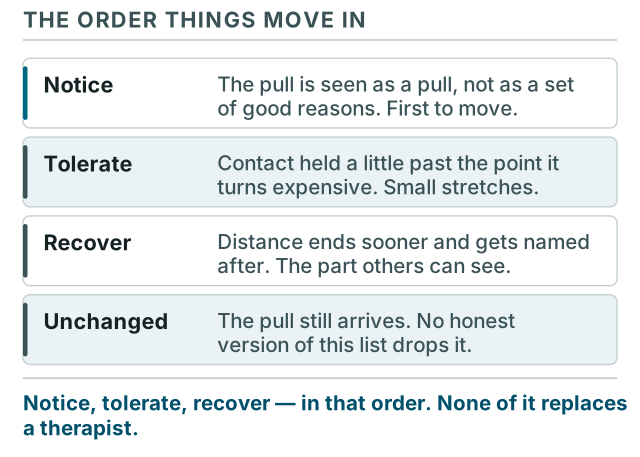
The second marker is language. Somebody who is moving tends to start describing the withdrawal out loud, badly and late, and the badly and late part is the point — an awkward sentence long after the fact is a change of category, not a change of degree. The week stops being quietly rewritten as an ordinary busy one.
Some things do not belong on the list of markers. Comfort is not among the early arrivals, and its absence proves nothing either way; the descriptions people give of the first stretch are mostly of it being harder than before, because noticing removes the option of not knowing. And the pull returning under stress is not a failure. Illness, grief, overwork and conflict all raise the cost of closeness, and the practised moves come back because they are the practised ones.
Whether any of this counts as the pattern itself changing is a separate question, asked most often by the person waiting for it rather than the person doing it, and it is answered on its own page: can it change, and what would that look like. The short version is that recovery speed is what people point to, and a promise is not evidence.
Other people usually notice something before the person does, and what they report noticing is rarely warmth. It is predictability: absences that get flagged in advance, returns that arrive without a cover story, and questions about the relationship that no longer end the evening. That is a low bar in the abstract and a substantial change in practice.
Where this stops being self-help
This guide stops where description stops being enough. It can name a pattern and describe what people report doing about it; it cannot assess a particular person, replace a professional relationship, or promise that any of this will work in your situation. Where that limit sits is set out below.
What this section does not do
A page about working on an attachment pattern is exactly where overreach is most tempting and most expensive. These are the lines this guide holds.
- It does not hand you a protocol
- There is no set of exercises here with a fixed duration attached and an outcome implied. Practices are described the way people describe using them, and their rhythm is left to the person doing them.
- It does not promise an outcome
- Nothing on this page can tell you that a particular relationship will improve or that a particular effort will succeed. Descriptions of what tends to move are not forecasts about you.
- It does not print timelines or success rates
- No intervals, no percentages, no figures about how well any approach works. The figures circulating on this subject could not be traced to a source we had actually read, so they are not repeated here.
- It does not diagnose anybody
- Avoidant attachment is a descriptive frame from attachment writing, not a condition someone has. This section describes behaviour patterns and refuses the language of illness for them.
- It is not treatment, and does not replace it
- This is editorial material. Where a professional relationship is what the situation calls for, this page says so plainly rather than positioning itself as the cheaper option.
What this section does stand behind
- A small, describable set of moves
- Notice, tolerate a little longer, say one true sentence. It is unglamorous, and it is what people actually report doing over long stretches.
- An honest account of what moves first
- Recovery speed and language, not the disappearance of the pull — including the part where the early stretch feels worse rather than better.
- Dated, not evergreen
- The month of the last check is printed, so material that has aged is identifiable as aged.
Where this page stops
This is a description of a behaviour pattern written for general readers, and it cannot tell the difference between the pattern described here and something that needs proper assessment. Withdrawal that comes with sustained low mood, difficulty functioning, or thoughts of harming yourself is a question for a qualified professional, not for a website, and it is worth raising sooner than most people do. The same applies to withdrawal that began after a frightening event.
The page also stops at the boundary of your particular case. It can describe what people in this pattern tend to do and what tends to move. It cannot tell you whether your relationship should continue, whether a specific practice suits you, or how long anything takes — and anything that answers those confidently has made the answer up. What this guide is built from, and where its language originally comes from, is set out on the sources page.
One more boundary, stated once and not laboured. If you are here on behalf of someone else, hoping to run this section at them, the outcome is reliably the opposite of the intended one. Being told you are avoidant turns a conversation into a defence. The pages written for partners handle that question with the same limits attached.
The rest of this section
This section has a companion page, and it takes the question this one leaves open. If you want to know whether the pattern itself can shift, what people accept as evidence of it, and why the question is usually asked by the person waiting rather than the person changing, read can it change, and what would that look like.
For context underneath all of it, the mechanism that this work is aimed at lives in deactivation, the history behind the habit is in where the pattern comes from, and the plain description of the pattern itself is on the main guide.