Why do avoidants come back at all?
Avoidant returns are what happens when distance removes the demand rather than the bond. A breakup cancels the obligations that made closeness expensive without cancelling the attachment underneath them, and an attachment with nothing owed on it is an easy thing to feel. Contact becomes possible again for exactly the reason it became hard: the pressure moved.
That sentence covers the core of what searches for whether avoidant partners come back are reaching for. In this pattern, closeness and its cost travel together. Being in the relationship means being expected, being asked about, being available. Distance turns all of that off at once, and what stays behind is the part that was wanted without the part that was heavy.
There is another reason, quieter than that one. During a separation the relationship is remembered rather than lived, and memory keeps the good evenings and drops the ordinary Tuesday that carried an expectation in it. The version being missed is lighter than the one that ended. That gap between the remembered relationship and the actual one is part of why returns can feel sincere to the person making them and confusing to the person receiving them.
None of that makes a return a reversal of the decision that ended things. The conditions that produced the withdrawal are still there, waiting on the other side of reconnection. The mechanism itself, including how it runs inside a relationship rather than after one, is described in full on the avoidant cycle. This page picks it up at the point where the relationship has already ended.
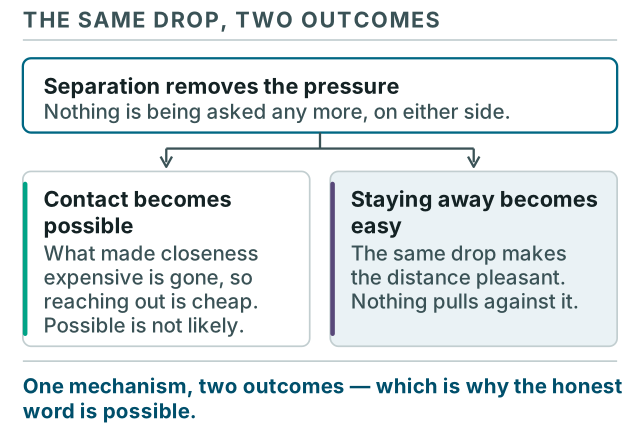
The dashed branch matters as much as the solid one. Relief is stable. A person whose pressure has dropped is not in distress about the distance, and comfort is a poor motor for reaching out. Both outcomes come out of the same mechanism, which is exactly why the mechanism cannot be used as a prediction.
What do people notice before an avoidant reaches out?
There is no signal that establishes what somebody is going to do. What exists is a set of behaviours partners report noticing in the period before contact resumed, reported also by people for whom nothing followed. Read as description they are useful. Read as evidence of an intention they are misleading.
A message with almost nothing in it. The openings people describe are small: a link, a question about a returned item, a comment on something shared long ago. The size is not accidental. A low-stakes message tests whether contact is available without putting anything at risk, and it can be walked back if the answer is cold.
A reappearance rather than a message. For example, watching stories after a long silence, a like on an old post, turning up at a place both people used. This is contact that does not require being answered, which makes it the cheapest kind available in this pattern.
A practical pretext. For instance, a box of belongings, a shared subscription, a mutual friend’s birthday. The pretext gives the contact a reason that is not about the relationship, and people who lean avoidant describe needing that cover to make the first move at all.
Warmth in a channel that carries no obligation. For example, long replies at odd hours, an unexpected memory raised, an old joke. Partners describe this as the confusing part, because it reads as intimacy while the practical questions stay untouched.
Unblocking, or the quiet undoing of a cut-off. Where contact was severed, the reversal can be silent: the number works again, the account is visible again, and nothing is said about either. What that means is genuinely ambiguous. It can precede a message, and it can be the whole of it.
Some cautions belong with that list, and they matter more than the list. One is that each item describes a behaviour, not a state of mind, and reading someone’s feelings from a viewed story is guesswork with an emotional cost attached. Another is that the same behaviours are described in accounts where contact never went further. A pattern that produces returns also produces near-returns, and from the outside they look identical until one of them continues.
The comparison this raises is with the opposite reading, and that is covered separately in signs an avoidant is done, where the same problem appears in reverse: behaviour that looks final is not proof either.
What does it mean when an avoidant comes back?
A return is evidence that pressure dropped and that the connection was real enough to pull someone back toward it. It is not evidence of a changed mind about the relationship, of new conditions, or of a plan. A recurring mistake is treating reconnection as an answer to the question the breakup asked, when it answers a different one.
Held next to each other, those readings explain the disappointment that can follow a reunion. Someone reappears with real warmth, and the person receiving it reasonably hears an implicit promise: this has been thought about, something has been decided. Nothing may have been decided at all. What changed was the weight, not the position.
| Reading | What the return supports | What it does not support |
|---|---|---|
| About the bond | That the connection mattered and did not vanish with the distance | That the relationship was misjudged, or that the ending was staged |
| About the pressure | That the demands which made closeness costly are currently absent | That those demands will feel different once the relationship resumes |
| About intention | That contact felt available enough to attempt | That a decision about commitment has been made |
| About the silence | That the quiet had a mechanism behind it | That the quiet was punishment, a test, or a strategy |
| About what happens next | Nothing. Reconnection describes the present moment only | Any timeline, any repetition, any outcome |
It also does not settle the question underneath a reunion, which is whether the same sequence runs again. Nothing on this page can tell you that. What accounts describe is that the return arrives at the light end of the relationship and that the weight returns with the relationship itself, which is why reconnection without anything else changing tends to arrive back at the same place. That is not a prophecy about a specific couple; it is the shape people describe.
Another distinction, and it is the one that gets skipped. Understanding why somebody came back does not oblige anyone to be there for it. A return that is explainable can still be more than a person wants to live through again, and the question of what you want is separate from the question of what they are doing. What they are doing is the question this page can help with. What you want is yours.
The letters
No forecasts and no timelines — just the next page when it lands
That did not go through. Nothing was saved and nothing was sent — try the address again, or write to us directly and we will add it by hand.
- What arrives
- A note when a page here is rewritten or a new one goes up, with one line on what changed.
- What does not
- Assessments, quizzes, coaching offers, anything that claims to tell you what someone else is.
No spam, ever. Unsubscribe anytime.
What should you do when an avoidant reaches out?
What tends to help is deciding what you want from contact before deciding what to type. People describe the first message after a silence as smaller than the silence was, and as arriving without an account of what happened. They describe answering it in a rush and regretting the speed rather than the answer.
There is no script here. Scripts sold for this work by applying pressure, and pressure is the input that produced the distance in the first place, so a technique for extracting a particular reply is both dishonest and self-defeating. What can be described are the choices people actually face and what they report about each.
Answering, at your own pace. Nothing requires a reply within any window. Taking the time to notice what you feel before responding is described as useful in a way that no particular wording is. The message will still be there tomorrow, and so will the choice.
Asking what the contact is for. A direct, unhostile question about what someone is asking for is a move partners describe as clarifying. It is uncomfortable because it forecloses the possibility of an ambiguous warm stretch, which is precisely the reason it is worth asking.
Naming what you would need. If reconnection is something you want, the conversation people describe as worth having is about what would be different, in behaviour rather than in feeling. That is a conversation with a real chance of not going anywhere, and knowing that early is better than learning it slowly.
Declining. A message does not create an obligation. People describe leaving one unanswered and finding the decision harder than the outcome. Not replying is a complete answer, and it does not require justification to anyone.
Waiting without disappearing into it. Some people choose to hold off responding while they think. That is workable when it is a genuine pause and corrosive when it becomes a strategy for producing a reaction, because a silence that is being monitored costs the person keeping it far more than the person receiving it.
The question of when to break a period of no contact belongs here in a narrower form than it is normally put. Distance that you keep because it is protecting your own week is one thing. Distance kept as a lever to produce an outcome is a different thing wearing the same clothes, and it puts your recovery on someone else’s schedule. General rules about no-contact strategy after any breakup are a whole subject of their own and not what this site covers; what we can say is attachment-specific, and it is this: silence lowers pressure whether or not you intended it as a message, so it is not a signal you control.
A last note on the returns that arrive after an ending that felt abrupt. Where the breakup itself came with little warning and little explanation, reconnection tends to land harder, because there is no shared account of what happened for it to attach to. That kind of ending has its own page in avoidant discard, and the reading offered there matters here: an ending without an explanation is not the same as an ending without a cause.
Why does nobody know how long it takes?
We do not answer how long it takes, because we cannot. There is no duration we can trace to a named source, and an invented figure would be repeated by someone counting days against it. Order can be described. Spacing cannot.
The cost of a fabricated timeline is not abstract. A number turns a description into a countdown, and a countdown gives the waiting a shape that hurts: the day it passes becomes evidence of something, when it is evidence of nothing at all. That is why this site publishes no figures anywhere, and this page is where the rule earns its keep.
What this page does not do
People hoping for a forecast land on this page. That is exactly why the limits are printed rather than implied.
- No timelines
- We give no window for how long a return takes and no figure for how frequent one is. The numbers of that kind circulating on this topic trace back to somebody's guess, and a guess with a decimal point in it is still a guess.
- No prediction about your situation
- Nothing here can tell you whether a particular person will get in touch. The same mechanism that produces returns also produces permanent distance, and from the outside the two are indistinguishable until one of them happens.
- No methods for producing a return
- We do not publish techniques for making somebody miss you, chase you, or reconsider. They work through pressure where they work at all, and pressure is the input this pattern retreats from. We also think they are a poor way to treat a person.
- No reading of anyone's mind
- A viewed story, a slow reply and an unblocked number are behaviours. What they meant is not visible from where you are standing, and the confident interpretations available online are not better informed than you are.
- No diagnosis
- Avoidant attachment is a descriptive frame from attachment theory, not a condition and not a verdict on a former partner. This page describes a pattern of behaviour and never a person's character.
- No advice about staying or leaving
- Whether to answer, to meet, or to try again is a decision with your life in it. We can describe what people report about each choice; we cannot make it, and anyone who makes it for you online is guessing about a stranger.
What we do stand behind
- The mechanism, stated plainly
- Distance lowers the pressure that produced the withdrawal, which makes contact possible again. That is describable, and it is the whole of what a return reliably shows.
- The line where we stop
- Where the question becomes clinical or becomes a safety question, we say so instead of answering it. The sources page lists what this was built from.
If a timeline is what you came for, the closest thing we can offer instead is the order of events on the diagram above, and the observation that people report waiting badly when they are waiting against a date. Waiting without one is not easier, but it is at least not measured against a deadline that somebody made up.
Where this page stops
This page describes a behavioural pattern from attachment theory as people report living it and noticing it. It cannot tell you what a specific person is feeling, why a specific relationship ended, or whether a specific message means what you hope. Avoidant attachment is also not the only reason someone reappears after a silence, and treating it as the explanation for every ending is a way of getting things wrong confidently.
Where the question is about grief that is not lifting, about a low mood that has stopped responding to ordinary things, or about anything that reads as clinical, this is the wrong kind of page and a qualified therapist is the right place to take it. The same applies with more urgency if the relationship involved fear, coercion or being controlled rather than distance. That is a safety question, not a pattern question, and it needs a professional rather than an article.
The wider set of pages on endings sits on our breakup hub, and the material this site works from is listed on the sources page.