
Texting an avoidant is texting into a medium that demands a response, leaves a record and offers no quiet exit, which is why the same person can run warm in a room and short on a phone. The usual advice about how to text an avoidant is a script: the message that supposedly gets a reply, the wait that supposedly resets interest. This page does neither. It describes what the common texting scenarios usually mean when someone leans avoidant, what they do not mean, and why the volume of messages is the variable that moves the outcome in a predictable direction.
Why is texting harder than talking?
Texting concentrates what a pattern built on self-reliance handles badly. It demands a response, so silence itself becomes an answer. It is visible, so the gap between the message and the reply is on the record for both people. And it leaves a written trace, which turns a passing sentence into something that can be re-read later.
For example, a conversation in a kitchen can be started sideways, paused for a task and picked up later without anyone naming what happened. A thread does not allow that. The pause is timestamped, the subject stays open on the screen, and a message left unanswered keeps asking. What was an easy medium for one person becomes a standing request for the other.
Another difficulty is the absence of pacing information. In a room, tone and posture do most of the work of signalling how much a question weighs. In a thread, a light question and a heavy one look identical, so the safer assumption is that any question might be heavy — which is a good reason to answer it later, when there is capacity for the heavy version.
None of this makes the medium unusable. It does mean that the same relationship can run warmly in person and coldly on a phone, and that reading the phone as the truer signal is usually a mistake. The mechanism underneath the withdrawal is described in avoidant deactivation.
The scenarios
The situations below come up again and again. Each has a common reading and a more likely one, and the gap between them is where the damage usually gets done.
A message left unanswered. The usual meaning is that the reply has a cost attached and the cost has not been paid yet. A message that needs a considered answer gets moved to a slot with capacity in it, then the slot gets missed, then the message has been outstanding long enough to feel awkward to answer at all. Silence compounds itself. What it does not usually mean is that the relationship was reassessed and downgraded overnight.
The “typing” indicator that appeared and vanished. This is a draft being written and deleted, and it tends to appear on the messages that matter. Something was composed, read back, judged as too much or not enough, and dropped. It is evidence of effort rather than of indifference — which is the opposite of how it is usually read on the other side of the screen.
One-word answers. A short reply is often the version that could be sent right now instead of the fuller one that could not. It keeps the thread alive at the lowest available cost. Reading it as contempt and responding with more words tends to produce even shorter answers, because the cost of the next reply just went up. For instance, the same thread often warms again the moment the subject changes to something practical, which is the clearest sign that the shortness belonged to the demand rather than to the person asking.
Read, and no answer. The receipt is the reason this one stings, and the receipt shows only that a screen was lit. For example, messages get opened in queues, at work, half-attended. Being seen is not the same as being processed, and the pattern’s habit of deferring a demanding reply survives contact with a blue tick.
| What happened | How it usually reads | What it more often means |
|---|---|---|
| A message left unanswered | You have been dropped | A reply with a cost, postponed and then compounded by the delay |
| “Typing” appeared, then stopped | They changed their mind about you | A draft written and deleted; effort, not indifference |
| One-word answers | Contempt, or boredom | The cheapest reply that keeps the thread open |
| Read, no answer | Deliberate ignoring | Opened in a queue, deferred, and then awkward to return to |
| Warm in person, flat on the phone | The phone is the real signal | The medium removes pacing; the room restores it |
Why do replies from an avoidant come slower?
The variable that moves the outcome more reliably than any wording is how much the thread asks for. Volume, urgency and emotional accounting all raise the cost of the next reply, and a reply with a higher cost arrives later. That is the whole loop, and it runs without anyone intending it.
The sequence is easy to trace after the fact. A message asks something that needs a real answer. The answer gets deferred. The delay is read as distance, so another message arrives asking about the silence. Now more replies are owed, one of them about the relationship itself. The cost has risen and the delay grows accordingly.
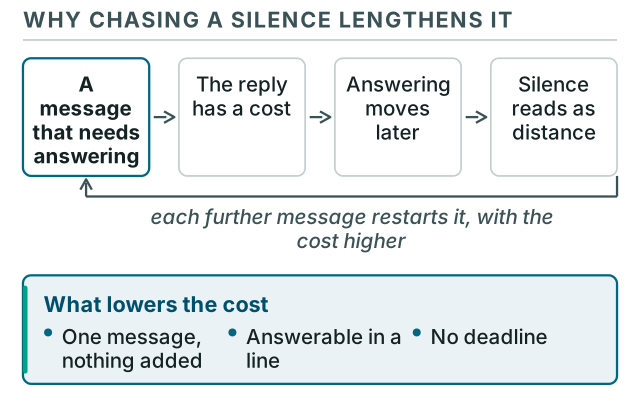
What raises the cost most sharply: asking for an account of feelings, attaching an outcome to the answer, and stacking messages while one is outstanding. What lowers it: a subject that can be answered in a line, an invitation with a stated plan and an easy way to decline, and contact that carries no request at all.
Asking someone out over text follows the same rule. A specific offer with a time and a way to say no — a thing, a day, no obligation — is easier to answer than an open question about availability, because an open question hands over the work of proposing, deciding and committing at once.
The letters
Occasional letters, none of them scripts
That did not go through. Nothing was saved and nothing was sent — try the address again, or write to us directly and we will add it by hand.
- What arrives
- A note when a page here is rewritten or a new one goes up, with one line on what changed.
- What does not
- Assessments, quizzes, coaching offers, anything that claims to tell you what someone else is.
No spam, ever. Unsubscribe anytime.
How do you reach out to an avoidant after a silence?
After a long gap — a stretch of no contact, whether chosen or drifted into — the first message is doing one job: showing that contact is available without asking for a reckoning. Anything that opens with the silence itself — where you went, why you stopped, what this means — asks the hardest possible question first, and the hardest question is the one most likely to be deferred again.
What tends to travel better is small, specific and non-accounting. Something that connects to a shared reference, needs no explanation of the gap, and can be answered in a line or ignored without a scene. The message is not a test, and treating the reply as a verdict on the whole relationship usually leads to a follow-up message that undoes the first.
The silence itself is worth reading correctly. Distance in this pattern often runs on relief rather than on decision, which is why contact sometimes resumes as though nothing was announced. What that resumption does and does not indicate is covered in do avoidants come back.
A gap that has to end with a real conversation is usually better ended in person or by voice, with the thread used only to arrange it. The framing that makes those conversations land, rather than shut down, is set out in how to communicate with an avoidant partner.
What does no reply actually prove?
A thread is thin evidence. It records timing and wording, and neither of those carries the reason behind them. The readings below are the ones this page will not offer, because the medium cannot support them.
What this page will not tell you about a silence
The most-shared texting advice sells certainty the medium cannot deliver, and the certainty is the part that causes harm.
- A set time to wait
- The wait times circulating online have no source behind them, and this site publishes no figures at all. A rule expressed as a countdown turns an unpredictable person into a schedule and then blames the reader when the schedule fails.
- A message that gets a reply
- There is no wording that reliably produces a response, and the scripts sold as such are pressure in a friendlier font. What can be improved is the cost of answering, not the odds of any single sentence landing.
- Silence read as a verdict
- A slow reply is not a ranking of importance, and a fast one is not a commitment. Threads reflect capacity, timing and habit rather than a decision that has already been made about someone.
- Advice on withholding contact
- Deliberately going quiet to provoke a response is a tactic, not a boundary. It works on the same pressure the pattern is already struggling with, and it usually buys a reply at the cost of the thing the reply was meant to prove.
What a thread can honestly show
- Direction over time
- Not any single gap, but whether contact returns without being chased, repeatedly, over a stretch of time.
- Whether stated space is kept
- Saying that a reply will come later, and then sending it, is a different pattern from vanishing without information.
Silence that persists without any signal is a separate matter from a slow reply. Being left without information indefinitely is not something an attachment description excuses, and a person deciding what they will accept does not need the pattern’s permission to decide it.
Where this page stops
This page describes a behavioural pattern in one medium. It cannot say what a particular silence meant, whether the person on the other end leans avoidant at all, or what else might explain a change in contact — illness, overload, another relationship, or a decision already made and not yet said out loud. Attachment language is a descriptive frame, not an assessment of anyone.
If waiting for replies has taken over sleep, work or peace of mind, that is worth raising with a therapist, who can ask the questions a page cannot. The rest of the early-stage material sits in dating someone avoidant, and the reading behind these descriptions is listed in sources.