Why “we need to talk” lands badly
Communicating with an avoidant partner means keeping a conversation low-stakes, unscheduled and escapable. Most attempts start instead with a sentence people reach for because it seems considerate. We need to talk is a warning, offered so nobody is ambushed. What it actually does is announce that stakes exist before saying what the subject is, which leaves the other person holding a serious conversation with no content in it.
Everything about the framing raises pressure at once. There is a problem, it is big enough to require notice, the outcome matters, the length is unknown, and there is no version of the evening where the conversation does not happen. For a pattern that steadies itself by keeping distance available, that combination is the least workable one on offer.
The gap between the announcement and the conversation does the rest. Time spent waiting is time spent rehearsing the worst available version of what is coming, and the person who arrives at the table has already had the argument alone. What looks like defensiveness from the outset is often the residue of that rehearsal.
None of this makes the partner who said it wrong. Giving notice is a reasonable, generous move that works in other contexts. The misfire is structural rather than personal: a considerate framing and a pressure-sensitive pattern produce a bad outcome without anyone behaving badly. The wider version of this — pursuit meeting distance — sits on the partner hub, and the mechanism underneath it is described on deactivation.
How do you make an avoidant partner feel safe enough to talk?
Timing, setting and the exit move the outcome more than wording does. They are unglamorous, which is why advice about talking to an avoidant partner tends to skip past them in favour of phrasing, and phrasing matters least of them.
Timing is about what the nervous system is already carrying. For instance, a subject raised at the end of a hard week, late at night, or in the hour after a previous disagreement arrives on top of a full load. The same subject raised in an ordinary stretch, when nothing is pending, is a different request even if the sentence is identical. Waiting until distance has done its work is not avoidance on your part; it is the difference between a conversation that can be had and one that cannot.
Setting changes how exposed the moment feels. Sustained face-to-face attention with nothing else happening concentrates everything on the person being asked. For example, side by side — driving, walking, washing up, doing a task together — leaves somewhere else to put the eyes, and reliably makes hard subjects easier to start. The conversation stops being an event and becomes part of a day.
The exit is the one most often removed by accident. A conversation someone can leave is a conversation they can enter. That means a stated end point, permission to stop and pick it up later, and no requirement that the matter be settled tonight. Removing the exit in order to get a resolution is the move that most reliably produces the opposite.
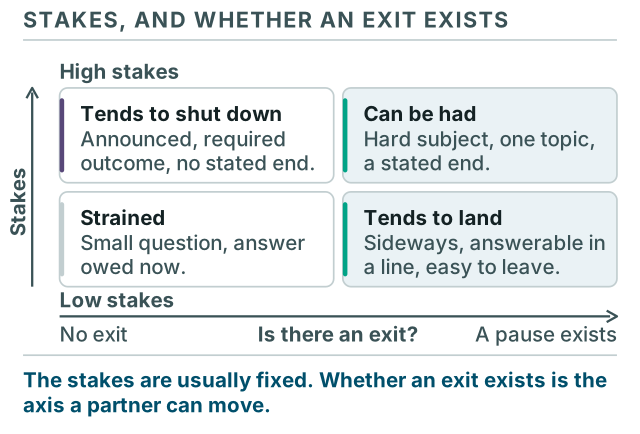
The grid is worth reading in one direction in particular. Necessary subjects often sit high on the stakes axis and cannot be moved down: money, children, whether this relationship is going anywhere. That is not a reason to avoid them. It is a reason to be careful with the axis that is still adjustable, because a high-stakes subject with an exit is a conversation, and the same subject with the door closed is an interrogation.
How can the same thing be said differently?
Nothing here is a forbidden phrase; the principle is narrower than a list of them. The same information can arrive with more demand attached or with less, and demand is the variable that decides whether the exchange survives its opening. What follows is not a set of scripts either, and anything promising a particular reply would be selling something this site cannot supply.
Demand rises in predictable ways. Asking for an account of feelings rather than a piece of information. Requiring the answer now. Stacking unrelated subjects into a single occasion. Attaching the relationship’s future to whatever gets said next. Most of what people list under what not to say to an avoidant partner is one of those moves wearing different words.
| What is being raised | The version that tends to shut it down | A version that tends to land |
|---|---|---|
| Wanting more contact | Asking why they never reach out first, and what that says about how they feel | Naming the thing you would like, plainly, as a preference rather than a verdict on them |
| A plan that keeps not being made | Asking where this is going, with an answer expected tonight | Proposing something specific with a date and an easy way to decline |
| A withdrawal you noticed | Asking what they are thinking, repeatedly, while it is happening | Saying you noticed, that it is not an accusation, and that you will pick it up later |
| Something that hurt you | Opening with a pattern — you always, you never — and a pile of examples | A single event, what it did on your side, no request for a confession |
| Needing to know where you stand | A conversation announced in advance with the relationship as the agenda | A question with a defined scope, asked in an ordinary moment |
| A recurring domestic friction | A backlog raised together because it has all built up | A single item, with the end of the conversation visible from the start |
The right-hand column has a quality worth naming: each version leaves the other person something they can actually do. An answerable request is easier to meet than an invitation to explain themselves, and someone who can meet a request is more likely to stay in the conversation than someone who has been asked to perform an emotional audit at short notice.
The question of how to get an avoidant to open up usually contains a hidden assumption — that opening up is a single event, produced by the right conditions on the right evening. What people describe instead is accumulation: small disclosures that were not punished, questions that did not become inquests, and subjects that got dropped and were still available later without a scene. That record is what makes the next disclosure cheaper.
Making a partner feel safe works the same way, which is why reassurance underperforms. Saying this is fine, we are fine has almost no weight next to plans that hold, reactions that stay proportionate to their cause, and hard evenings that end without the relationship being renegotiated. Safety in this frame is a track record, not a sentence. What a partner most often needs to hear, plainly, is that a stated need is not an accusation and that the conversation has an end.
The letters
One email, sent only when a page is added
That did not go through. Nothing was saved and nothing was sent — try the address again, or write to us directly and we will add it by hand.
- What arrives
- A note when a page here is rewritten or a new one goes up, with one line on what changed.
- What does not
- Assessments, quizzes, coaching offers, anything that claims to tell you what someone else is.
No spam, ever. Unsubscribe anytime.
How do you set a boundary without it becoming an ultimatum?
Setting boundaries with an avoidant partner gets tangled because a boundary and an ultimatum are easy to confuse from the outside. A boundary is a statement about what you will do. An ultimatum is a statement about what they must do, with a consequence and a clock attached. They can involve the same subject and produce opposite dynamics.
The structural problem with an ultimatum here is familiar by now: it is maximum stakes with the exit removed, delivered as a demand for an immediate decision. Even when it is entirely justified, it asks a pressure-sensitive pattern to produce its most exposed answer under its worst conditions. A yes given that way is often a yes to ending the pressure rather than to the thing itself.
A boundary needs no compliance to work. For example, I am not going to keep raising this — I will say it and then leave it with you describes your own behaviour, is enforceable by you alone, and does not require the other person to agree to anything. So does declining to make plans that keep dissolving, or ending a conversation that has stopped being a conversation.
That independence is the practical point rather than a rhetorical one. Boundaries phrased as levers — designed to produce a reaction — collapse when the reaction does not come, because the distance stays and the boundary turns out to have been a request. Boundaries phrased as your own terms hold either way. What they cost is the fantasy that the right sentence, correctly delivered, obliges someone else to change.
Related notes belong here. Conflict inside these conversations follows its own rules, described on conflict avoidance, and the moments that most often set the whole sequence off are set out on triggers.
How do you reengage an avoidant partner after silence?
Reengaging after a stretch of silence follows the same logic in a smaller form. The first exchange back has one job, which is to establish that the door is not locked; it does not have to settle anything. Leading with the gap itself puts the most exposed subject in the relationship at the front of a conversation that has not started yet, and that ordering is what stalls it. The gap can be discussed later, once there is a conversation to discuss it inside.
Sometimes the conditions are right and nothing happens anyway. The stakes were low, the exit was open, the subject was small, and the answer still did not come. That outcome is not evidence that the framing was wrong or that a better sentence existed somewhere unfound.
It is worth saying plainly, because the market around this topic implies otherwise: there is no arrangement of words that obliges another adult to participate. Conditions change odds. They do not produce disclosure, and treating them as though they should turns every unanswered attempt into a personal failure that belongs to the person who tried hardest.
The other side of that is what the effort costs you. A partner who spends a long stretch engineering the temperature of every conversation is doing real work, usually invisibly, and the fact that it is skilled work does not make it sustainable indefinitely. Noticing that price is information about the relationship, not a verdict on either person.
What this page does not do
Communication in this pattern is describable. The description does not reach as far as the advice around it usually claims.
- No scripts with promised outcomes
- Nothing here is a line that makes someone open up, reply, or commit. The reframings on this page describe how demand goes up or down in a sentence, which is a claim about pressure and not about what another person will do with it.
- No method borrowed and rebranded
- Structured communication frameworks exist, they have named authors and their own evidence base, and none of them is ours. Where a technique from that literature would apply, the honest move is to point at the field rather than to present a repackaged version as a house method.
- No figures
- No number appears on this site that could not be traced to a named, dated source — which rules out percentages for which approaches work, and intervals for how long to leave something before raising it again.
- No verdict on your partner
- A page cannot tell you whether this pattern is what you are looking at. Distance during hard conversations has explanations an article cannot rule out from the outside, including ones that have nothing to do with attachment.
- No advice on staying or leaving
- That decision involves your history, your circumstances and things no article can see. We describe what tends to happen in these conversations; what any of it is worth to you is not a question this site is in a position to answer.
Where this page stops
This page describes conditions, not a technique, and it cannot tell any particular reader whether the pattern it describes is present in their relationship. Attachment language is borrowed from research to name behaviour, not to assess a person, and using it as a verdict on a partner is the one move that reliably makes it useless.
There is also a point where communication advice is the wrong tool entirely. If conversations at home are frightening rather than difficult, if silence is being used to control what you do or who you see, or if raising a subject carries a risk to your safety, that is a matter for a domestic support service, a therapist or a doctor rather than for reading. Confidential support lines exist and are typically free to call.
Persistent distress on either side — sleep going, work slipping, a relationship that has become the main source of dread in ordinary life — belongs with a professional too. Couples work exists for the version of this that a couple cannot get through alone, and choosing it is not an admission that the relationship failed.
For the wider picture of living with the pattern, the partner hub is the starting point rather than this page. What we read and how we handle evidence is set out on our sources page.