
Can a dismissive avoidant change? The question lands on a framework before it lands on a person. Attachment patterns are described as things that were learned, and anything learned is treated as open to revision. That is the honest general answer. The useful part is narrower: what would count as change, what it looks like from outside, and what it is routinely mistaken for.
Why the question is usually asked by the other person
This is rarely a question asked from a calm place. It arrives from a partner deciding whether to keep waiting, and it is doing a second job underneath the first one: it is asking whether staying is reasonable. Those are different questions, and only the first one has a general answer worth writing down.
That matters for how the rest of this page reads. A general statement — patterns are learned, learning can be revised — is true and almost useless when applied to one relationship on a Tuesday night. It says nothing about whether a particular person is moving, and it cannot, because a page has no access to anyone.
The other version of the question comes from the person who recognises themselves in the description. It is usually asked with less patience and more dread: is this the setting I am stuck with. The framework answers that one the same way, and the evidence it points at is identical, which is the convenient part of this page.
What we can do is describe what movement looks like when people report it, in enough detail that a reader can check against something. Not a verdict. A set of observable things that either are happening or are not, watched across a season rather than across an easy fortnight.
What does change mean for a dismissive avoidant?
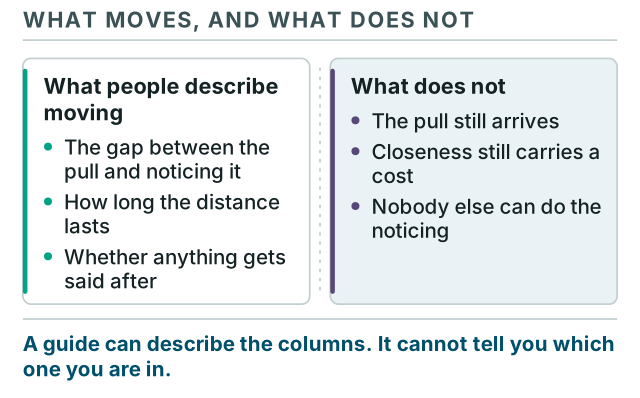
Inside this framework, change does not mean the urge to create distance disappears. It means the sequence around that urge gets shorter and more visible. The pull still fires, the withdrawal still starts, and what shifts is how long it runs before it is noticed, named and walked back.
That is a deflating definition, and it is the accurate one. The pull is described as the durable part — the reflex learned early, running fast, arriving before any thought about the person in the room. Reflexes are not usually reported as removable. What sits on top of them is.
So the frame separates the layers that get collapsed into a single word. There is the reflex. There is the behaviour it produces: the short answers, the cancelled evening, the conversation pushed to a later that does not come. And there is the recovery: what happens after, and how long after.
Change, described this way, works from the outside inward. The recovery moves first. The behaviour softens next, and unevenly, holding under ordinary pressure and giving way under heavy pressure. The reflex is what people describe still feeling long afterwards, at a lower volume, with a name attached to it.
| Layer | What it is | What people report |
|---|---|---|
| The pull | The reflex toward space when closeness raises obligation | Described as the durable layer; quieter over time, not absent |
| The behaviour | Going short, going busy, postponing the conversation | Softens unevenly — holds on an ordinary week, gives way on a heavy one |
| The recovery | How long the distance runs before it ends | The first thing that shortens, and the easiest to observe from outside |
| The naming | Saying afterwards what happened, without being asked | Appears last; treated as a clear sign of movement |
The opposite of avoidant attachment, as the frame names it
The phrase “opposite of avoidant attachment” usually expects another pattern as the answer. The framework does not supply one. What it names on the other side is security: a working expectation that closeness can be relied on, which is a description of confidence rather than a description of behaviour.
This is worth saying plainly, because the assumed opposite is a different insecure pattern, and swapping one for another is not what the frame calls improvement. That other pattern is the subject of a different body of writing and is not described here. Movement, in this model, is toward security, and security is a low-drama thing: needs mentioned early, distance taken without disappearing, repair that does not need a crisis to start.
What are the signs a dismissive avoidant is changing?
Evidence here is behavioural and repeated. It shows up in the shape of a hard week rather than in a calm conversation about hard weeks, and it is easier to see over a season than over a day. The signs people point to concern timing and language: how quickly the distance ends, and whether it gets named without prompting.
The withdrawal gets shorter. The same trigger produces the same pullback, and the return comes quickly where it used to run on and on. Nothing about the reaction looks different at the start. The difference is entirely in the back half, which is why it is usually noticed in hindsight.
It gets named afterwards, unprompted. Not an apology and not an explanation of why the week was busy — a plain description: I went quiet, that was the old thing, it was not about you. The naming matters because it means the pattern was observed by the person inside it.
Contact holds during the distance. A thinner version of contact, but a version. A message that says less rather than a silence that says nothing. People describe this as the change a partner notices first, because it removes the part that did the most damage.
Something gets asked for. Small and unromantic, usually — a request for a night alone that is framed as a preference rather than delivered as a fact. Asking involves letting the other person’s answer matter, which is the specific move the pattern was built to avoid.
It survives one bad stretch. Under real strain, the old version returns. What people count as evidence is not the absence of a relapse but a shorter one, and the fact that returning did not require an ultimatum from the other side.
Why a season is the shortest useful window
None of the signs above mean anything measured over a good week. The pattern is described as pressure-activated, so a stretch with no pressure in it produces the same behaviour from someone who has worked on nothing and someone who has worked on a great deal. Only a hard week tells them apart.
That is inconvenient for the person doing the watching, because it means the evidence arrives exactly when they have least appetite for observing anything. It also means the honest test is comparative rather than absolute: not whether this withdrawal was pleasant, but whether it was shorter, thinner and more openly named than the last one of the same size.
There is also a version of watching that turns into monitoring, and it is worth naming because of what it costs the person doing it. For example, keeping a running ledger of every short reply is a full-time job, and it reads a relationship as a case file. The comparison this frame points at is coarser than that: the last hard stretch against the one before it, remembered rather than logged.
The letters
Occasional letters about what does and does not shift
That did not go through. Nothing was saved and nothing was sent — try the address again, or write to us directly and we will add it by hand.
- What arrives
- A note when a page here is rewritten or a new one goes up, with one line on what changed.
- What does not
- Assessments, quizzes, coaching offers, anything that claims to tell you what someone else is.
Occasional emails about the avoidant pattern. Unsubscribe anytime.
What gets mistaken for change?
Some of what gets read as change is produced by the pattern rather than by movement out of it. A calm stretch, a warm return, a fluent conversation about attachment: each can happen with nothing underneath it. What follows is what this page will not accept as a sign, and why each one carries less information than it appears to.
What this page will not treat as a sign
Material read as proof of change is often produced by the pattern itself, and reading it as movement is how people end up waiting on nothing.
- A conversation about changing
- Insight is cheap in a calm room. Someone can describe their own pattern accurately, agree with every word of it, and do the identical thing the following week. Articulate self-knowledge sits easily alongside this pattern and is not, on its own, an indicator of anything.
- A return after a long silence
- Coming back says the pull eased, which it eventually does whether or not anything was worked on. A return only carries information if what happens next differs from what happened last time — the same warm reappearance has preceded the same withdrawal before.
- A very good stretch
- The pattern is described as pressure-activated, so a period with no pressure in it tests nothing. Holidays, early months and long-distance arrangements all remove the trigger rather than change the response to it.
- Reading about attachment
- Vocabulary arrives faster than behaviour. New language can genuinely help, and it can also become a more precise way of describing the same withdrawal while performing it. This site is part of that risk and would rather name it.
- Change that only exists in the other person's effort
- If the movement is that a partner has learned to ask for less, provoke less, and absorb the silence more quietly, the pattern has not moved. That arrangement is often mistaken for progress because the arguments stop.
Is awareness required for change?
It is possible to read a description of the pattern, recognise it immediately, and still not see it running in real time, because the withdrawal presents itself as a reasonable response to circumstances rather than as a reaction to closeness. Recognition and awareness are not the same thing here.
That is the mechanism worth understanding. During deactivation, the reasons feel true. For instance, work is genuinely busy, the flat genuinely needs sorting, the relationship genuinely does look less appealing than it did last month. Nothing feels like avoidance from the inside; it feels like accurate perception arriving at a convenient time.
So the question “do avoidants know they are avoidant” splits. Knowing the label is one thing, and it can sit alongside never once catching the pattern live. The movement people describe is not gaining knowledge — it is the gap closing between the withdrawal and the moment it gets recognised as one, until the recognition lands while it is still happening.
| Where the recognition lands | What it sounds like | What becomes possible |
|---|---|---|
| Never | The distance is explained entirely by circumstances | Nothing; there is no pattern in view to act on |
| Long afterwards | That whole stretch was the old thing again | The episode can be named afterwards to the other person |
| Shortly afterwards | I did it again on Tuesday | The return happens without the other person staging a rescue |
| During | I can feel myself going quiet right now | Contact can be kept thin instead of dropped |
Whether change can happen without any awareness at all is a harder question, and the honest answer is that we do not know of a way to observe it. A pattern that runs unnoticed has nothing acting on it. What can change without awareness is the setting: a relationship with less pressure produces fewer withdrawals without altering what produces them.
One more thing belongs in this section, because it is a familiar way the question gets answered badly. In practice, a partner who has read enough to spot deactivation often starts narrating it in real time, in the belief that pointing at the mechanism will interrupt it. People describe the opposite effect: being described tends to raise the pressure that started the withdrawal.
There is also the question underneath, which is whether a partner can supply the awareness on someone’s behalf. Naming a pattern for another person tends to land as an accusation and produce more distance, not less. What sits inside a partner’s control is described on the partner section, and where the pattern comes from in the first place is on what causes avoidant attachment.
Where this page stops
This page describes a framework for behaviour under pressure, and it stops there. It cannot tell a reader whether a particular person is changing, cannot say whether waiting is reasonable, and does not separate an attachment pattern from clinical conditions that resemble it from outside. Attachment language is not a diagnosis, and nothing here is care.
Anyone whose situation involves being afraid of a partner, being controlled, or being cut off from money or other people is looking at something this framework does not cover, and that belongs with a professional or a local support service rather than with a guide. The same route applies to distress that is heavy, persistent, or getting in the way of ordinary life.
What working on the pattern involves is set out across the healing section, and how the pattern behaves inside a live relationship is described in avoidant attachment in relationships. The reading behind the framework used on this site is listed on our sources page.