
Avoidant attachment is described as forming where expressing a need reliably did not bring comfort, so not needing became the steadier option. The question of what causes avoidant attachment style is therefore a question about conditions, not about a single event that can be located and named. Nothing in the framework points at an incident. It points at a repeated result, and at what a person sensibly concluded from it. This page sets out the conditions it describes, what each one teaches, and where the description stops being useful.
Where does avoidant attachment come from?
Attachment describes what a person learned to expect from closeness, and in the avoidant version the working expectation is that reaching for someone costs more than it returns. Handling things alone is not a preference that arrived from nowhere. It is the strategy that made sense in a setting where the alternative did not work.
The mechanism runs in the same order every time. A need gets expressed — by a small child, that means crying, reaching, following. A response arrives, or arrives in a form that does not settle anything. And something gets learned from the gap between them. Repeat that enough and the first step quietly gets skipped.
That is the whole engine. Not a wound, not a verdict, not a single afternoon that changed everything. A repeated result that made a repeated adjustment sensible. When the adjustment is “ask for less,” what grows on top of it looks like independence, competence and calm.
The word “causes” promises more precision than anyone can deliver about one life. What the framework offers is a description of learning that can be recognised, not a chain of events that can be traced. The distinction matters most on this page, because origin stories are where readers are most tempted to assign fault.
What conditions produce avoidant attachment?
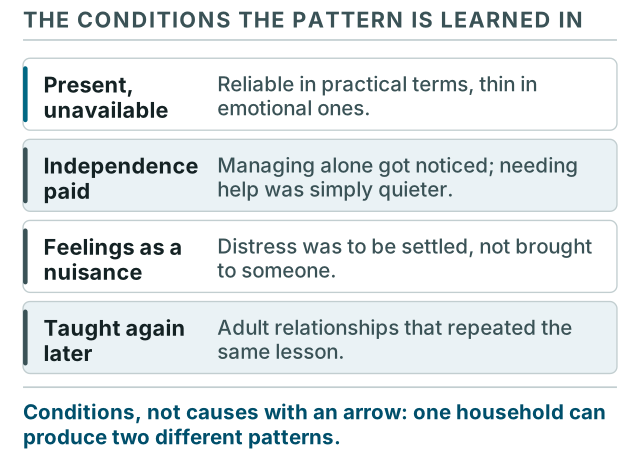
The conditions below are settings in which self-reliance is the reasonable answer. They are not accusations, and no single one of them is required. Read them as descriptions of what a system in that setting would sensibly conclude.
| Need expressed | Response received | What gets learned |
|---|---|---|
| Distress shown openly | Practical fix offered, feeling not acknowledged | Feelings are noise; problems are the acceptable currency |
| Comfort sought after a fright | Consistent unavailability, without hostility | Reaching does not return anything, so stop reaching |
| Upset expressed loudly | Irritation, or a request to stop | Expressing a need makes the room worse |
| Coping quietly without help | Praise, relief, visible approval | Not needing is the version of me that lands well |
| A worry mentioned in passing | Treated as an inconvenience or exaggeration | Check the thing alone before mentioning it |
Unavailability without hostility
A condition described here is not harshness at all. It is a caregiver who was present, functional and reliably unreachable on the emotional channel. Nothing frightening happened. The reach simply did not land, and after enough repetitions the reach stops being attempted.
This is why the pattern is described as forming in households that look, from the outside and from the inside, entirely fine. There is no incident to point at. There is an absence, and absences do not store as memories the way events do.
Independence that was rewarded
Another condition is praise attached to not needing. For instance, a child who managed alone got warmth, approval and an easier household. A child who asked got a flatter response. Nothing was withheld cruelly; one behaviour was simply cheaper than the other.
That is a real reward structure, and systems learn from reward structures. What forms is not a fear of closeness so much as a preference for the version of the self that was reliably well received — the one who does not require anything.
Feelings treated as an inconvenience
A further condition is a household where emotion was handled as a disruption to be shortened. Not punished, usually. Redirected, minimised, or answered with a solution. The lesson is that the feeling itself has no standing; only the solvable part is worth raising.
Adults who recognise this describe being extremely articulate about problems and strangely mute about states. That combination is the fingerprint of the condition, and it explains why “what’s wrong?” can be answered with a full logistics report and no answer.
What “avoidant parents” usually means here
The phrase gets used loosely, and it is worth pinning down. In this framework it does not mean a parent who left, and it does not describe anyone’s character. It points at a narrow thing: an adult who handled their own closeness by keeping distance from it, and whose household ran on that setting.
A parent relating that way can be warm about tasks, funny at the table and completely dependable in a crisis. The distance shows up in a narrow place — what happens when someone in the room is upset. Naming that is a description of a channel, not a summary of a person, and this site does not extend it into one.
Later relationships that taught the same thing
The framework does not describe a sealed childhood file. Expectations stay open to revision, which is the same property that makes change possible later. A relationship in which candour reliably cost something, or in which asking was treated as an imposition, runs the same lesson through the same mechanism.
There is a confusion worth separating here. A pattern can be built by repetition, and a pattern that was quiet before can be amplified by a relationship that keeps activating it. From the inside they feel the same: this was not this loud before. From outside, no text can tell which happened.
Can avoidant attachment form when my parents were fine?
Yes: the familiar objection that nothing bad happened can be entirely accurate, and it is not a contradiction. Consistent unavailability is not an event. It leaves no scene to recall, no anniversary, no story to tell at a dinner table.
What memory keeps is episodes. What this pattern is made of is the absence of episodes — the times a reach did not produce a response worth storing. A person can hold a genuinely warm set of memories and still have learned, underneath them, that needs are handled alone.
There is also a reporting problem, and it is structural. Where the working strategy is “do not need anything”, a history gets described in exactly that register: it was fine, it was normal, other people had it worse. That is not denial. It is the same pattern applied to the past, and it is one reason self-diagnosis by origin story is unreliable.
Finally, “fine” is a comparison, and comparisons drift. A household can be safe, funded, and attentive to homework while being unreachable on the one channel this framework describes. Both facts can be true about the same address, and holding both is closer to the truth than choosing one.
Why one household can produce different patterns
A related objection comes from inside the same family. Siblings raised at the same address, by the same adults, often describe closeness in ways that do not match, and that mismatch gets read as proof that the whole description is wrong. It is not. What the framework accounts for is a repeated exchange between one child and whoever was responding, and that exchange is not identical for two people who happened to share a kitchen.
Adults change across the years a family runs. For example, a caregiver stretched by work, illness or grief in one stretch of time may be reachable in another, and a child who arrives in the second stretch meets a different responder. The size of the household rearranges it again: the attention available to a child with no siblings is not the attention available once there are several.
Temperament sits on the other side of the exchange. A child who protests loudly and keeps protesting until something answers is running a different experiment from one who goes quiet early, and the same level of availability answers those two experiments differently. None of that is measurable from the outside, and this page does not attempt to rank which sibling had it harder. The point is narrower: growing up in the same rooms is a thinner piece of evidence than it looks.
Why the question arrives at a specific moment
The question “why am I avoidant” does not tend to arrive while things are steady. It surfaces after a particular event: someone left, a partner named the pattern out loud, or a withdrawal happened that the person could watch themselves perform and could not stop.
That timing shapes what the answer is being asked to do. It is not really a request for history. It is a request for reassurance that the pattern is explainable rather than evidence of being built wrong. The framework does answer that much: the behaviour has a mechanism, and a mechanism is not a character flaw.
What it cannot do is supply the specific story that produced it. Reading a pattern forwards — this is what the system does now, and here is the kind of learning that produces it — is what attachment language is built for. Reading it backwards to identify a responsible party is a different activity, and a much less reliable one.
The letters
Occasional writing on where the pattern is thought to come from
That did not go through. Nothing was saved and nothing was sent — try the address again, or write to us directly and we will add it by hand.
- What arrives
- A note when a page here is rewritten or a new one goes up, with one line on what changed.
- What does not
- Assessments, quizzes, coaching offers, anything that claims to tell you what someone else is.
Occasional emails about the avoidant pattern. Unsubscribe anytime.
What does knowing the cause actually change?
Knowing where a pattern came from changes the meaning of a reaction, not the reaction. That is a real change and a limited one. The urge to go quiet after a heavy conversation does not dissolve because its origin has a name.
What the explanation removes is the layer on top. Without it, a withdrawal arrives with a verdict attached: something is broken in me, I do not love properly. With it, the same withdrawal reads as an old strategy firing in a setting it was not built for. The strategy still fires. The shame around it gets quieter, and a quieter reaction is easier to notice before acting on it.
There is a second change, and it shows up in how the pattern gets discussed rather than in how it feels. Origin language gives a person something to say other than nothing. For example, “I go quiet when a conversation gets heavy, and that is an old habit rather than a verdict on you” is a sentence that can be said out loud to a partner. Without a frame, the same moment usually gets explained as tiredness or work, which is accurate about the surface and misleading about everything under it.
What none of this supplies is a schedule. An explanation can land in one afternoon; a response that was practised for years does not change on that timetable, and expecting it to is the quickest route back to the verdict the explanation was supposed to remove.
The situations that set it off in the present tense are mapped on the triggers page, and what changes over time — plus what realistically does not — is covered in healing avoidant attachment.
What causes does not mean
What this page will not do
Origin stories are the easiest place on this subject to do damage, so several things are off the table here deliberately.
- Deliver a verdict on a parent
- What the framework accounts for is what a set of expectations learned, and it stops there. Why a particular adult was hard to reach — work, illness, grief, a pattern of their own — is not something a page written for everybody has any access to.
- Use trauma as a diagnostic frame
- This site does not classify anyone's past as trauma and does not treat an attachment pattern as a clinical category. Whether something in a reader's history belongs under that word is a question for a clinician who can ask about context.
- Reconstruct a reader's childhood
- A page has no access to anyone's history. If a description here matches, it matches because the mechanics are recognisable. Recognition is not evidence about what happened, and it should not be treated as a recovered memory.
- Label a person rather than a pattern
- Avoidant attachment describes behaviour under pressure. It is not an identity, not a personality type, and not something a reader is. This site describes what a pattern does, and stops there.
- Promise that insight is the change
- Understanding an origin is not the same as altering a response. Anywhere this page could be read as implying otherwise, it says the opposite instead.
Where this page stops
This page describes a framework for explaining where a pattern of relating is thought to come from, and it stops there. It cannot establish what happened in any particular reader’s life, cannot confirm that the pattern described here is what is actually going on, and does not distinguish an attachment pattern from clinical conditions that can look similar from the outside. An attachment pattern is a description of behaviour, not a diagnosis, and nothing here is assessment or care.
Anyone whose distress is heavy, persistent, or getting in the way of ordinary life has a question that belongs with a therapist or a doctor — someone who can ask about history and context in a way that a page cannot. That is also the right route for anyone who reads a section above and finds it opening something that does not close again.
The rest of the pattern — how it shows up, what it looks like from the outside, what happens under pressure — is mapped across the dismissive-avoidant hub, and the whole guide starts from the front page. The reading behind the framework used on this site is listed on our sources page.