The early phase, and why it feels easy
Avoidant attachment in relationships is a rhythm rather than a constant: closeness builds, then distance restores the balance. It often goes unnoticed at the start, because the early phase asks for very little of the thing the pattern finds costly. Nobody is owed daily contact yet, plans are made at short notice, and independence reads as confidence rather than as distance. The pattern is present; the conditions that make it visible are not.
That early ease is worth taking seriously instead of rewriting later as a performance. People who lean avoidant describe the opening stretch as genuinely good, not as an act. Attention is easy to give when nothing is being asked. Warmth is easy to sustain when retreat is available at any moment and requires no explanation.
The mechanics behind it are unremarkable. In the early stretch, the distance a person needs is built into the situation: separate homes, separate schedules, gaps between meetings that nobody has to negotiate. Recovery time arrives free of charge, so no withdrawal has to be staged and no partner has to notice one.
There is another reason the beginning runs smoothly, and it is less flattering to everyone involved. In the early phase the relationship is made of preference — what you like, where you eat, what you find funny. It is not yet made of obligation. Preference costs nothing to share. Obligation is where the pattern starts to push back.
Partners often describe this stage afterwards as the version they are trying to get back to, which sets up the trap this whole page is about. The easy phase was not the real relationship being interrupted by a problem. It was the same relationship under lighter load. What arrived later is what this pattern does when the load increases.
When does the pattern become visible?
The pattern usually surfaces at the point where the relationship starts asking for continuity rather than enthusiasm. A label, a key, a shared holiday booked well ahead, a first real argument, a partner who now expects to hear back the same day. Each of these converts a pleasant arrangement into something with consequences attached, and consequences are the input this pattern is organised around.
What a partner sees at that point is rarely a stated objection. It is a change in texture: replies that arrive later and shorter, weekends that fill up, an enthusiasm that has gone polite. Nothing has been refused. Something has been quietly restructured so there is more room in it.
The most confusing feature is the timing. The retreat tends to follow the good stretch, not the bad one — the trip that went well, the night something honest was said, the moment the relationship visibly moved forward. Read as a reaction to closeness rather than to a problem, the sequence stops looking arbitrary.
| Phase | What is happening | What a partner tends to see |
|---|---|---|
| Closeness builds | Contact increases, something honest gets said, the relationship moves forward | The best stretch so far; warmth and momentum |
| Pressure registers | Mattering more means more to lose, and less room to move without being noticed | Nothing yet — this part happens out of sight |
| Distance restores balance | Contact thins out, plans get vague, the schedule fills | A pull-back with no cause anyone can point to |
| Pressure drops | Space does its job; the relationship stops feeling like an obligation | Silence, usually the hardest part to sit with |
| Closeness resumes | Contact returns, often without reference to the gap | Relief, followed by waiting for the next round |
The damage in that table comes from what goes unsaid at either end. The pull-back arrives with no announcement, so a partner is left assigning it a cause and usually picks themselves. The return arrives without commentary, which means nothing gets resolved on the way back — the same turn stays available to run again.
Conflict deserves its own note, because it is where the change in texture is sharpest. The pattern rarely produces a raised voice; it produces an exit. For example, the room gets left, the subject gets changed, the answer arrives as I do not want to do this right now. A partner who grew up with argument as a normal event experiences that as being abandoned mid-sentence, while the person leaving experiences it as the only way to stop the pressure rising.
The mechanism has its own page, because the moment-to-moment version of it is where it is easiest to get stuck: the avoidant cycle covers why the return so often follows the exact moment a partner stops chasing, and why that timing teaches both people something unhelpful.
One boundary belongs here: this site describes the avoidant side of a relationship only, so how a partner’s own pattern meets it is left to people who cover that properly.
What does an avoidant look like in a long relationship?
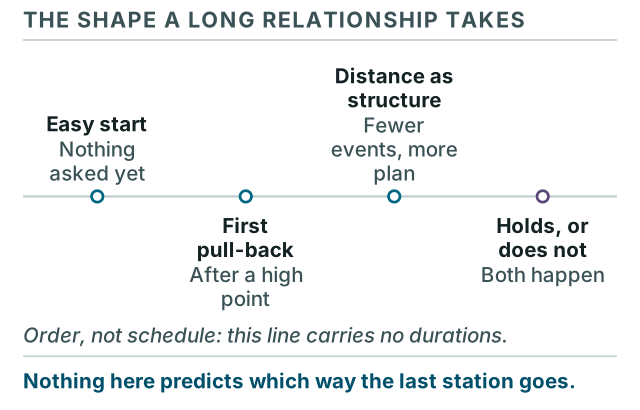
Long relationships with this pattern do not stay in a permanent crisis; they settle into an arrangement. The rhythm becomes routine, both people learn its shape, and the pull-backs get shorter or at least more predictable. Whether that arrangement is comfortable or hollow depends less on the pattern than on whether it was ever discussed out loud.
What tends to stabilise well is the practical layer. Households run, logistics get handled, problems get solved without drama. Someone whose default is self-reliance is often good at the parts of shared life that reward competence, and partners frequently report that the relationship is easiest exactly where other couples struggle.
What tends not to stabilise on its own is the conversational layer. Difficult topics get raised and dropped, then raised again much later with the same result. Over time, that produces a relationship with an accumulating list of subjects nobody opens, and the list is usually invisible until something forces one of them.
Living together changes the format of distance rather than removing it. The gap that used to happen naturally between meetings has to be recreated inside a shared space, which is why partners describe long showers, late work, one room that belongs to one person, a hobby that happens elsewhere. Those are not signs of a relationship failing. They are the same recovery time in a smaller container.
The steady state also has a version worth naming plainly, because it is common and rarely described: the relationship that works well and is quietly short on one thing. Practical care arrives reliably, spoken closeness arrives rarely, and one partner spends a long time deciding whether the balance is enough. That is a real question, and it does not have a pattern-shaped answer — it depends on what a specific person needs.
For the partner side of this, including what tends to help and what reliably makes the retreat longer, the material sits on the partner hub. Where the arrangement has been running for a long time, the long-horizon version is on married to an avoidant.
The letters
Written for people living alongside the pattern
That did not go through. Nothing was saved and nothing was sent — try the address again, or write to us directly and we will add it by hand.
- What arrives
- A note when a page here is rewritten or a new one goes up, with one line on what changed.
- What does not
- Assessments, quizzes, coaching offers, anything that claims to tell you what someone else is.
No spam, ever. Unsubscribe anytime.
What is an avoidant-avoidant relationship like?
An avoidant-avoidant relationship removes the friction most people expect from this pattern, which is exactly what makes it hard to read. Neither person is being chased, so neither one has to defend their space. Distance is not an incident; it is the shared default, and it goes unremarked because nobody is waiting on the other end of it.
People in these pairings describe the early stretch as unusually restful. For example, cancelled plans get a genuine no problem. A quiet week is a quiet week. There is no negotiation about texting frequency, because neither party is counting.
The difficulty is structural rather than emotional, and it shows up late. Repair requires someone to walk back towards a conversation that both people were relieved to end. When both defaults point away from that, disagreements do not get resolved so much as filed. The relationship can look calm from outside for a long stretch while the pile grows.
| Arrangement | What tends to go smoothly | Where the strain shows up |
|---|---|---|
| One partner leans avoidant | Practical life, independence, low day-to-day maintenance | Pull-backs read as rejection; the other partner carries the emotional initiative |
| Both partners lean avoidant | Space is uncontested; almost no conflict about contact or frequency | Nobody initiates repair, so unresolved topics accumulate quietly |
| Living together | Shared logistics handled competently | Recovery time has to be recreated inside the home |
| A close friendship | Long gaps carry no penalty; contact resumes easily | Disclosure stays light; support arrives as help rather than as talk |
The other common outcome is a slow fade. Partners who both find it easier to let contact lapse can end a relationship without either of them deciding to, simply by each waiting for the other to make the move that reopens it. Nothing happened, and that is precisely how it ended.
None of that makes the pairing unworkable. It means the thing it lacks is a built-in prompt. Couples who describe this arrangement working usually describe an artificial one they agreed to keep — a standing conversation, a habit of naming a retreat out loud instead of just taking it.
How does avoidant attachment show up in friendships?
Avoidant attachment in friendships is often the easiest place for the pattern to live, because friendship asks for intermittent access rather than continuous closeness. Long stretches can pass without contact and the friendship survives intact, since neither side treats a gap as evidence of anything. The same terms that strain a relationship are unremarkable between friends.
What friends describe is a person who is reliable in the concrete sense and light in the disclosing sense. For instance, they will help you move, sort out the thing you are stuck on, turn up when there is a task. The conversation about how they are actually doing arrives later, shorter, and rarely gets returned to.
The friction appears in the friendships that expect more. Someone who wants a confidant may find the exchange one-sided: they disclose, the other person receives it well, and very little comes back. That imbalance is rarely a judgement about the friendship’s value; it is the same handling of exposure showing up in a lower-stakes setting.
Long stretches of silence are the part most often misread. In this pattern a lapse in contact usually carries no message at all — no offence taken, no decision made. Friends who assume the worst during a gap and then get a warm reply long afterwards are seeing the ordinary version of this, not a reconciliation.
Can it work?
Relationships with this pattern do work, and the honest answer stops well short of a guarantee. What separates the arrangements people describe as good from the ones they describe as exhausting is not the strength of the pattern. It is whether the rhythm is acknowledged out loud, and whether both people are getting enough inside it.
Several features show up repeatedly in the workable version. The distance gets named rather than just taken, so a partner is not left inventing a reason. Requests are treated as information instead of as accusations. And the person who needs more spoken closeness has somewhere in their life to get some, so the relationship is not the only supply.
It also helps to be specific about what working means here, since the word hides a lot. It does not mean the pull-backs stop. In the versions people describe as good, the pull-backs are still there and have simply lost their power to frighten, because both people know what they are and roughly how they end. The relationship stopped treating the rhythm as a crisis and started treating it as a known feature.
What nobody can supply is a schedule for arriving at that. Some couples get there quickly, some only after a long stretch, and some never do — and the difference is not something a page can predict from outside. Anyone offering a timetable for another person’s change is selling certainty they do not have.
The unworkable version has its own shape, and it is worth stating: one person spends the relationship monitoring the other, adjusting themselves to avoid triggering a retreat, and calling that effort love. Exhaustion of that kind is information, and it does not become less true because the pattern behind it is understandable.
What this page does not do
A description of how a pattern tends to play out has a boundary around it. Here is where this one sits, for anyone reading from inside a relationship.
- No verdict on your relationship
- Nothing here can tell you whether yours will work. We describe what people report; we do not have access to your situation, and any page that claims otherwise is guessing on your behalf.
- No advice to stay or to leave
- That decision belongs to the person living in it, and it depends on what you need rather than on which pattern is in the room. We describe the arrangement; we do not grade it.
- No techniques for changing someone
- There are no scripts here for getting a partner to close the distance. Methods built on pressure produce compliance, and compliance is the thing that looks like progress and is not.
- No diagnosis
- Attachment language describes how closeness gets handled. It is not a clinical finding, and matching a description does not turn anyone into a category.
- No timelines
- We do not write that a pull-back lasts a certain stretch or that a relationship turns a corner by a certain point. Predictions about another person's behaviour are guesses, and selling them as guidance is how this category takes advantage of people who are waiting.
- No numbers
- Nothing here is counted. There is no share for how often any of this happens, because the counts in circulation could not be followed back to anybody who did the counting.
What we do stand behind
- Moments, not summaries
- Particular evenings and what happened in them. No adjectives get handed out, and no category gets attached to anyone who did not ask for one.
- Where the description runs out
- The page says where it stops being able to help rather than carrying on in the same tone. The reading behind it is on the sources page.
The earlier stage of all this — how the same pattern reads before a relationship has a shape, when the question is whether someone is pulling back or simply not interested — is covered on dating. The wider map of the pattern, including how it is recognised in the first place, sits on the dismissive-avoidant hub.
Where this page stops
The subject here is a pattern in the abstract, held at the distance a general description has to be held at. It has no view of one household: not whether a particular partner is going to move, not what a particular quiet fortnight was doing. Attachment language names behaviour, and it does not separate this pattern from the several other things that make a person hold themselves apart.
Two situations belong somewhere other than a guide. One is a relationship that has become frightening rather than puzzling. The other is uncertainty that has grown large enough to run your week. Both are worth putting in front of a clinician. Our reading is on the sources page.