The avoidant cycle is the name people give to a shape they keep noticing: warmth, then a cooling, then distance, then contact again, then warmth. This page describes that shape as one person’s rhythm — what each move does, why the return lands where it does, and what the loop cannot tell anyone about what happens next.
What are the stages of the avoidant cycle?
Closeness builds, deactivation lowers it, distance brings relief, and the pull toward connection returns once nothing is being asked. The loop has an order that holds up across accounts, and a spacing that does not. The moves are described below in that order, with no duration attached to any of them, because the duration is the part that varies most.
Closeness builds. The relationship gets warmer in a way that is wanted, not resisted: an unusually open evening, a plan that assumes shared time, an admission that would have been kept back earlier on. Nothing is wrong at this point, and that matters for reading the rest of the loop. The move that follows attaches to the good part, not to a rupture.
Deactivation. The word describes an internal turning-down rather than a decision. Warmth gets lowered before it is voiced, attention moves to practical subjects, and whatever explanation surfaces is a mundane one — an early start, a stretch of work, no particular reason at all. From outside, this is the stage where the tone changes and the explanation given does not match the size of the change.
Distance, and relief. Contact thins. Replies get shorter and later, plans get rescheduled, evenings get spent alone on purpose. The part that is hardest to hear from the other side is that this stage tends to feel better from the inside — not better than the relationship, but better than the pressure. Relief is what makes the stage stable enough to last.
The return. With pressure gone, the reasons for staying away lose their force, and what is left is a person who mattered. The pull toward contact comes back on its own terms rather than in response to a request. It rarely arrives with an account of the previous stage attached, which is why the return can feel to the other person like a different conversation entirely.
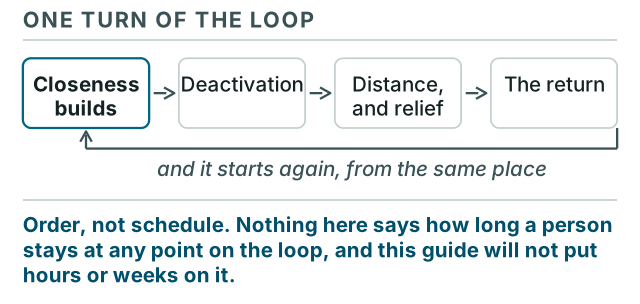
One thing the circle gets right and a list would hide: there is no start. Whoever is reading has joined somewhere, and the stage they joined at colours how the whole thing looks. For example, meeting someone during the warm stretch makes the cooling look like a decision. Meeting them during the distance makes the return look like a reversal.
| Move | Inside | How it reads to the other person |
|---|---|---|
| Closeness builds | Wanted, and increasingly exposing | Things are finally going well |
| Deactivation | Warmth lowered before it is named | A change of tone with no reason given |
| Distance, and relief | Pressure drops; the stage feels stable | Punishment, or losing interest |
| The return | The pull is back once nothing is asked | A reversal, or proof of mixed signals |
Why does the return come when it does?
The return is timed by pressure rather than by feeling. Distance does not remove the bond; it removes the demand attached to it. Once the demand is gone, what made the closeness costly is gone too, and the ordinary pull toward someone who mattered is what remains. That is why the return so often arrives after the other person has given up expecting it.
Read from the other side, that timing looks like a taunt, or like proof that the whole thing was about control. It is worth separating the shape from the intent. A loop can produce a cruel effect without a plan behind it, and the account given from the inside is often one of surprise at their own timing rather than satisfaction with it.
There is a second reason the return arrives late. During the distance, the relationship is remembered rather than lived, and memory is friendlier than a Tuesday evening. The version being missed has none of the pressure in it, which makes reconnection easier to want than the relationship it leads back to. This is where the loop tends to repeat instead of ending: the return happens at the warm stage, which is also where the next round starts.
What the return does not settle is whether the previous stage will be discussed. Often it is not. For example, the contact resumes at the level of ordinary life — a message about something practical, a question about a shared thing — and the silence before it is left unexplained. Whether returns of this kind lead anywhere is the subject of do avoidants come back, which stays closer to the aftermath of an ending than this page does.
The letters
A note whenever another part of the loop gets written up
That did not go through. Nothing was saved and nothing was sent — try the address again, or write to us directly and we will add it by hand.
- What arrives
- A note when a page here is rewritten or a new one goes up, with one line on what changed.
- What does not
- Assessments, quizzes, coaching offers, anything that claims to tell you what someone else is.
No spam, ever. Unsubscribe anytime.
What is the avoidant death wheel?
Avoidant death wheel is community vocabulary, not a term from the literature. It names the same loop with the emphasis on repetition: the sense that the round will run again regardless of what anyone does. The phrase carries a verdict inside it, which is worth noticing before adopting it as a description of a person.
Other names circulate for the same shape. The cycle on its own is the plainest of them. The dismissive avoidant cycle is the same loop with the sub-type spelled out, and nothing in the description changes when it is. Hot and cold is the everyday version, which describes the surface accurately while explaining nothing about what produced it.
We use the avoidant cycle here for one reason: it names a rhythm without predicting an outcome. A wheel implies that nothing can interrupt it, and that claim is larger than anything a description of behaviour can support. What the loop supports is recognition — the ability to see which move is running now, and to stop reading the current move as a statement about the relationship as a whole.
One boundary belongs here explicitly. This page describes the rhythm of one person. What happens when two people with different patterns respond to each other over time is a separate subject with its own literature, and it is not covered on this site. If the shape you are recognising is mostly about the interaction between two people rather than one person’s returning rhythm, this is not the page for it.
What happens when the other person stops chasing?
Stepping back tends to produce relief first and absence second. The immediate effect of removing contact is that pressure drops, which is the condition the loop moves toward anyway. What follows is less predictable: with nothing to manage, the loss stops being buffered, and it becomes possible to feel it. Neither stage is a verdict on the relationship.
That two-stage response explains why the answers people get online contradict each other. For instance, the account that says nothing happened and the account that says they came back long afterwards can both be accurate, because they describe different points of the same sequence — and neither one says which point the reader’s situation is at.
Walking away and going quiet are not the same move, and they do not land the same way. An ending that is stated leaves the other person with information. Silence that is simply applied leaves them with a puzzle, and the puzzle tends to get solved in the least flattering way available. The loop above runs on pressure, and an unexplained disappearance is pressure of a particular kind: it removes the demand and adds an alarm at once.
People ask about the sharper version of that move separately — disappearing without notice, or what most people would call ghosting an avoidant partner. The answer is the same shape with the volume raised. What tends to be reported afterwards is not a change of pattern but a stronger version of the ordinary one: less contact, less explanation, and a longer stretch before anything is said.
Leaving the relationship outright is the version with the fewest surprises in it, because it ends the loop rather than pausing it. The calm reaction people describe at the point of separation is often the distance stage doing what it always does, which is why an ending can land quietly and become heavy later. That is a different subject from the rhythm described here, and it belongs to the pages about endings rather than to this one.
The version worth stating plainly is this. Stepping back is a reasonable thing to do for your own reasons — because the rhythm is costing more than the relationship returns, or because you want to stop organising your week around someone’s availability. It is not reliable as a method for producing a return. Anything framed as a technique for triggering contact is a prediction about another person’s behaviour, and this site does not make those. What the partner’s side of this looks like day to day is covered in the partner’s guide, and how the pattern behaves inside a continuing relationship in avoidant attachment in relationships.
What the cycle does not predict
The loop is a description of a shape. Almost every misuse of it comes from treating the shape as a forecast.
- When, or whether, someone comes back
- The order of the moves is the claim. The spacing is not, and it varies with the relationship, the person and the circumstances. Any timeline attached to a return is somebody's individual case being sold as a rule.
- That the loop must repeat
- Naming a cycle does not make it permanent. People describe the same rhythm running strongly in one relationship and faintly in another. A description of behaviour under pressure is not a sentence passed on a person.
- Whether the closeness was real
- A retreat that follows a good stretch is not evidence that the good stretch was performance. The loop attaches to closeness precisely because the closeness registered.
- What to do to move someone along it
- There are no steps here for producing a return, and we do not publish them anywhere on this site. Scripts aimed at changing another person's behaviour are a different genre, and a less honest one.
What the loop is good for
- Reading the current move
- Knowing which stage is running makes the tone change less bewildering, even when nothing about it can be changed.
- Separating shape from intent
- An effect that lands as rejection can come from a rhythm rather than from an aim, and the difference matters for what you decide next.
- Deciding on your own terms
- Seeing the rhythm clearly is what makes it possible to choose whether you want to live inside it, which is a decision no page can make.
Where this page stops
What this page has described is a shape, and a shape is all it is. It carries no information about one particular relationship, about what anybody meant by anything, or about whether the loop a reader recognises here is this one or a different arrangement that resembles it from a distance. Attachment vocabulary names behaviour; it does not assess the person producing it.
Where the rhythm has started costing sleep, work or a sense of safety — or where silence is being used in a way that frightens you — the person to take that to is a clinician, who can ask the follow-up questions this page has no way of asking. The mechanism underneath the second move is set out in avoidant deactivation, and the reading behind these descriptions is listed in sources.