Why the question comes up
Signs an avoidant loves you but is scared are the forms care takes when closeness itself feels risky: reliability, access and specific attention rather than declarations. People searching for them are usually holding sets of evidence that will not reconcile. On one side: someone who shows up, remembers things, handles the boring parts of a shared life. On the other: a person who goes quiet after a good weekend, who deflects the word love, who answers a direct question about the future with a change of subject.
The question is really about which set counts. And the honest starting point is that neither set settles it, because behaviour is not a confession. What this page can do is describe what care tends to look like when closeness itself feels risky, so the reading gets less frantic and more specific.
The frame matters here. Avoidant attachment describes a pattern of handling closeness — distance used to bring the temperature back down — not a verdict about who somebody is or what they are capable of feeling. Nothing on this page reads a mind. It describes behaviour that people who lean avoidant report, and that their partners report seeing.
By the time the question gets asked in this form, the obvious test has usually been tried and found useless. Asking directly produces either a deflection or a sentence delivered under pressure, and neither one clears anything up. So the search turns into forensics: rereading messages, weighing how a goodbye sounded, comparing this week against last month. Forensics is what people do when the plainest source of information has gone quiet.
The other reason the question persists is that the evidence in this pattern is often strongest in the least dramatic places. A partner waits for the moment that would settle it — the speech, the tears, the declaration in a crisis — and the pattern tends not to produce those. What it produces instead is unremarkable and continuous, which is exactly the kind of evidence that fails to register as evidence.
There is also a version of this search that is not really about love at all. It is about whether something is ending. That is a different question with different evidence, and it has its own page: signs an avoidant is done.
How does an avoidant person show love?
Care in avoidant attachment tends to arrive as reliability rather than as declaration. The pattern favours forms of closeness that do not require an exposed statement: turning up, solving something, keeping a routine intact, granting access to parts of life that are normally kept private. Those forms are easy to miss because none of them announce themselves as love.
The clearest marker is usually access. Someone who protects their space by default and then hands you a key, a calendar, a family dinner, or the true version of how work is going has moved a boundary that costs them something. The size of that move is invisible unless you know how firmly the boundary is normally held.
Then there is maintenance. Fixing the thing that broke, driving the distance, handling the admin nobody wants, showing up for the appointment. Practical effort is a way of saying something that does not put the speaker on record. It is doing rather than declaring, which is exactly why it is a common route.
And there is specificity. For example, remembering the name of a colleague you complained about in March, buying the exact replacement for the mug you broke, noticing which version of tired you are. Attention of that grain is not accidental, and it is not something a person sustains for someone they have stopped thinking about.
Naming what care in this pattern often does not look like matters too, because an absence gets read as an answer. It frequently does not look like reassurance offered before it is asked for, like emotional narration, like enthusiasm about labels, or like an eagerness to define what the relationship is. Those are the moves that require a person to be on record about wanting something, and being on record is the cost the pattern is built to avoid paying.
The awkward consequence is that the most legible signals of love in general culture are the ones this pattern supplies least readily. A partner who grew up expecting warmth to be spoken is left grading someone on a scale they never score well on, while the things they do supply go uncounted because nobody taught anyone to count them.
| What it looks like | What it is doing | Why it gets missed |
|---|---|---|
| Consistency without ceremony | Keeping the shape of the relationship steady when nothing forces them to | Reads as habit rather than as choice |
| Access to private territory | Letting you into the home, the family, the finances, the unedited version | The size of the concession is invisible from outside |
| Practical maintenance | Care delivered as effort instead of as a sentence | Looks like competence, or like a favour anyone would do |
| Specific memory | Sustained attention to detail about your life | Small enough to overlook one instance at a time |
| Return after distance | Coming back on their own rather than being retrieved | The distance beforehand overshadows the return |
| Plans that assume you | Putting you into a future without narrating it | Never stated, so it is never confirmed |
| Physical closeness in low-stakes moments | Contact chosen when nothing is being asked for | Discounted because it happens outside the serious conversations |
None of these entries is proof, and collecting several of them is not a score. The table describes routes, not evidence. The same list can be produced for very different reasons, and the only thing the list reliably shows is where to look when someone’s words and their conduct are running on different tracks.
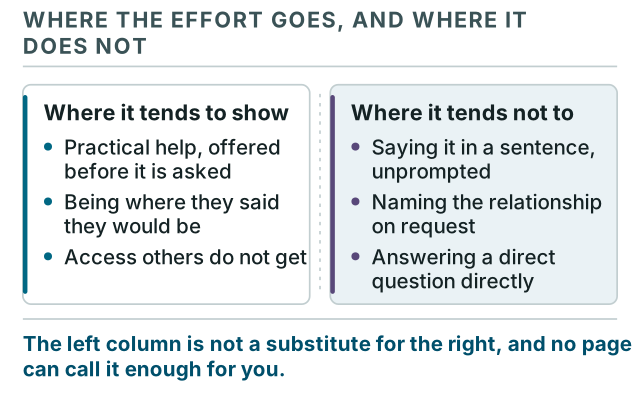
Why is saying it out loud the hard part?
A declaration is the single most exposed act in a relationship, and exposure is the thing the pattern is organised around. Saying I love you commits the speaker to a position they cannot walk back, and it asks for an answer, which hands the other person real power over how the moment ends. Care expressed through actions carries none of that.
That is the mechanism worth holding onto: the feeling is not what triggers the retreat. The visibility of the feeling is. Which is why the retreat so often follows the good evening rather than the bad one, and why partners describe the sequence as arriving out of nowhere when it actually arrives out of closeness.
| Stage | What happens | What a partner sees |
|---|---|---|
| Feeling | Attachment registers; the person matters more than they did | Warmth, more contact, an easier stretch |
| Exposure risk | Mattering means being seen needing something, which raises the cost of being let down | Nothing yet — this part is internal |
| Regulation | Distance restores the balance: shorter replies, a busy week, less initiation | A pull-back with no visible cause |
| Indirect expression | The feeling routes into action instead of words: effort, access, showing up | Care that never gets labelled |
| Return | Once the pressure is off, closeness resumes | The cycle repeats, and nothing was ever said |
The pull-back stage has a name and a mechanism of its own, and it is the part most likely to be read as loss of interest. Deactivation covers what that looks like from both chairs, including why the timing runs the way it does.
What happens when the words come from the other direction is a related question. Hearing a declaration is not neutral either: it arrives as something that now has to be answered, and the available answers are to match it, to deflect it, or to go quiet. Partners describe the aftermath as a chill rather than a rejection — the sentence itself was rarely the problem; the obligation attached to it was.
That is worth separating from the reading that usually follows it, which is that the declaration was unwelcome. A person can be glad it was said and still handle the following days badly. Those two things look identical from outside, which is why the aftermath of saying it first is such poor material for drawing conclusions.
Some practical consequences follow. The absence of the sentence is weak evidence in either direction, because the sentence is the item the pattern is most likely to withhold regardless of what is underneath. And asking for it directly usually produces the retreat rather than the answer, since a request for a declaration is a request for exposure on a deadline.
The letters
An occasional note, and never a promise about anyone
That did not go through. Nothing was saved and nothing was sent — try the address again, or write to us directly and we will add it by hand.
- What arrives
- A note when a page here is rewritten or a new one goes up, with one line on what changed.
- What does not
- Assessments, quizzes, coaching offers, anything that claims to tell you what someone else is.
No spam, ever. Unsubscribe anytime.
What are the signs an avoidant is trying?
The signs an avoidant is trying tend to show up as small changes in the pattern’s own rules rather than as grand gestures: a retreat that gets announced instead of just happening, a hard conversation that resumes after a break instead of dying, a request that gets answered rather than absorbed. Trying is a different question from feeling, and a more useful one, because effort is observable in a way that inner states are not.
Naming the distance. For instance, I need some time, it is not about you is a different event from vanishing for the same stretch. The behaviour is unchanged; what changed is that the other person was given information. That is effort, and it usually costs more than it looks like it costs.
Coming back to a conversation. The pattern’s default is that a difficult topic, once dropped, stays dropped. Returning to it — even clumsily, even later — means someone went back towards discomfort on purpose.
Tolerating a request without renegotiating it. Not agreeing to everything, but hearing I need more contact during the week without treating it as an accusation or a contract negotiation.
Letting themselves be helped. Accepting practical support is harder in this pattern than giving it, because receiving is the position with less control in it.
Repair after the fact. Not an apology performance, but a return: mentioning the thing that went badly, doing something differently the next time it comes round.
Making the pattern visible on purpose. In practice, saying I get further away when things get good, and I am aware of it is a sizeable move. It gives up the cover of the behaviour looking accidental, and once named, it is harder to retreat behind.
Trying is not the same as placating, and the difference matters. Placating ends the conversation as fast as possible: agreement without change, an apology that closes the topic, a promise made to stop the discomfort in the room. Effort usually looks worse in the moment and better later on — slower, more awkward, and followed by something actually being different.
What none of these prove is direction of travel. Effort in a given stretch is not a guarantee of a given outcome, and the honest version of this section stops at describing what effort looks like. If you want the other half — how to ask for something in a way that has a chance of being answered rather than triggering a retreat — that sits in how to communicate with an avoidant partner.
What none of this proves
What this page does not do
Everything above comes from what people report doing and noticing. That kind of material answers some questions and cannot touch others, and the second list is the one that matters here.
- No mind reading
- Nothing here tells you what a specific person feels. Behaviour is the only available evidence, and behaviour is compatible with more than one internal story — including ambivalence, which rarely gets named.
- No promise that feelings are there
- This page does not exist to reassure. The same list of behaviours can belong to someone who is deeply attached and to someone who is fond of you and staying out of habit. We cannot tell you which one you are looking at.
- No scripts for extracting a confession
- There is no technique here for making someone say it, because those techniques work by pressure, and a declaration produced by pressure answers nothing for either person.
- No predictions
- We do not write that someone will come round, open up, or return by any particular point. Timelines for other people's behaviour are guesses, and dressing a guess as guidance is how this category takes advantage of people who are waiting.
- No numbers
- This page carries no proportions and no frequencies. Invented precision reads as authority, which is exactly why it is worse than saying plainly that we do not know.
What we do stand behind
- Actions rather than adjectives
- What somebody did, in the moment they did it. Nothing here converts a run of actions into a description of who a person is.
- An edge that is printed
- Where behaviour stops being able to answer the question, that is said on the page rather than papered over. Our reading sits on the sources page.
There is a version of this question that no amount of pattern-reading answers, and it is worth separating from the rest: whether the relationship you are in is giving you enough to live on. Care expressed only in logistics can be real and still not be sufficient for a person who needs to hear things. Both facts can hold at once, and the second one is about you rather than about the pattern.
That is the part reading signs cannot decide. Watching someone closely enough to interpret every silence is exhausting, and the exhaustion itself is information about how the arrangement is working for you.
Where this page stops
Everything above is about how care travels in this pattern, and none of it reaches inside anybody. What a specific partner feels, whether the relationship is going to shift, what a specific silence held — those stay unavailable, and a page that answered them would be making them up. Attachment vocabulary names a way of behaving; several other things produce the same distance, and none of them can be ruled out from here.
There is a point where reading stops being the right activity. If the wondering has started running your days, or if what is happening at home has crossed from confusing into frightening, take it to a therapist or a doctor instead. The wider map of this pattern sits on the dismissive-avoidant hub, and our reading is listed on the sources page.