
What is avoidant behavior?
Avoidant behavior is a strategy for pressure, not a description of a personality. When a situation carries more demand than a person can hold comfortably, the strategy takes the demand away rather than meeting it: the subject moves, the room empties, the answer arrives short. The move is aimed at the pressure, and only incidentally at the person creating it.
That distinction is the whole reason this page exists. A trait explains nothing and predicts badly. A strategy can be described in detail — what sets it off, what it does, what it leaves behind — and description is the only thing that makes any of it recognisable when it is happening.
Both spellings of the term point at the same thing. Avoidant behavior and avoidant behaviour are the same set of moves, and the search demand behind them is broader than attachment: some of it comes from people asking about avoidant coping in general, not about relationships at all.
The word strategy is not a compliment here, and it does not mean the move was planned. Nobody decides to become busy at the moment a partner sits down to talk. The choosing happened a long time ago and stopped being a choice, which is why the behavior is so hard to argue with from outside: there is no decision to appeal.
Avoidant coping, avoidant strategies, avoidant defense mechanisms
Avoidant coping is the general name for handling a stressor by reducing contact with it rather than by acting on it. It sits opposite approach coping, where the stressor gets addressed directly. Both are ordinary. For example, someone who leaves an email unopened until Monday is using the same mechanism as someone who leaves a conversation about the future unopened indefinitely.
The phrase defense mechanism arrives from a different tradition and is used loosely online, often as a polite way of saying someone is being difficult. This page stays at the level of behavior on purpose: what the move is, what it lowers, what it leaves. That level can be checked against what actually happened last Tuesday, and the deeper claims cannot.
Avoidant strategies are also not automatically the wrong call. Stepping out of an argument that has become frightening is a good decision. Declining to discuss a marriage at a family dinner is a good decision. The strategy becomes a problem when it stops being situational — when it is the only available response, including to conversations that were never dangerous.
What are examples of avoidant behavior?
The moves people describe are ordinary. They do not look dramatic from outside, and they are the kind of thing that turns up in ordinary life. What makes them worth naming is what they have in common: each one reliably lowers pressure right now, and each one leaves the thing that caused the pressure exactly where it was.
| The move | What it lowers | What it leaves behind |
|---|---|---|
| Changing the subject | The demand to respond to something personal right now | The subject, unaddressed, with a signal that it is not welcome |
| Going quiet mid-conversation | The volume of everything at once | A silence the other person has to interpret alone |
| Answering the question that was not asked | The exposure of saying what is actually true | A technically complete reply that settles nothing |
| Staying busy | Unstructured time in which a conversation could start | A schedule that explains the distance without anyone naming it |
| Keeping plans loose | The weight of a commitment that could later be enforced | A relationship that cannot be counted on out loud |
| Leaving the room during an argument | Physical and emotional intensity, immediately | An argument frozen rather than finished |
| Minimising the need — 'it is not a big deal' | The risk of asking and being disappointed | A need that still exists and now cannot be raised |
| Handling it alone — 'I've got it' | Dependence on someone whose response is uncertain | A partner with nothing to do and no way in |
| Focusing on the flaw | The pull toward someone who is becoming important | A grievance that stands in for the discomfort underneath |
Some of these deserve a longer look, because they are the ones so easily read as something else.
Minimising the need. It is not a big deal is usually reported as honesty, and from inside it feels like honesty. Functionally it is a pre-emptive move: a need that is never stated cannot be declined. The cost is that a partner learns there is nothing to offer, and stops offering.
Handling it alone. Self-reliance is a genuine strength, and it is also the avoidant move that tends to draw approval rather than complaint. Nobody criticises someone for coping. But when every difficult week is handled privately, the relationship never becomes the place difficult weeks go, and the distance that follows is not a decision anyone announced.
Focusing on the flaw is hard for partners to make sense of. Attention narrows onto something small and real — a laugh, a phrase, a way of eating — usually just after a period of closeness. The complaint is not a verdict on the person. It is a reason for the distance that already arrived.
Avoidant communication
Avoidant communication is the version of the pattern that happens in words, and its signature is an answer that is technically responsive and materially empty. For instance, the question was about how someone feels about the relationship; the reply is about how busy the week has been. Nothing was refused, so nothing can be pursued.
Delay does the same work more quietly. A message left for the evening, then for tomorrow, is not usually a decision to ignore anyone — it is the gap between a question arriving and an answer being possible, and the gap keeps growing because the delay itself adds pressure of its own.
Humour and agreement close a subject without ever refusing it. A joke ends a topic while leaving everyone in a good mood. Agreeing early — you are right, I’ll think about it — ends it faster still, and leaves the other person holding a resolution that was never real. Both are usually reported as keeping the peace, and both remove the conversation from the room.
The moves that show up specifically around disagreement have their own page: conflict avoidance covers why leaving the room can be the calmest and least resolvable response in the house.
Why does avoidant behavior work in the short term?
Avoidant behavior survives because it delivers. The relief it produces is fast, dependable and requires no cooperation from anyone else — properties that make any behavior repeat. Nothing about the pattern requires it to be effective in the long run; it only has to work by tonight, and it does.
| Stage | What happens | What it teaches |
|---|---|---|
| Cue | Something raises the pressure of closeness or conflict — a question about the future, a sudden sit-down talk, a partner asking what is wrong | That this kind of moment is a demand before it is an invitation |
| Avoidance | Attention and body move away: subject changes, phone comes out, the reply gets shorter, someone remembers an errand | That a move is available which does not require the conversation |
| Relief | The pressure drops almost immediately, and the room becomes manageable again | That the strategy works — reliably, and faster than talking would |
| Repetition | The same move arrives earlier next time, and on smaller cues | That the strategy is worth using before the pressure builds at all |
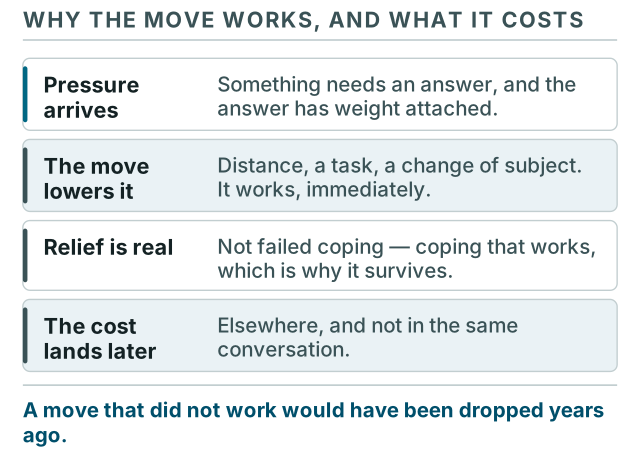
The last row is where the pattern does its real work. Relief that arrives quickly does not just maintain a behavior, it widens it. A move that started as a response to genuinely difficult conversations begins covering ordinary ones, then pre-empting them, until the avoidance runs before anything uncomfortable has happened.
This is also why the behavior looks so unreasonable from the other chair. The partner sees a retreat from a mild question. The person retreating is not responding to that question, but to a familiar shape it shares with something older. Nothing about the mismatch is visible to either of them in the moment.
There is a further reason the loop resists direct pressure. Asking someone to stop avoiding adds demand to a situation that was already over capacity, and demand is the cue the whole strategy exists to answer. This is why conversations about the avoidance so often end in more of it, and why the person raising them is left feeling they made things worse by being reasonable.
The loop is also close to invisible from inside. Relief does not announce itself; it feels like the room simply becoming normal again. What the person notices is a preference — I don’t enjoy long conversations, I think better on my own — and preferences do not look like anything that needs examining. That is what makes the pattern durable rather than what makes it deliberate.
When the same loop runs at the scale of a whole relationship rather than a single conversation, it has a name and a mechanism of its own: deactivation covers what happens when the distance is not a move but a state.
What does avoidant behavior cost a relationship?
The costs follow directly from the mechanism: a strategy that removes pressure without addressing what caused it will accumulate whatever it did not address. They are not moral, and they are not punishment. That accumulation is the entire price.
The original thing stays. Every conversation ended early is still available to be had. Unsaid material does not decay; it collects, and it raises the cost of the conversation that eventually happens, which makes avoiding it more attractive again.
The other person starts working with guesses. Silence, short answers and loose plans all get interpreted, because a partner cannot leave them uninterpreted. The interpretation tends to be worse than the truth, and it often goes unchecked, because checking it triggers the same retreat.
The relationship narrows. Topics get quietly removed from circulation. Nothing is announced; there is simply a set of subjects that produce distance, and both people learn to route around them. What remains is easier and thinner.
Self-reliance stops being a choice. The most uncomfortable cost is the one that lands on the person using the strategy. A system that has learned to handle everything alone keeps handling everything alone during the weeks when help was actually wanted, and there is no obvious moment at which that can be reversed.
The other side gets a job it cannot do. A partner watching this usually responds by trying harder: more questions, more reassurance, more attempts to have the conversation properly. Each attempt is well meant and each one raises the pressure, which is the input the strategy is built to reduce. Effort and effect come apart completely.
None of this is a claim about how any particular relationship will turn out. It is what the mechanism does when nothing interrupts it, which is a different statement. A relationship can run this loop for a long stretch without anything dramatic happening; the cost shows up as a slow narrowing rather than as an event, which is exactly why it is easy to under-notice from both chairs.
The letters
One letter when a new page goes up
That did not go through. Nothing was saved and nothing was sent — try the address again, or write to us directly and we will add it by hand.
- What arrives
- A note when a page here is rewritten or a new one goes up, with one line on what changed.
- What does not
- Assessments, quizzes, coaching offers, anything that claims to tell you what someone else is.
No spam, ever. Unsubscribe anytime.
Is avoidant behavior the same as avoidant attachment?
The two terms are not interchangeable, and the difference matters for anyone trying to work out which one they are reading about. Avoidant behavior is a move. Avoidant attachment is a description of a pattern those moves belong to, and avoidance can occur entirely outside that pattern.
A single instance is just a person managing a hard moment. For example, putting off a phone call, softening an answer, going quiet after a long day — these are avoidance in the plain sense, and they carry no information about attachment at all.
The attachment frame becomes useful only when these hold together: the pressure is coming from closeness specifically, the same kind of move appears across different situations, and the pattern holds across relationships rather than describing one difficult period. Repetition is what the frame is built on.
Even then, the frame describes behavior, not a person and not a diagnosis. People who lean avoidant are not a category of human being, and the pattern is not evenly present in every part of a life. The behaviors that people notice — in themselves or in someone close — are set out on signs of avoidant attachment, and the wider map of the pattern sits on the dismissive avoidant hub.
In practice the useful questions are about range rather than intensity. Does the pressure come from closeness, or from this specific person? Does the same move appear at work, with friends, with family? Has it shown up in relationships before this one, with people who behaved very differently? Answers pointing in one direction make the frame worth reading about; answers scattered across it usually mean something more particular is going on.
There is a further reason to keep the terms apart. Reading a list of avoidant behaviors and recognising a partner is easy, and the label that follows tends to close the subject rather than open it. A description is useful when it makes the next conversation more specific. When it supplies a verdict instead, it has been used as the opposite of a description.
There is a boundary worth stating plainly: avoidance that alternates with intense pulling-closer is a different pattern with a different name, and this site does not describe it.
What this page does not do
Avoidant behavior is describable. That is the whole claim, and it does not extend as far as readers are sometimes told it does.
- No diagnosis
- Recognising several of these moves identifies a coping strategy, not a condition. Nothing here distinguishes an attachment pattern from clinical conditions that can look similar from outside, and nothing here should be used to label anyone.
- No steps to change someone else
- There is no sequence on this page for getting a partner to stop avoiding, because a strategy that reduces pressure will not respond to more pressure. What one person can do about their own side is a separate question.
- No figures
- Where a number would normally sit, this page describes the mechanism instead. Nothing here is quantified — not how common any of it is, not how long any of it runs — because none of the quantities in circulation survived being looked up.
- No account of what someone is feeling
- A retreat is observable; the experience behind it is not. This page describes what avoidant behavior does and leaves the inner report to the person who could actually give it.
- No clinical avoidance
- Avoidance in anxiety treatment, phobia work and exposure-based therapy is a different subject with its own literature. It is not covered here, and the overlap in vocabulary is not an overlap in meaning.
Where this page stops
This page describes a coping strategy and the loop that keeps it running. It cannot tell any particular reader why their own version started, how entrenched it is, or what would change it in their relationship. An attachment pattern is a descriptive frame borrowed from research, not a clinical assessment, and the same behaviors have other explanations this page cannot rule out.
If the avoidance is shaping daily life — work, health, contact with people who matter — or if someone is frightened by what happens when it lifts, that is a conversation for a therapist or a doctor rather than for an article. What this site reads and how we handle evidence is set out on our sources page.