What does it mean to be conflict avoidant?
Being conflict avoidant means handling disagreement by lowering its temperature rather than working through it: dropping a subject, agreeing early, leaving the room, waiting for a mood to pass. Avoidant attachment is a wider description about closeness in general. The two words share a root and describe different things, and this page keeps them apart before it puts them together.
Conflict avoidance often has nothing to do with attachment. It comes from a household where arguments got loud, or from one where nothing was ever said out loud, or from a workplace where disagreeing upward was expensive, or simply from a temperament that finds raised voices unpleasant. Those are ordinary origins for an ordinary preference.
The attachment version is narrower. There, what raises the pressure is not the disagreement but the closeness inside it: being known, being needed, being asked to account for a feeling in front of someone who matters. The argument is the occasion, not the cause. A person can be difficult to argue with for either reason, and the two look nearly identical from the doorway.
That difference matters for readers trying to place themselves or someone else. Reading about avoidant attachment because a partner ends arguments early is a reasonable move, and it is often the wrong one. The question that separates them is not how much someone dislikes conflict. It is whether ease returns once the conflict is over, or whether the distance stays.
What does conflict avoidance look like?
Conflict-avoidant behaviour is rarely loud, and it almost never looks like refusal, which is why it is hard to name in the moment: the conversation appears to be happening, and then it is over, and nothing has been settled. The moves below are the ones people describe when they try to explain what happened afterwards.
| The move | What it buys in the moment | What it stores up |
|---|---|---|
| Agreeing early | The length and heat of the exchange | An agreement neither person believes, and a subject that cannot be raised twice |
| Changing the subject | The demand to answer this particular question | A subject that is now marked, and the marking is learned fast by the other side |
| Going quiet mid-argument | Intensity, immediately and completely | A blank the other person has to fill in on their own terms |
| Leaving the room | Physical proximity to the noise | An argument stopped at its worst moment and preserved there |
| Saying it is fine | The risk of a longer conversation about why it is not | A problem that is now officially resolved and still entirely present |
| Waiting it out | The need to say anything at all today | A grievance that gets older and heavier without being discussed |
| Humour | The seriousness the moment had built up | A partner unsure whether they were answered or dismissed |
| Pre-emptive agreement to plans | The friction of stating a preference | Resentment with no visible cause, since nothing was ever refused |
An avoidant communication style is recognised by its texture rather than its content. The answers are short but polite. The tone stays level. Questions get responses that are technically accurate and materially empty — the week was busy, it is not a big deal, there is nothing to talk about. Nothing was refused, so nothing can be pursued.
A more telling marker is not what happens during the disagreement but what happens after it. For example, a conversation that ended without resolution but with real ease afterwards was probably a person managing a hard evening. A conversation that ended in polite agreement and left a week of careful distance behind it was doing something else.
What does conflict avoidance protect, and what does it cost?
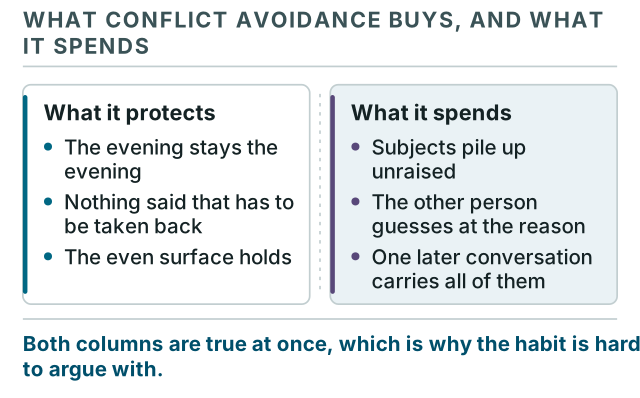
Conflict avoidance persists because it works. It buys back the evening, keeps the relationship pleasant on the surface, and protects the person using it from an outcome they expect to be worse than silence. That protection is real, and describing the costs without acknowledging it explains nothing about why anyone does this.
What it protects, in the words people use themselves: the relationship’s calm, the other person’s feelings, their own composure in an argument they expect to lose, and the belief that whatever is wrong will look smaller in a week. Sometimes it will. Peacekeeping is not a defect, and in plenty of situations it is the accurate call.
The costs are structural rather than moral. Nothing is removed by a dropped subject; it is only moved somewhere it cannot be worked on.
Small things become large by storage. For instance, a subject dropped in March is heavier in July, not because anyone rehearsed it, but because the case for raising it now has to justify the months of not raising it.
The other person stops getting accurate information. Early agreement, it is fine, and quick subject changes all feed back a picture of a relationship with fewer problems than it has. Someone acting on that picture is acting on bad data, and will be surprised later.
The range of speakable subjects shrinks. No decision is taken about this. A topic goes badly, then gets steered away from, and then stops being raised at all — leaving a household with a map of where conversation is allowed to go that neither person drew on purpose.
The disagreement migrates to the other side. Someone who cannot get a topic started usually starts it more often, louder, and at worse moments. The loudest attempt is the one most likely to be escaped, so trying harder produces the outcome trying was meant to prevent.
The letters
A short email when this section grows
That did not go through. Nothing was saved and nothing was sent — try the address again, or write to us directly and we will add it by hand.
- What arrives
- A note when a page here is rewritten or a new one goes up, with one line on what changed.
- What does not
- Assessments, quizzes, coaching offers, anything that claims to tell you what someone else is.
No spam, ever. Unsubscribe anytime.
Where do conflict avoidance and avoidant attachment overlap?
The overlap is genuine, which is why the terms get confused. Someone with an avoidant attachment pattern will tend to be conflict avoidant as well, because conflict carries closeness. The reverse does not hold: conflict-avoidant people are often direct about their needs, reliable about commitment and comfortable being known, and none of that fits the attachment description.
| Conflict avoidance only | Where they overlap | Avoidant attachment only |
|---|---|---|
| Dislike of raised voices and open disagreement, anywhere | Arguments end early and unresolved | Distance rises after closeness, with no argument involved at all |
| Peacekeeping learned at home, at work, or both | Agreement given quickly to close a subject | Discomfort with being depended on, even in easy weeks |
| Ease returns once the disagreement is over | Silence used as the exit from intensity | Ease returns only after a stretch of distance |
| Needs stated plainly outside a conflict | Needs minimised in the moment — 'it is not a big deal' | Needs minimised everywhere, including alone |
| Appears with specific people or specific topics | The subject stays unaddressed afterwards | Appears across relationships, over years, with very different partners |
Avoidant conflict style, as the phrase is used in the wider literature on disagreement, describes the middle column and not the right one. That literature is about negotiation and workplace disputes, and much of what people find when searching the term was written for that setting. It is useful, and it is not a description of an attachment pattern.
The overlap has another version that gets less attention: two conflict-avoidant people together. Nothing escalates, which reads for a long time as compatibility. Decisions get made by drift, the list of unavailable subjects grows on both sides, and the relationship is genuinely calm right up until the point where something has to be discussed and there is no practice at doing it.
Where the pressure comes from closeness rather than from disagreement, the moves belong to a larger set described on avoidant behavior, and the overall map of the pattern sits on the dismissive avoidant hub. One line is worth drawing before anyone reads further: where retreat alternates with intense pursuit in the same person, that belongs to a separate pattern with its own name and its own literature, and this site does not cover it.
Is shutting down mid-argument normal?
A shutdown mid-argument is common, and it is something that happens to a person rather than something they do. Attention narrows, words stop arriving, and the person appears to have left while still sitting in the room. It is not chosen in the moment, and it is easily misread in a conflict-avoidant exchange.
From the other chair it reads as contempt or as punishment, because a face that has gone unreadable in the middle of a serious conversation is a hard thing to interpret generously. From the inside it is reported as blankness — no argument available, no line to say, an overwhelming pull toward being somewhere quieter.
What follows the shutdown matters more than the shutdown. For example, a pause taken with a stated return — that the conversation is not over, only postponed to a named time — leaves the subject alive. A pause with nothing attached leaves the other person to guess whether the topic died, and to choose between raising it again and letting it go.
What tends to make it worse is also the natural response. Pursuing the conversation into the shutdown adds intensity to a system that has already reached its limit. Treating the silence as a verdict and withdrawing in return removes the possibility of returning to the topic at all. Neither is unreasonable; both accelerate the thing they are trying to stop.
What partners actually try, and what tends to land, is set out in more detail on how to communicate with an avoidant partner. None of it is a technique for making someone engage. It is a description of conditions under which conversations are more likely to survive being started.
What this page does not do
Conflict avoidance is describable. That description does not stretch as far as readers are sometimes told it does.
- No negotiation techniques presented as ours
- There is a large body of work on managing disagreement in workplaces and mediation. It has its own authors and its own evidence, and repackaging it here as relationship advice would misrepresent where it came from and what it was tested on.
- No clinical labels
- Withdrawing during an argument has names in couples research and in clinical settings. We describe what happens instead of applying those terms, because applying a clinical term to a partner from a web page is exactly the move that makes it useless.
- No figures
- No percentage appears here for how common any of this is, and no length for how long a shutdown runs. Figures that cannot be followed back to a named, dated source do not get printed on this site, however often they are repeated elsewhere.
- No verdict on a specific person
- Recognising several moves on this page identifies a habit around disagreement, not an attachment pattern, and not a person. The same behaviour has explanations this page cannot rule out from the outside.
- No script for making someone talk
- Pressure is the input the whole strategy exists to reduce, so there is no sequence here that reliably produces engagement. What one person can change is their own side of the conditions, which is a smaller and more honest claim.
Where this page stops
This page describes a habit and what it does, which leaves several things outside it: where one reader’s own version started, whether the attachment frame belongs on it at all, and what would shift it inside a particular relationship. Attachment descriptions are borrowed from research to name a pattern, not to assess anyone, and identical behaviour has other explanations that a page cannot rule out.
Some situations are outside what any article covers. If avoiding a conversation is about safety rather than discomfort, if a disagreement at home is frightening, or if the shutdowns are spreading into work and health, that is a conversation for a therapist, a doctor, or a local support service rather than for reading. Support lines exist for the first of those.
For readers who arrived from a wider question about the pattern itself, the avoidant attachment guide is the starting point rather than this page. What we read and how we handle evidence is set out on our sources page.