Signs of avoidant attachment are the behaviours people report clustering around distance under pressure: needs stated late or not at all, conflict handled by leaving the room rather than raising the voice, and closeness followed by a quiet retreat. People search for them from opposite directions. Something in a partner keeps repeating and has stopped making sense. Or something in their own behaviour has, usually after a relationship ended in a way they did not plan and did not entirely regret.
This page describes what gets reported in both directions, in behaviour rather than adjectives. It stays away from scoring, because a list of behaviours read as a verdict does more harm than the confusion it was meant to settle.
What are signs of avoidant attachment in how closeness is handled?
In how closeness is handled, the reported signs are quiet ones: warmth that arrives fully and then thins out, plans kept loose, personal information released in small measured amounts, and a strong preference for being the person who gives help rather than the one who asks for it. Nothing dramatic happens. Distance is maintained rather than announced.
Closeness followed by a retreat. For example, an unguarded conversation, a night that ran longer than either person planned, a morning that felt settled — and then a stretch of shorter replies. The retreat is not a reaction to anything that went wrong. It follows the part that went right, which is why it reads as arbitrary from outside.
Plans that stay open. Weekends unconfirmed until close to the day, holidays discussed in principle, moving in raised and then left alone. The reluctance is rarely about the specific plan. It is about the commitment the plan makes visible.
Information released slowly. Family, past relationships, money, the bad year. Not concealed, exactly, and often answered honestly if asked directly, but not volunteered. Over months the other person notices that the traffic runs mostly one way.
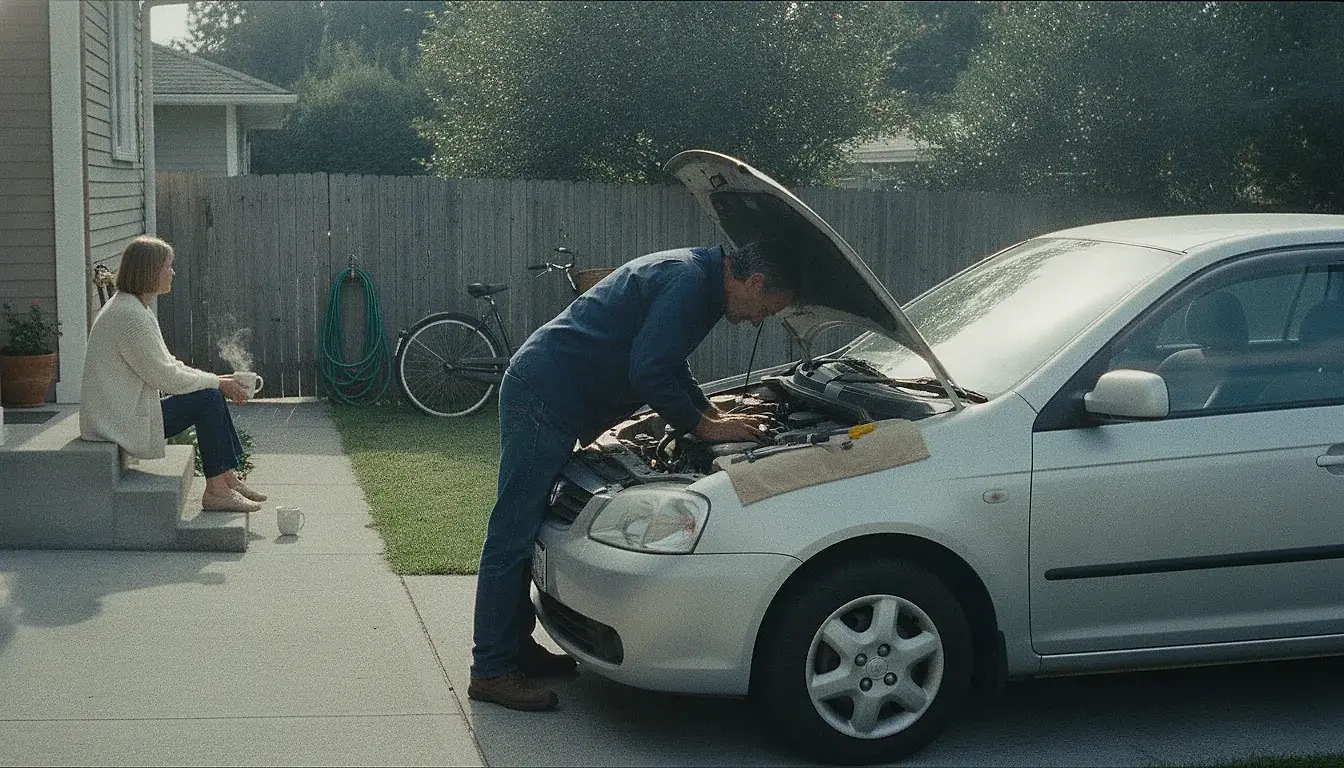
Help given, rarely requested. Practical support is often generous. Lifts, repairs, money problems solved, a difficult call made on someone else’s behalf. Asking for the same thing back is where the difficulty sits, and it is often described as not wanting to be a burden.
Independence held as a value rather than a preference. Self-reliance gets stated as an identity, not a habit. Needing nobody is described with some pride, and needing someone is described as a state to be corrected.
Present without much traffic. Sitting in the same room is comfortable. Being asked what is going on internally is not. Partners describe someone who is physically reliable and conversationally narrow, and who does not experience that combination as a problem.
What people describe is often not behaviour at all but absence. No requests. No checking whether things are all right between you. Few questions about the relationship as a thing with a direction. Nothing raised the morning after a difficult night. Absence is harder to point at than an action, which is why partners often struggle to explain what is wrong and end up describing a good person and an unsatisfying situation in the same sentence.
The timing matters as much as the behaviour. Distance that follows a hard week reads as ordinary recovery. Distance that follows an unusually close evening is the version people report here, and it is the sequence rather than the withdrawal that makes it recognisable.
| What is observed | Read by a partner as | Other ordinary explanations |
|---|---|---|
| Shorter replies after a close weekend | Losing interest | A heavy work week, an introverted recovery period, illness |
| Plans left unconfirmed | Keeping options open | Genuinely unsettled schedule, dislike of committing to things that may fall through |
| Rarely asking for help | Not letting me in | Habit from a household where nobody asked, competence, not noticing the need |
| Leaving the room during an argument | Not caring about the outcome | Learned de-escalation, fear of saying something unrecoverable |
| Subjects that never come up | Hiding something | Nobody ever asked, or the subject has no vocabulary attached to it |
The behaviours themselves are taken apart mechanism by mechanism in avoidant behaviour, which asks what each one is doing in the moment rather than what it signals. The withdrawal that follows closeness has its own machinery, described in deactivation.
How does someone with avoidant attachment handle conflict?
In conflict, the reported signs are the opposite of volume. Voices stay level, the room gets left, agreement arrives suspiciously early, and questions get answered slightly beside the point. The disagreement is not won or lost. It is drained of pressure until it stops, and then it is not returned to unless the other person returns to it.
What does not appear is often as informative as what does. There is usually no pursuit: no repeated calls, no long messages sent at night, no demand for an answer before the day ends. From the other side of an argument this can look like indifference, and from the inside it is more often described as an attempt to stop the pressure rising until it can no longer be managed.
The exit rather than the escalation. Standing up, going for a drive, going to bed, ending the call. From inside it is often described as the responsible move, taken to stop the situation getting worse. From outside it lands as being left in the middle of something.
The adjacent answer. For instance, a question about how someone felt gets a reply about what happened. A question about the relationship gets a reply about the schedule. The answer is accurate and addresses a question that was not the one asked.
Early agreement. Conceding the point quickly, apologising in general terms, saying whatever closes the subject. The argument ends and nothing about it has been settled, which is why the same argument arrives again in a different costume.
Delay that hardens into silence. A difficult message left unanswered for a day, then longer, then long enough that answering it now requires explaining the delay as well. What began as postponement becomes its own obstacle.
Return without repair. For example, after a gap of hours or days, ordinary life resumes: coffee, plans, normal tone. The unfinished conversation is not mentioned. Partners often describe this as the most disorienting part, because the relationship looks repaired while the subject stays open.
Conflict avoidance is not the same thing as the attachment pattern, and treating them as identical is a recurring misreading on this subject. Someone can dislike conflict and still raise needs, come back to unfinished conversations, and ask for reassurance. Where the two overlap and where they part is set out in conflict avoidance. How the pattern behaves once a relationship is established is described in avoidant attachment in relationships.
What signs do people notice in themselves?
People who recognise the pattern in themselves usually do not report coldness. They report relief when plans are cancelled, an urge to leave that arrives exactly when things are going well, needs that are noticed hours or days after they mattered, and a long history of describing former partners as wanting too much. The inside view rarely matches the outside one.
Relief at cancellation. A plan falls through and the first response is not disappointment. That reaction is worth noticing not because it is wrong but because it is informative about how much effort closeness was quietly taking.
The urge to leave at the good part. The relationship is going well, the other person has just said something warm, and the impulse is to create space. People describe this as the moment that makes least sense to them, and it is often what starts the search that leads to pages like this one.
Needs noticed late. The answer to what do you need is genuinely absent at the time it is asked, and arrives clearly days later. The need existed. The access to it did not.
Former partners described in a single category. Too much, too intense, too needy. The category may be fair in individual cases, and it is worth a second look when it covers everyone.
Self-reliance that was never a decision. Handling things alone does not feel like a strategy. It feels like the only sensible way to operate, which is what makes it hard to see from inside.
People often ask whether someone with this pattern would recognise it in themselves. Not necessarily, and not because of denial: the pattern works. Distance lowers pressure quickly and reliably, so from inside there is no obvious problem to explain. Recognition usually arrives from the outside, through a relationship ending or a partner describing the same thing repeatedly.
Self-recognition has a known failure mode in both directions. Reading a page like this one during a bad week produces false positives, because withdrawal under load is ordinary. Reading it while things are calm produces false negatives, because the pattern only becomes visible where there is pressure to withdraw from. The more useful material is endings: what happened in the last stretch of previous relationships, who raised the unfinished subjects, and what the other person said on the way out.
The letters
One email when there is a new description to read
That did not go through. Nothing was saved and nothing was sent — try the address again, or write to us directly and we will add it by hand.
- What arrives
- A note when a page here is rewritten or a new one goes up, with one line on what changed.
- What does not
- Assessments, quizzes, coaching offers, anything that claims to tell you what someone else is.
No spam, ever. Unsubscribe anytime.
What these signs do not prove
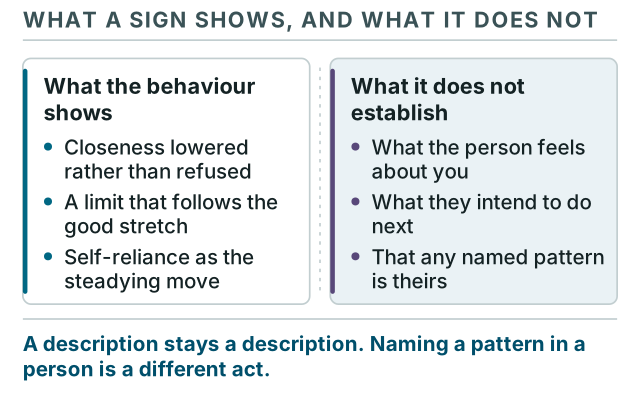
A single behaviour proves nothing about attachment. What the descriptions above can support is narrower: a set of behaviours that repeats across different relationships, arrives in response to closeness rather than to strain, and stays stable when circumstances change. Repetition is the evidence. A difficult month is not.
| Level | What is visible | What it supports |
|---|---|---|
| A single instance | Answers went short for a few days | Nothing about attachment. Ordinary explanations fit just as well. |
| Repeats in this relationship | The quiet stretches keep landing after the closest evenings | A reliable sequence worth naming and describing out loud |
| Repeats across relationships | The same sequence appeared with different partners | A stable way of handling closeness rather than a reaction to one person |
| Repeats when conditions change | Present in calm periods, not only under work stress | Something more durable than circumstance, and still not a diagnosis |
Readers regularly arrive wanting a yes or no about a specific person. It cannot be given. What is described here is a framework for reading behaviour, and the same behaviours are produced by grief, overwork, a new job, an undiscussed health problem, a relationship someone has quietly decided to end, and simple mismatch in how much contact two people want. The sources this framework comes from are listed on sources.
Readers arrive at this section from opposite ends. One wants confirmation that they were not imagining the distance, and can have that: the behaviours are real, common, and worth describing out loud to the person concerned. The other wants a label to hand over, which is where this page declines. A description is something two people can discuss. A category assigned to someone in their absence is not, and it tends to end the conversation it was meant to open.
What this page won't do
A signs page invites certain moves, and this one declines them.
- Score you
- There is no count here that decides anything, and no threshold above which the answer becomes yes. Recognising some of these descriptions is normal and means only that the descriptions are drawn from common behaviour.
- Label a person
- This site describes a pattern, not a personality. Someone leans avoidant in a situation; nobody is an avoidant. The distinction matters because the first can be discussed with the person and the second is a verdict delivered about them.
- Answer whether he is avoidant
- That question arrives constantly and has no honest answer from outside a relationship. What can be described is behaviour and its repetition, which is what the section above sets out.
- Treat this as clinical assessment
- These are descriptions from attachment literature and from what people report, not diagnostic criteria, and nothing here identifies or rules out any clinical condition.
Where this page stops
This page describes behaviour. It cannot tell you what is happening inside another person, what they intend, whether the pattern applies to them, or whether the relationship should continue. An attachment pattern is a descriptive framework, and no framework distinguishes it from the other things that produce identical behaviour from the outside.
If what you are reading here is shaping your sleep, your work, or your sense of safety, that is a question for a therapist or a doctor rather than for a page. A professional can ask what a page cannot: about you specifically, and about the parts you have not written down.
The rest of the pattern, including where it is thought to come from and what it looks like across a long relationship, is mapped on the dismissive avoidant attachment hub.