Avoidant attachment triggers are easier to describe as moments than as feelings. Something raises the amount of closeness that has to be handled at once, and a pattern built on self-reliance answers by making room. This page catalogues those moments, what each one switches on internally, and how the same moment reads to the person standing across from it.
What does “trigger” mean here?
A trigger, in this description, is a signal that raises the pressure of closeness faster than it can be absorbed. It is a piece of timing information, not an accusation. Naming what set the pattern off says nothing about whether the person who supplied the signal did anything unreasonable, and the entries below are ordinary requests.
The word is borrowed from a heavier context and used narrowly here. It does not carry the clinical meaning it has in trauma medicine, and this page cannot tell anyone which sense applies to them.
The event and the sequence it starts are easy to merge. The event comes from outside and is usually small. The sequence it starts was already in place, learned long before this relationship, and runs at its own speed. That split is why the same short question lands differently depending on who is asked and when. Where the sequence is thought to come from is covered in what causes avoidant attachment.
It also means the list has a limit built into it. A catalogue of signals cannot say what a particular silence meant last Tuesday. It can say which situations show up again and again in how people describe the pattern from both sides.
What triggers an avoidant?
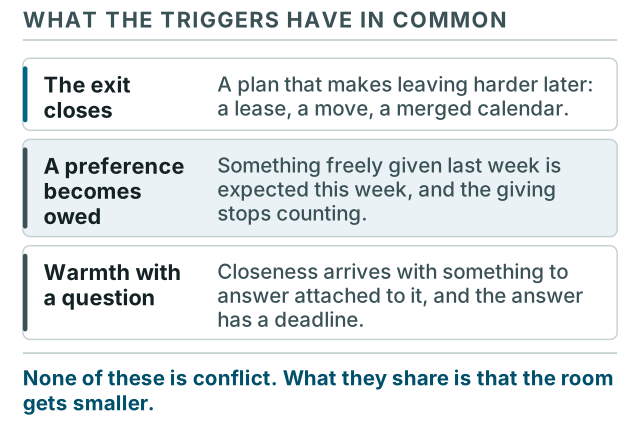
The triggers cluster around one theme: closeness that arrives faster than it can be paced, or a situation that removes the option of stepping back. Conflict itself is often not the trigger. Being enclosed by warmth, by a deadline, or by an expectation with no room in it usually does more than an argument does.
A sudden increase in intimacy. For example, a weekend that went unusually well, a first “I love you”, an introduction to family, a night of unusual openness. What switches on is not regret about the closeness but a sense of exposure that follows it. From outside, the puzzling part is the timing: the pullback arrives after the good part, not after a fight.
A request framed as an ultimatum. The subject can be reasonable and the framing still does the work. What lands is not the question but the consequence bolted to it: answer this, and something follows immediately. The room gets smaller, and the first move is to make it bigger again rather than to decide. Outside, this looks like stalling or like refusing to take the relationship seriously.
Being asked to account for a feeling on the spot. “What are you feeling right now” is a harder question than it sounds for someone whose practised move is to lower the signal before reading it. What switches on is a blank, then pressure to produce something. Outside, the blank reads as withholding.
A plan that removes the exit. For instance, moving in, merging money, a long trip with no separate time inside it, a commitment that would be expensive to reverse. The plan may be wanted in principle. The absence of a way to step back is the part that raises pressure.
Being corrected about how they handle closeness. Comments about being cold, distant or closed off tend to land as a verdict on a whole person rather than as a request. What switches on is defence of self-sufficiency, and the visible result is a flat tone.
Monitoring. Repeated check-ins, questions about time accounted for, a phone that must be answered promptly. Each instance is small. The accumulation reads as supervision, and the response is to become less available rather than to object.
Solitude removed without notice. For example, a plan added to an evening that had been kept empty, a guest arriving unannounced, a shared calendar filling in. Time alone functions here as maintenance rather than as rejection, and losing it without warning has a cost the schedule does not show.
People often ask which of these hurts an avoidant the most, and the moments that recur in those descriptions are not the loud ones. Being called cold while still in the room, or being held to an answer with no way to pause first, is described as landing harder than an argument does, because the pattern has no practised reply to it other than to step back. That is what readers report about the experience, not a ranking that can be applied to a particular person.
| Trigger | What switches on inside | How it looks from outside |
|---|---|---|
| A jump in intimacy | Exposure, and a pull to restore separateness | Cooling off right after a good stretch |
| A request framed as a deadline | The exit is closing; space has to be reclaimed | Stalling, vagueness about the future |
| Being asked to name a feeling now | A blank, then pressure to produce an answer | Withholding, shrugging, changing the subject |
| A plan with no way back | Cost of reversal, not doubt about the person | Cold feet before something that was agreed |
| Being called distant | Defence of self-reliance | Flat tone, an argument about wording |
| Repeated check-ins | Supervision rather than interest | Slower replies, less detail volunteered |
| Alone time removed without notice | Loss of the way pressure is normally released | Irritability over something unrelated |
The letters
A note when something new is published here
That did not go through. Nothing was saved and nothing was sent — try the address again, or write to us directly and we will add it by hand.
- What arrives
- A note when a page here is rewritten or a new one goes up, with one line on what changed.
- What does not
- Assessments, quizzes, coaching offers, anything that claims to tell you what someone else is.
No spam, ever. Unsubscribe anytime.
Why does the reaction look delayed?
The gap between the trigger and the visible response is the part that causes the misreading. Nothing happens in the room. The evening ends normally, agreement is given, the plan stands. The distance arrives later, attached to a reason that has nothing to do with the moment that started it, which makes them look unrelated.
The reason is order of operations. Nothing gets voiced at the time, because the signal is turned down before it is read, and a moment that was never marked cannot be pointed back at later. What does surface, hours or days on, is a reasonable account of needing time. The account is sincere. It is also the end of the sequence rather than its beginning.
| Stage | Inside | Visible to the other person |
|---|---|---|
| The moment | Pressure registers below deliberate attention | Nothing; the evening looks fine |
| Smoothing over | The signal is lowered rather than named | Agreement, sometimes unusually easy |
| Flattening | Warmth is turned down to reduce exposure | Shorter replies, practical topics only |
| Distance | Relief, attached to an ordinary reason | Cancelled plans, silence, sudden busyness |
| Ordinary contact | Pressure has dropped; the moment is rarely revisited | Contact resumes as if nothing was said |
This delayed shape is why the withdrawal so often gets read as a punishment aimed at someone. The mechanics of that withdrawal, including why relief and closeness end up on opposite ends of it, are described in avoidant deactivation.
The delay also has a practical consequence for the partner. Reacting to distance as if it were the message usually escalates it, because the pressure that started it is still unnamed. What tends to change the outcome is the framing of the original request rather than the response to the silence, which is the subject of how to communicate with an avoidant partner.
What a trigger does not justify
Explaining a reaction is not the same as excusing it, and a list like this one gets misused in predictable ways.
- Disappearing without a word
- A trigger accounts for the pull toward space. It does not account for leaving someone without information for a stretch of silence. Space that is stated is a boundary; space that is taken silently is something the other person is left to interpret alone.
- Turning the list into rules for the partner
- This page is not a set of things to stop doing. A relationship organised around never raising the pressure asks one person to shrink so the other never has to notice the pattern, and that arrangement fails quietly.
- Using it as a verdict on a person
- "Avoidant" describes behaviour under a particular kind of pressure, not a character or a diagnosis. Recognising entries above says something about situations, not about whether someone is capable of a relationship.
What is fair to expect
- A signal instead of a vanishing
- Naming that space is needed, without a reason and without a debate, is available once the pattern has a name.
- A return to the subject
- The conversation that was left can be picked up later. Later is workable; never is a different problem.
Where this page stops
This page describes a pattern of handling closeness. It cannot say what happened in a specific relationship, what another person intended, or whether what someone recognises here is this pattern rather than something else with a similar surface. Attachment language is a descriptive frame, not an assessment, and nothing here separates it from conditions that need a clinician.
If the reactions described above are shaping sleep, work or safety, that is a question for a therapist or a doctor, who can ask what a page cannot. The rest of the pattern is mapped in the dismissive-avoidant guide, and the reading behind these descriptions is listed in sources.