Why people search by gender
A dismissive avoidant woman is a woman who handles closeness the way this pattern describes: distance used to bring the pressure of closeness back down. Searches split by gender long before the pattern does. Someone types dismissive avoidant woman or avoidant man because they are not trying to understand a theory — they are trying to understand one person, and that person has a gender, so the question arrives carrying it. The split is in the search box, not in the pattern.
There is a second reason, and it is less obvious. The writing about avoidant attachment tends to address a woman reading about a man. That imbalance is why the phrase avoidant man returns a crowded page and the phrase avoidant woman returns a thinner one, and why people searching the second one often assume they have found something rare.
They have not. What they have found is a gap in who gets written about, which is a fact about publishing rather than a fact about attachment. This page keeps the gendered wording because that is how the question is actually asked, and then puts it down.
The other thing worth naming: the question is usually asked in a bad moment. This is not something people look up while things are calm. That matters, because a pattern named during a bad week tends to get read as a verdict on the whole person, and it is not one.
There is also a phrasing tell in the searches themselves. For example, signs of an avoidant man is usually typed by someone deciding whether to keep going. Signs of a dismissive avoidant woman is typed by someone who has already noticed the distance and is looking for a name that fits it. Same cluster of words, two different moments in a relationship.
We keep the gendered phrases on this page for one reason only: they are the doors people come through. What is behind the door is the same room.
What stays the same in men and women?
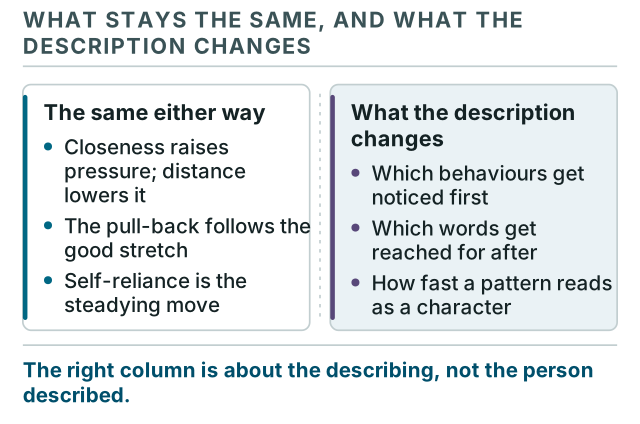
The core of the pattern does not change with gender. Closeness rises, the pressure of it rises with it, and distance is what brings the pressure back down: shorter replies, a delayed answer, a plan that keeps an exit, difficulty handled alone rather than shared. That sequence is what the description names, in anyone.
The steps stay in the same order too. Something increases exposure — a question about feelings, a plan that assumes a shared future, an argument that will not close quickly. The response is rarely a refusal. It is a slow move sideways: the subject changes, the tone flattens, the schedule fills up.
Certain features are worth stating separately, because they are what make the pattern recognisable rather than just a description of someone being busy. The distance follows closeness rather than conflict — it often arrives after a good stretch, not a bad one. It arrives without a fight, which is why it is missed. And it is reduced by space rather than by reassurance, which is the opposite of what a partner tends to try first.
The internal logic is also shared. Distance is not aimed at the partner, even though it lands on them. It is aimed at the pressure. We describe how that mechanism runs across our deactivation pages; the point here is only that nothing in it is gender-specific.
None of those features has a male or female version. A partner describing any of them will produce roughly the same account of the week: things were going well, then something closed, and no argument explains when. The gender of the person who closed changes the adjectives in the account, not the sequence of events in it.
So is the confusion that follows. A partner on the receiving end of withdrawal usually reads it as a message about them, because that is the most available explanation when someone goes quiet. The full list of what the pattern looks like from outside sits on our page about the signs of avoidant attachment.
What differs between avoidant men and women?
The difference is not in the behaviour but in what happens after it. The same withdrawal draws different responses depending on who produced it. In a man it is more often filed under independence, focus, or being hard to pin down. In a woman it is more often filed under coldness, disinterest, or having something wrong with her.
That difference has consequences, and they are not cosmetic. A behaviour that is admired goes unexamined. A behaviour that is criticised gets explained, defended, or hidden — and hiding it does not remove it, it only moves it out of view. That is the main way social expectation reaches into the pattern itself.
| The behaviour | Common reading when a man does it | Common reading when a woman does it |
|---|---|---|
| Goes quiet for a stretch after conflict | Needs space to cool off | Punishing me with silence |
| Keeps friends, plans and finances separate | Independent, has his own life | Holding something back, uncommitted |
| Answers a question about feelings with facts | Practical, not the talking type | Cold, hard to reach |
| Avoids naming the relationship | Taking it slow | Stringing someone along |
| Ends things without a long conversation | Clean break, decisive | Heartless |
Read the table row by row and the shape appears: the left column is stable, the reading columns beside it are not. Nothing about the underlying move has changed between them. What changed is the expectation the observer brought — that a man’s distance is a trait and a woman’s distance is a failure to provide something.
The reverse also happens, and it hurts in a different direction. A man whose withdrawal is praised as independence rarely gets a chance to notice it, because no one around him treats it as a question. Admiration and complaint are both forms of noise; neither one describes what is happening.
One more asymmetry sits underneath the table, and it is about who gets asked. Distance that reads as independence is rarely questioned out loud, so the person producing it is not put in the position of explaining something they may not have words for. Distance that reads as coldness gets questioned constantly, which turns an ordinary evening into an account that has to be given.
That does not make one version easier to live inside. It makes them fail in different directions. Unquestioned distance tends to grow because nothing pushes back on it. Questioned distance tends to go underground, because the fastest way to end the questioning is to look more available than you feel. Neither route reaches the thing the pattern is actually doing.
The letters
One letter a week, written plainly
That did not go through. Nothing was saved and nothing was sent — try the address again, or write to us directly and we will add it by hand.
- What arrives
- A note when a page here is rewritten or a new one goes up, with one line on what changed.
- What does not
- Assessments, quizzes, coaching offers, anything that claims to tell you what someone else is.
Descriptions of the pattern, not scripts for changing someone. Unsubscribe anytime.
How do people describe an avoidant man?
When people describe a man who leans avoidant, the descriptions cluster around self-sufficiency: he handles things alone, he is hard to reach during stress, he moves the conversation to logistics when it turns personal, and he treats a request for closeness as a request for a decision. The behaviours are ordinary; the pattern is in their consistency.
Partners describe the specifics in similar words. He is present and warm until a certain depth, then a lid comes down. For instance, he answers I’m fine in a tone that closes the subject. He is more reachable by message about a plan than by phone about a feeling. He remembers the practical things and skips the emotional summary.
What makes this cluster hard to see is that every item on it is socially rewarded. Handling problems alone reads as competence. Not needing reassurance reads as strength. Working late during a difficult stretch reads as responsibility. The pattern hides inside behaviour that gets applause, which is why it is often named late, usually by a partner rather than by the person.
One correction, because the search phrase invites the error: avoidant man is not a type of man. It is shorthand for a way of handling closeness that a given man may show in one relationship and not in another, more under some conditions than others. Used as a category it stops describing anything and starts sorting people.
How do people describe an avoidant woman?
When people describe a woman who leans avoidant, the same behaviours show up, and the vocabulary around them changes. For example, she is independent to a degree others find pointed. She does not report her day. She keeps parts of her life separate on purpose. She ends things cleanly rather than slowly. The moves match; the words used for them are harsher.
The phrase dismissive avoidant woman tends to be searched by a partner trying to interpret distance he did not expect, and by a woman who has read enough of the material to recognise herself in the descriptions written about men. Both arrive at the same place — the pattern reads the same, the reception around it does not.
There is one extra layer worth naming, and we will name it carefully. Where closeness work is expected by default — remembering, asking, smoothing, checking in — someone who does less of it stands out more, and gets asked about it more. Being asked to account for distance is itself a form of pressure, and pressure is exactly what the pattern is set up to reduce. That loop is real and it is situational, not a trait of anybody in it.
It is also worth pulling apart what gets merged in this search. Wanting less contact is not, by itself, evidence of anything — people differ in how much closeness they want, and a preference is not a pattern. What makes it a pattern is the shape: closeness rising, pressure rising with it, distance arriving as the release valve, repeatedly, across different relationships and different partners.
The practical result is that avoidant behaviour in women is more often labelled early and more often argued about, and less often described neutrally. That does not make it more severe. It makes it noisier. If you are on the receiving end of it, our pages for the partner describe what the distance is doing, and our page on avoidant attachment in relationships covers how the rhythm plays out over time.
What this page refuses to say
What this page will not do
A gendered question invites gendered conclusions. These are the ones we decline to draw.
- Tell you men are like this and women are like that
- Nothing on this page describes a gender. It describes a pattern that appears in people of any gender, and the different vocabulary that gets attached to it afterwards. A sentence that starts 'men are' has stopped describing anyone you actually know.
- Give you a prevalence figure
- We publish no numbers anywhere on this site, and this page is where the temptation is strongest. Ratios by gender come from measures that do not agree with each other, and a contested figure repeated confidently is worse than no figure at all.
- Turn a description into a diagnosis
- Avoidant attachment is a way of describing behaviour under the pressure of closeness. It is not a clinical category, it is not a verdict, and reading this page does not qualify anyone — including you — to assign it to another person.
- Hand you a script for changing someone
- There is no wording that reliably produces closeness in a person who is pulling back, and pages offering one have invented it. We describe what tends to happen. What to do with that is yours.
What we do stand behind
- The behaviour is the evidence
- We describe what someone does — the shortened answer, the moved plan, the subject that changes — rather than what they supposedly are. Behaviour can be checked against your own experience. A label cannot.
- The reading is separable from the act
- Once you can tell the move apart from the meaning assigned to it, most gendered arguments about avoidant attachment lose their grip. That separation is the whole content of this page.
- We show our reading
- The literature this site draws on, and its limits, are listed on our sources page rather than gestured at in passing.
If you recognised yourself in one of these lists
Reading a description of your own behaviour written in someone else’s complaint is an unpleasant way to meet it. The lists above are written from the outside, because that is who mostly writes about this — partners. Seen from inside, the same moves usually do not feel like distance at all. They feel like relief, or efficiency, or the only sensible response to a conversation that had started to feel like a demand.
Both accounts can be accurate at once. That is the useful thing to take from a gendered page: if the label you have been handed is cold or independent depending on who is speaking, then the label was never the reliable part. The behaviour is. What you do in the days after something goes unusually well, how you answer when someone asks what is wrong, whether space is the first thing you reach for — those are checkable, and they belong to you rather than to whoever is describing you.
Where this page stops
This page describes how a pattern is perceived. It does not explain where the pattern came from in any individual, and it cannot tell you whether what you are living with is the pattern at all or something else that resembles it from outside. Those are different questions with different evidence behind them.
If distance in your relationship comes with fear, coercion, or a situation that is not safe to be in, none of the framing here applies and the description is the wrong tool. That is a question for a professional who can hear the specifics, not for a page written for everybody.
For where our descriptions come from and what they do not cover, see our sources. For the rest of the pattern — the behaviours, the causes we can and cannot speak to, and what the style looks like from the inside — start at the hub for the dismissive-avoidant style.